
The Tool Desk
Outbyte PC Repair FREERepair Windows errors before they cause bigger problemsFix Now →Outbyte Driver Updater FREEScan for outdated or missing drivers - takes under a minuteDriver Scan →A virtual power plant (VPP) balances load by coordinating many small energy resources—such as batteries, solar panels, electric-vehicle chargers, and flexible building loads—as if they were one grid resource. It can shift when electricity is stored or used, then adjust the combined output or demand to help meet a target, reduce a peak, or provide grid services. The phrase “ONS NA 2019” does not identify a verifiable publication or event in the available evidence, so the explanation below covers VPP load balancing without attributing it to that specific label.
What load balancing means in a VPP
Electricity supply and demand must stay in balance continuously. A VPP helps by aggregating distributed energy resources (DERs) at homes and businesses, then coordinating their generation, storage, or consumption. The grid operator or program can treat the coordinated portfolio as a resource rather than dispatching each small device separately.
The portfolio may include rooftop solar, behind-the-meter batteries, electric vehicles and chargers, smart buildings and equipment, and flexible commercial and industrial loads. Not every VPP includes every resource: its capabilities depend on the equipment, customer permissions, communications, and the service the program is designed to provide.
How a VPP coordinates its resources
- Measure and forecast. A control platform receives telemetry such as battery state of charge and device availability, and forecasts renewable output and flexible demand. These forecasts are imperfect; cloud cover, customer activity, and changing device availability can alter the portfolio’s expected contribution.
- Set a schedule or target. The operator plans how the portfolio should behave over a chosen horizon. A day-ahead schedule can plan around expected demand and generation; real-time dispatch can respond to changing grid needs or balancing signals.
- Dispatch a mix of actions. The system may charge batteries when energy is abundant, discharge them during constrained periods, shift EV charging, or adjust participating building loads. Solar and other generation contribute when available. Controls can combine actions across many sites to meet a portfolio-level target.
- Check delivery and adjust. Telemetry lets the operator compare actual performance with the schedule or requested response. If resources underperform or conditions change, the operator can revise dispatch across the available portfolio.
A 2019 study by Huang and co-authors describes day-ahead VPP scheduling that considers emissions and moving-EV charging demand, and reports balancing peak and off-peak electricity-market load. A separate 2019 IEEE PES General Meeting contribution by Gong, Rallabandi, and Ionel models rooftop-solar homes paired with batteries and develops coordinated controls to reduce load variation. These are research examples of scheduling and control approaches, not proof that every operating VPP uses the same algorithm or achieves the same result.
#1 Best Overall
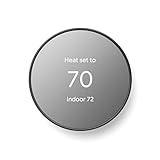
- ENERGY STAR certified smart thermostat for home that helps you save energy and stay comfortable.Connectivity : Wi-Fi - 802.11b/g/n 2.4 GHz, 802.11a/n 5 GHz Wi-Fi., Wireless interconnect : Bluetooth Low Energy Please refer to the product description section below for all applicable legal disclaimers.Product note: You can also check your system’s compatibility before purchasing a Nest thermostat with our online Nest Compatibility Checker on the Google Nest support page
- The Nest Thermostat is designed to work without a C wire in most homes, but for some systems, including heating only, cooling only, zone controlled, and heat pump systems, you’ll need a C wire or other compatible power accessory
- Nest Thermostat turns itself down when you leave, so you don’t waste energy heating or cooling an empty home. Lock feature: No
- Programmable thermostat that lets you create an energy efficient schedule in the Google Home app on your Android or iPhone
- Remote control lets family members change the thermostat temperature from anywhere on a phone, laptop, or tablet[1]
Which devices can participate, and what each can do
| Resource | Potential contribution | Practical constraint |
|---|---|---|
| Behind-the-meter batteries | Store energy and discharge it during a peak or other requested period. | Available output depends on the battery’s charge, power rating, program settings, and any customer-set backup reserve. |
| Rooftop solar | Contribute generation when sunlight is available; paired solar and batteries can be coordinated to change a home’s net load. | Solar output varies with weather and time of day, so it is forecast rather than guaranteed. |
| Electric vehicles and chargers | Shift charging to a different time, or coordinate charging demand with the portfolio schedule. | Vehicle connection, customer travel needs, charger capability, and permission determine availability. A VPP’s ability to control charging does not by itself establish that it can send power back from a vehicle to the grid. |
| Smart buildings, HVAC, and water heating | Shift or briefly adjust flexible electricity use to reduce demand at a target time. | Response must respect comfort, operating needs, equipment limits, and customer override settings. |
| Commercial and industrial flexible loads | Adjust eligible processes or equipment use as part of an aggregated demand response. | Which loads can respond, how quickly, and for how long depends on the facility and its program agreement. |
How to compare VPP balancing approaches
A VPP’s resource mix alone does not tell you how it will perform. The relevant comparison depends on the grid service and the limits of the participating devices.
- Dispatch horizon and response speed: A day-ahead energy schedule differs from a real-time response to a balancing signal. Ask when the operator can call resources and how quickly they are expected to respond.
- Forecast uncertainty: Solar generation, customer demand, and device availability can differ from forecasts. A portfolio’s operating plan needs to account for those variations.
- Customer protections: Check whether customers can override dispatch, set a battery backup reserve, or specify comfort and operating limits.
- Telemetry and communications: The operator needs sufficiently reliable information about participating resources to plan and verify delivery.
- Grid service: Programs may target energy, capacity, ancillary services, or local distribution relief. A resource eligible for one service is not automatically eligible for another.
- Compensation and eligibility: Payment terms, enrollment rules, eligible equipment, and service territory vary by program. Compare the actual current terms rather than assuming all VPPs compensate participants the same way.
What VPPs could mean for grid costs and peak demand
The U.S. Department of Energy’s 2023 Pathways to Commercial Liftoff material estimates that 80–160 GW of VPP capacity by 2030 could address 10–20% of peak load and save about $10 billion per year in grid costs. These are potential U.S. outcomes associated with a future capacity range, not measured savings from one VPP or a guaranteed result for an individual customer.
Rank #2

- An Alexa thermostat - Amazon Smart Thermostat is an easy way to switch from a traditional thermostats for homes and help reduce energy usage.
- Create comfort zones throughout your home by connecting to select Alexa devices to automatically adjust heating and cooling based on temperature readings or presence detection.
- Save money and energy - After purchase, Amazon will send you an email with details about home thermostat rebates that may be available from energy providers in your area.
- Save energy - According to EPA estimates, ENERGY STAR certified thermostats save an average of $90 on yearly energy bills.
- Programmable thermostat and automatic control - Create your own home, away and sleep schedules, or have Alexa automatically control the temperature with Alexa+ advanced features.
As one program example, RMI’s 2024 case material reports that National Grid Massachusetts’ residential-battery enrollment reached 21.23 MW across 3,096 customers for summer 2023 performance. That figure describes the named program and period; it should not be treated as a typical VPP size or a measure of savings for other utilities.
What residential participation may require
Solis describes one North American pathway for residential customers. In that pathway, participation requires a compatible Solis hybrid inverter and battery, an internet-connected system reporting through SolisCloud, residence in a participating utility territory, and enrollment in an available program. Solis identifies Derapi as its aggregator-connectivity platform and says EnergyHub integration applies to approved-manufacturer listings.
Outdated Drivers Are Slowing You Down
One free scan finds every outdated or missing driver and matches the right update for your exact hardware.Free scan · exact hardware matchWindows Errors? Fix Them Before They Spread
Repair common Windows errors and clear accumulated junk for a smoother, more stable PC - no reinstall needed.Free scan · no reinstallRank #3

- Save up to 23% every year on heating and cooling costs, adjusts to your set schedule to save energy when you’re gone and optimize comfort when you’re home. Compared to a hold of 72
- Compatible with 85% of systems, check your system’s compatibility with our online ecobee Compatibility Checker on the ecobee support page
- Change your temperature by easily tapping the color touchscreen or using the ecobee app. Plus, free software upgrades ensure you get the best out of your Smart Thermostat Essential, for years to come
- Automatically adjusts to your set schedule to save energy when you’re gone and optimize comfort when you’re home. Keep track of your energy consumption when you're on the go on the ecobee app
- Easy DIY install. No C Wire, no problem. Get the ecobee Power Extender Kit (PEK) for homes without a C-Wire and keep your walls looking nice with our trim kit – both sold separately
During peak-demand events or grid emergencies, the documented Solis setup may discharge the battery to the grid or reduce on-site load, subject to a customer-defined backup reserve. This is a manufacturer-described program pathway, not a universal VPP enrollment rule. Availability and incentives depend on the customer’s utility territory and current program.
- Check your utility territory. Confirm that an active VPP or demand-response program serves your address; eligibility is not nationwide or uniform.
- Confirm hardware compatibility. Ask the program operator or manufacturer whether your specific inverter, battery, charger, or other equipment is eligible.
- Review connectivity and permissions. Determine what telemetry is required, how the system connects, and what dispatch authority you grant.
- Read event and customer-control terms. Check when dispatch can occur, how a backup reserve or override works, how compensation is calculated, and whether there are participation obligations.
- Enroll through the current program channel. Verify the program’s current status and terms directly with the utility, aggregator, or manufacturer before enrolling.
Why “ONS NA 2019” cannot be cited as the source
The exact shorthand “ONS NA 2019: VPP Load Balancing” does not resolve to a uniquely identifiable publication or conference record. The evidence supports discussion of VPP load balancing and includes distinct 2019 academic contributions, but it does not establish that either is the work meant by “ONS NA 2019.” The label should not be used to attribute the findings above to a particular event or publication unless its full identity is confirmed.
Rank #4

- EASY DIY INSTALLATION: Do it yourself fast with a built-in level and simple step-by-step instructions. Works with the HVAC equipment found in most homes
- COMMON WIRE REQUIREMENTS: Common wire(C-Wire) required for heat pump and heat/cool only systems. C-wire not required on most systems
- SAVE ABOUT 23% ON HVAC ENERGY: ENERGY STAR-certified and packed with features that help you save money, including flexible scheduling, geofencing, remote access and usage reports
- PRIVACY PROTECTION: Sensi won’t sell your personal information to third parties or leverage your thermostat activity data for targeting or advertising purposes
- CONTROL FROM ANYWHERE: The top-rated mobile app for Android and iOS devices makes it easy to control your comfort from a smartphone or tablet
The DOE also describes more than 20 VPP research, development, demonstration, and deployment programs on its project page, illustrating that VPPs are a category of programs and technologies rather than one standardized product or control design.
Quick Recap
Product prices and availability are accurate as of the date/time indicated and are subject to change. Any price and availability information displayed on Amazon at the time of purchase will apply.

