
Justina is an interpreted, Basic-like language for Arduino that lets you enter commands interactively or run programs without compiling each language statement into machine code. Install its Arduino library, upload a starter sketch to a supported board, and use a serial terminal to try expressions and control connected hardware.
What Justina is—and when it is useful
Justina stands for “Just an Interpreter for Arduino.” It is a structured, non-object-oriented language and an Arduino library by Herwig Taveirne. The interpreter parses Justina statements into tokens and executes them on the board. The Arduino sketch provides the host environment; you can then enter commands at a prompt or load a Justina program file.
This workflow is useful for rapid prototyping, experimenting with expressions, and testing hardware behavior interactively. It is an alternative to writing every change in Arduino C++, compiling the sketch, and uploading it again—not a replacement for C++ in every project. The author describes Justina as “ideal for fast prototyping” in the Hackster project description.
Boards and capabilities
The documented and tested targets are three 32-bit Arduino Nano boards: Nano ESP32, Nano 33 IoT, and Nano RP2040. Taveirne says he prefers the Nano ESP32 because compilation is relatively fast and it has more memory than the Nano 33 IoT. That is the author’s preference, not a published benchmark or a comparison of interpreter performance.
#1 Best Overall

- START CODING WITH THE ELEGOO UNO R3: Connect the included USB cable, upload your first sketch, and build sensor, motor, display, and automation projects, making it a practical controller for maker desks, classrooms, coding clubs, and robotics labs
- ATMEGA328P CORE FOR EVERYDAY PROJECTS: A 16 MHz clock, 32 KB flash, 14 digital I/O pins with 6 PWM outputs and 6 analog inputs provide a versatile foundation for LEDs, buttons, relays, servos, displays and sensors
- RELIABLE USB PROGRAMMING AND CLEAR WIRING: The ATmega16U2 USB interface supports sketch uploads and serial communication, while clearly labeled headers help simplify connections to jumper wires, shields and modules
- POWER AND EXPAND YOUR WAY: Run the board from USB or a recommended 7-12 V external supply, then add compatible shields and modules for data logging, automation, robotics, test fixtures and custom electronics projects
- BOARD AND USB CABLE INCLUDED: Comes with 1 ELEGOO UNO R3 development board and 1 USB-A to USB-B data cable; breadboard, sensors, shields and power adapter are not included, and younger learners should work with an experienced adult
The project page describes more than 250 built-in functions, commands, and operators, along with more than 70 predefined symbolic constants. The manual also lists over 30 functions for Arduino I/O ports and memory. Language features include:
- Integer, floating-point, and string values; variables, constants, and arrays.
- Loops, conditionals, and arithmetic, relational, logical, bitwise, assignment, increment, and exponentiation operators.
- Configurable display formatting, including results shown in the interactive console.
These counts describe the project’s documented feature set; they do not establish that every function applies to every board or connected device.
Rank #2
![Arduino Uno REV3 [A000066] - ATmega328P Microcontroller, 16MHz, 14 Digital I/O Pins, 6 Analog Inputs, 32KB Flash, USB Connectivity, Compatible with Arduino IDE for DIY Projects and Prototyping](https://m.media-amazon.com/images/I/515P6aYSP4L._SL160_.jpg)
- ATmega328P Microcontroller: Powered by the reliable ATmega328P, running at 16 MHz with 32KB of flash memory, 2KB SRAM, and 1KB EEPROM, offering ample resources for a wide range of basic to advanced electronics projects.
- 14 Digital I/O Pins & 6 Analog Inputs: Features 14 digital I/O pins (6 of which support PWM output) and 6 analog inputs (10-bit resolution), providing flexible options for sensors, motors, and other external components.
- USB Connectivity for Easy Programming: The built-in USB port allows for direct programming and serial communication, enabling a simple connection to your computer for sketch uploading and debugging through the Arduino IDE.
- Compatible with Arduino IDE: Full compatibility with the Arduino IDE ensures easy access to a vast array of libraries, code examples, and community-driven projects, making the Uno a great choice for both beginners and experienced makers.
- Widely Used in Education & Prototyping: The Arduino Uno is a standard in educational environments, widely used for learning and teaching electronics and programming. It's perfect for prototyping, robotics, IoT projects, and more.
Install Justina and try the prompt
- In Arduino IDE, open Tools → Manage Libraries, search for “Justina,” and install Justina interpreter.
- Select a supported Nano board and its port.
- Open Examples from Custom Libraries and choose Justina_easy.
- Compile and upload the example sketch.
- Open Serial Monitor at the baud rate configured by the sketch. The manual’s starter sketch uses 115200 baud.
- Enter an expression or command at the
Justina>prompt and review the result.
The Arduino IDE Serial Monitor is enough for basic command entry. For transferring program files or working with additional streams, the manual suggests using a separate terminal such as YAT. The project also supplies a minimal interpreter sketch, callback examples, OLED-related examples, and Justina language programs.
How Justina connects to hardware
Serial is the default console, but the interpreter can be configured to use other I/O streams. The manual describes support for up to four I/O devices, including TCP/IP and SPI or I2C connections. That makes peripherals such as OLED displays possible when the appropriate hardware and libraries are connected and configured.
PC Slower Than It Used to Be?
A free scan shows the junk files, broken settings and background clutter dragging Windows down - then fixes them in one click.Free scan · Windows 10 & 11Crashes, No Sound, or Screen Glitches?
Random freezes, missing sound and display glitches usually trace back to one bad driver. Find and replace yours safely.Free scan · under a minuteRank #3
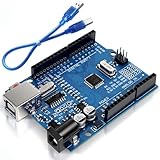
- Unlock your creativity with the versatile UNO R3 Board ATmega328P! Explore endless possibilities in electronics projects with its user-friendly Arduino development environment, extensive digital and analog I/O pins, and compatibility with various sensors and modules. Let your imagination soar!
- Experience the power of UNO R3 Board ATmega328P! This feature-packed development board boasts a high-performance ATmega328P microcontroller, 32KB of flash memory, and 2KB of SRAM. It's perfect for both beginners and advanced users seeking to build innovative applications in robotics, home automation, and more.
- Ignite your passion for electronics with the UNO R3 Board ATmega328P! Its open-source design allows for customization, while its 14 digital I/O pins and 6 analog input pins provide ample connectivity options. Get ready to bring your ideas to life and create interactive projects like never before.
- Elevate your DIY projects with the UNO R3 Board ATmega328P! This highly versatile development board offers seamless integration with the Arduino ecosystem, providing access to a vast library of code and resources. With its reliable performance and broad compatibility, you can easily prototype and realize your electronic dreams.
- Discover the endless potential of the UNO R3 Board ATmega328P! With its robust communication interfaces, including UART, SPI, and I2C, you can connect and communicate with a wide range of devices. Whether you're a hobbyist or a professional, this powerful development board is a must-have for creating innovative and interactive electronic systems.
For file operations, connect an SD-card breakout over SPI. Justina can then open, read, write, and list files, as well as process program files stored on the card. These are integration options, not requirements for the basic serial prompt.
Debugging and extending a program
Justina separates parsing errors from execution errors and reports them with error numbers. Its debugger can stop execution, step through a program, evaluate breakpoint trigger expressions or hit counts, inspect watched expressions, view local and static variables, and review the call stack.
Rank #4

- START CODING WITH A FLEXIBLE UNO R3 BOARD: Connect the included USB cable, upload sketches with Arduino IDE and build sensor, motor, display and automation projects for maker desks, classrooms, coding labs and electronics prototyping
- ATMEGA328P CORE FOR EVERYDAY PROJECTS: A 16 MHz clock, 32 KB flash, 2 KB SRAM, 1 KB EEPROM, 14 digital I/O pins with 6 PWM outputs and 6 analog inputs support LEDs, buttons, relays, servos, displays and sensors
- CH340C USB-TO-SERIAL INTERFACE: The onboard CH340C handles USB communication for sketch uploads and serial monitoring, while clearly labeled digital, analog and power headers help simplify wiring to modules and shields
- USB OR EXTERNAL POWER: Run the board from the included USB cable or a recommended 7-12 V external DC supply, then expand with compatible shields and modules for robotics, data logging, automation and custom embedded projects
- BOARD AND USB CABLE INCLUDED: Comes with 1 ELEGOO UNO R3 controller board and 1 USB-A to USB-B data cable; breadboard, jumper wires, sensors, shields and power adapter are not included
C++ callbacks provide an extension point when the language’s built-ins are not enough. System callbacks can handle recurring background work, such as TCP maintenance; registered user callbacks can expose hardware-specific or time-critical functions to Justina programs. The project page’s description of invoking the interpreter from an Arduino C++ program explains this relationship: Justina on Hackster.
Independent reader supportYour contribution helps us test, update, and keep practical guides available for everyone.Justina versus ordinary Arduino C++
| Consideration | Justina | Arduino C++ |
|---|---|---|
| Typical workflow | Enter commands interactively or run interpreted program files after uploading an interpreter sketch. | Write and compile a sketch, then upload it to the board. |
| Syntax and learning | Structured, Basic-like, and non-object-oriented; intended to be approachable for rapid experiments. | Uses C++ and its broader language model, which can be more demanding for beginners. |
| Errors and debugging | Reports numbered parsing and execution errors; includes stepping, breakpoints, watches, variable inspection, and call-stack review. | Uses the Arduino toolchain’s compile-time diagnostics and the debugging facilities available for the board and development environment. |
| Hardware access | Provides Arduino-oriented functions and configured Serial, TCP/IP, SPI, I2C, and SD-card integrations. | Can use Arduino APIs and C++ libraries directly, subject to board and library support. |
| Performance and resources | Interprets statements on the board; published benchmark timings and memory-footprint measurements are not stated on the project page. | Compiled sketches do not require Justina’s interpreter, but no measured comparison is stated here. |
| Extending behavior | C++ system and user callbacks can add background tasks and hardware-specific functions. | Hardware behavior can be implemented directly in the sketch or through compatible libraries. |
Choose Justina when the interactive, simpler syntax suits the experiment and the target board is supported. Choose C++ when you need the directness and ecosystem of ordinary Arduino development, or when the interpreter’s board support and integration are not a fit. The available project material does not provide comparative speed tests or memory measurements, so it cannot establish which approach is faster for a particular program.
Quick Recap
Best Value

- TURN CODE INTO REAL-WORLD RESULTS — Follow 22+ guided lessons to make LEDs blink, read temperature and distance, move servo and stepper motors, control an LCD and respond to joystick or IR input; ideal for a family weekend build, homeschool unit, coding club or STEM classroom
- MORE PROJECT VARIETY IN ONE ORGANIZED KIT — Includes the UNO R3 controller, LCD1602 with pre-soldered header, breadboard power module, ultrasonic and DHT11 sensors, joystick, IR receiver and remote, SG90 servo, stepper motor, relay, DC motor, fan blade, displays, LEDs, buttons, resistors and jumper wires
- START WITHOUT SOLDERING — Plug-in modules, a solderless breadboard and the pre-soldered LCD help beginners focus on wiring, code and testing; the illustrated component list makes it easier to find each part and move from one lesson to the next
- LEARN THE LOGIC, THEN CREATE YOUR OWN — Use Arduino IDE and the included example code to understand digital input and output, analog sensing, timing, motor control and display functions, then change thresholds, speeds and sequences for alarms, environmental monitors, reaction games and motion projects
- CLEAR SETUP SUPPORT FOR FIRST-TIME BUILDERS — Download the latest tutorial and code, select the UNO board and correct computer port, check component polarity and breadboard rows, and keep power-module input at 9V or below; younger learners should work with an experienced adult
Product prices and availability are accurate as of the date/time indicated and are subject to change. Any price and availability information displayed on Amazon at the time of purchase will apply.

