
What’s actually slowing this PC down?
Pick the symptom - the matching free tool is one click away.
iTechGuides is reader-supported. When you buy through links on our site, we may earn an affiliate commission. As an Amazon Associate I earn from qualifying purchases. Learn more
China is building two separate low-Earth-orbit satellite-internet systems: Qianfan, a Shanghai-led commercial constellation, and Guowang, a national program. Both have begun launching satellites, but their published plans—more than 15,000 for Qianfan’s later phase and about 13,000 for Guowang—are far larger than the fleets reported in orbit so far. The figures describe staged deployment, not completed networks.
What is China’s “Starlink” megaconstellation?
There is no single Chinese project by that name. The comparison with Starlink usually refers to two distinct Chinese low-Earth-orbit broadband efforts: Qianfan, also called Thousand Sails or Spacesail, and Guowang. Their operators, plans and publicly reported deployment records differ, so their satellite totals should not be combined as if they were one constellation.
Low-Earth-orbit broadband systems use satellites to relay communications and internet traffic. Qianfan’s stated purpose is broadband communications and internet access; Chinese government reporting says it uses Ku and Q/V frequency bands and flat-panel broadband satellites. These are descriptions of the planned system, not evidence that all planned coverage or services are already available.
How do Qianfan and Guowang differ?
| Program | Institutional base | Published planned scale | Deployment evidence in the cited reports | Stated service emphasis |
|---|---|---|---|---|
| Qianfan / Thousand Sails / Spacesail | Commercial project developed and operated by Shanghai Spacesail Technologies, also reported as Shanghai Spacecom Satellite Technology; described by China’s Ministry of Industry and Information Technology (MIIT) as a commercial low-orbit constellation. | 648 satellites for regional coverage; 1,296 for global coverage; more than 15,000 in a later integrated-services phase, according to Chinese government reporting. | MIIT reported 54 in orbit after a 5 December 2024 launch; Songjiang District Government later reported 90 after five batches and 126 after a launch on 7 April 2025. | Broadband communications, internet access, overseas markets and direct-to-mobile applications are among the stated uses. |
| Guowang | China’s national satellite-internet effort associated with China SatNet. | About 13,000 satellites in an MIT-affiliated 2025 analysis. | The State Council information portal reported the first group launched from Wenchang on 16 December 2024. A comparable in-orbit total is not stated in that report. | Satellite internet; more detailed service and performance information is not established by the cited public accounts. |
The two sets of planned figures are not directly equivalent in maturity or scope: Qianfan’s more-than-15,000 figure refers to a later integrated-services phase, while Guowang’s approximately 13,000 figure is the planned scale described by the MIT-affiliated analysis. Neither number is a count of satellites currently operating.
#1 Best Overall

- HOBBY MODEL KIT – Unassembled model packed in an envelope with easy to follow instructions. Ideal for ages 14 and up.
- NO GLUE OR SOLDER NEEDED – Parts can be easily clipped from the metal sheets. Tweezers are the recommended tool for bending and twisting the connection tabs.
- VOYAGER – 1.5 Sheet Model with a moderate difficulty level. Assembled Size: 1.38 x 1.77 x 6.70 inches.
- FROM STEEL SHEETS TO 3D – Pop out the pieces and connect using tabs and holes. Includes illustrated instructions.
- HIGHLY DETAILED ETCHED MODEL – Display your 3D model once completed - collect and build them all.
How many satellites has China launched?
The clearest dated public count in the cited reporting is for Qianfan. On 5 December 2024, MIIT said an 18-satellite launch aboard a Long March 6A brought the in-orbit total to 54. Later, Songjiang District Government reported 90 satellites after five batches, then 126 after another 18-satellite launch on 7 April 2025. These are snapshots from different report dates, not a live count or a guarantee that every satellite was providing commercial service.
Songjiang described Qianfan launches as using an “one rocket, 18 satellites” approach. The same municipal reporting said satellites were undergoing business-performance testing and service-function demonstrations. That distinction matters: reaching an in-orbit milestone is not the same as having completed a global network or demonstrated routine service to customers.
Rank #2

- Model Kit
- May Require Paints and Glues to Assemble
- Accurate Scale Model
- Detailed Instructions Provided
- Decals/Transfers Included
For Guowang, the State Council information portal reported that its first group of low-Earth-orbit internet satellites launched from Wenchang on 16 December 2024. The cited account does not give a total that can be compared with Qianfan’s dated counts. Because launches continue and the available counts come from different dates, the evidence here does not establish a precise combined total or the current fleet size in 2026.
Free tools Windows power users keep installed
One-click scans. No signup required.
What are the planned stages and services?
Qianfan’s phased buildout
Chinese government descriptions set out three stages: 648 satellites for regional coverage, 1,296 for global coverage, and more than 15,000 in a later phase intended for integrated services. Qianfan reporting also points to international uses, including Belt and Road markets and overseas Chinese enterprises, alongside direct-to-mobile connectivity. These are stated goals and applications; the cited sources do not verify their commercial availability or performance.
Rank #3

- HOBBY MODEL KIT – Unassembled model packed in an envelope with easy to follow instructions. Ideal for ages 14 and up
- NO GLUE OR SOLDER NEEDED – Parts can be easily clipped from the metal sheets. Tweezers are the recommended tool for bending and twisting the connection tabs
- APOLLO CSM – 3.5 Sheet Model with a challenging difficulty level. Assembled Size: 5.07 L x 2.28 W x 3.45 H inches.
- FROM STEEL SHEETS TO 3D – Pop out the pieces and connect using tabs and holes. Includes illustrated instructions
- HIGHLY DETAILED ETCHED MODEL – Display your 3D model once completed - collect and build them all
Guowang’s national program
Guowang is a separate national buildout rather than another name for Qianfan. The first group’s launch was reported in December 2024, while an MIT-affiliated analysis describes a planned constellation of about 13,000 satellites. Public technical and deployment details in the cited accounts are less complete than Qianfan’s reported batch milestones.
Are either of the networks fully operational?
The launch milestones show that both programs have moved beyond plans and put satellites into orbit. They do not establish completed global coverage. Qianfan’s reported testing and service-function demonstrations indicate work still underway in the accounts that report its 90- and 126-satellite milestones. None of the cited sources establishes a completed global commercial service date for either network.
Rank #4

- HOBBY MODEL KIT – Unassembled model packed in an envelope with easy to follow instructions. Ideal for ages 14 and up.
- NO GLUE OR SOLDER NEEDED – Parts can be easily clipped from the metal sheets. Tweezers are the recommended tool for bending and twisting the connection tabs.
- JAMES WEBB SPACE TELESCOPE - 2.75 Sheet Model with a moderate difficulty level. Assembled Size: 4.13 L x 2.75 W x 2.75 H inches. 1:221 Scale. 62 Pieces
- FROM STEEL SHEETS TO 3D – Pop out the pieces and connect using tabs and holes. Includes illustrated instructions.
- HIGHLY DETAILED ETCHED MODEL – Display your 3D model once completed - collect and build them all.
Technical performance information for Qianfan is limited: the MIT-affiliated analysis notes that detailed performance data are not officially disclosed. The cited sources also do not establish a verified consumer purchase channel for Qianfan or Guowang terminals. A constellation’s planned scale should therefore not be read as proof of available service, customer access, or a particular level of performance.
Recommended Free Tools
Could Qianfan affect astronomy?
There is observational evidence that Qianfan satellites can be bright enough to matter to astronomy. A 2025 preprint reports a mean apparent magnitude of 5.76 ± 0.04 based on 1,161 observations and warns that the satellites may affect astronomical research and the aesthetic experience of the night sky unless brightness is mitigated. Apparent magnitude is a measure of how bright an object looks from Earth; the reported average is tied to those observations and should not be treated as a brightness value for every satellite, at every time or from every location.
Best Value
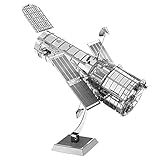
- HOBBY MODEL KIT – Unassembled model packed in an envelope with easy to follow instructions. Ideal for ages 14 and up.
- NO GLUE OR SOLDER NEEDED – Parts can be easily clipped from the metal sheets. Tweezers are the recommended tool for bending and twisting the connection tabs.
- HUBBLE TELESCOPE – 1 Sheet Model with a moderate difficulty level. Assembled Size: 3.00 x 2.00 x 2.50 inches.
- FROM STEEL SHEETS TO 3D – Pop out the pieces and connect using tabs and holes. Includes illustrated instructions.
- HIGHLY DETAILED ETCHED MODEL – Display your 3D model once completed - collect and build them all.
This finding concerns Qianfan. The cited observation study does not provide an equivalent measurement for Guowang, so its result should not be generalized to all Chinese satellites or constellations. More broadly, a large planned fleet raises questions about the orbital environment as well as connectivity, but the available cited figures do not quantify the overall impact of both programs on astronomy or orbital congestion.
Why does the scale matter?
Thousands of satellites require repeated launches and a supporting network on the ground. The Qianfan reports document batch launches and the role of ground-network infrastructure; they do not establish that launch cadence, satellite production, gateways or other network needs have already been met at the scale required by the published plans. Those practical steps help explain why the planned totals and current service status are different questions.
Qianfan and Guowang are frequently discussed alongside Starlink as part of strategic competition in satellite internet. But comparisons should stay grounded in what is publicly documented: the Chinese programs have different institutional bases, their own deployment records, and incomplete public performance disclosures. The scale of a plan alone does not show that one system matches another in coverage, reliability or service.
Quick Recap
Product prices and availability are accurate as of the date/time indicated and are subject to change. Any price and availability information displayed on Amazon at the time of purchase will apply.

