
What’s actually slowing this PC down?
Pick the symptom - the matching free tool is one click away.
For a 12-year-old who mainly needs to call or text family and friends, a basic or flip phone can be a sensible first device. Choose a smartphone when its broader features meet a real need and your family is ready to set and revisit boundaries for apps, web access, privacy, and use. Age alone does not determine readiness.
How the two options differ
| Decision point | Basic or flip phone | Smartphone |
|---|---|---|
| Best fit | Often enough when the main need is calls and texts. Check the exact device: features vary. | Useful when the child needs broader apps, web access, or other smartphone functions. |
| Access | May offer fewer app and web features, but do not assume these are absent. | Opens access to apps and websites, including some not intended for children and teens. |
| Family setup | Agree on contacts and availability; check whether features such as location sharing are included. | Set expectations for privacy, content, contacts, downloads, purchases, and time. |
| Ongoing review | Reassess whether it still meets the child’s communication needs as school and activities change. | Check in every few weeks and adjust the plan if use affects sleep, homework, relationships, or family routines. |
This is a comparison of device categories based on guidance, not a head-to-head test of specific phones. No particular model, price, carrier compatibility, or performance is established here. The guidance cited is US-focused; availability, network compatibility, carrier plans, parental controls, and school rules vary.
When a basic phone may be the better start
If the practical need is coordinating rides, reaching caregivers, or keeping in touch with friends, calls and texts may be enough. A basic phone can provide that connection without making broad app and web access central to the decision.
Do not rely on the label “flip phone” to tell you what a device can do. Before buying, check its actual browser, app, messaging, and location features, as well as whether it works with your carrier and local network. An unlocked 4G LTE flip phone is one category to consider, not a guarantee of compatibility or restricted access.
#1 Best Overall

- 【Strong Adsorption】The inspiration of the silicone phone suction case comes from the adhesive force of the octopus. Each suction cup phone mount is 3.15 inches long and 2.17 inches wide, with 24 independent suction cups providing a stronger and more stable suction force, so you don't have to worry about your phone falling during use.
- 【Back of Phone Suction Grip】Remove the adhesive film on the phone suction cup and stick it on the phone case. You can then fix the phone on any smooth surface, which is very convenient. (The phone suction cup cannot be removed and reused after being attached to the phone case. It is recommended to attach it to a regular phone case, not a valuable one.)
- 【Widely Used】Our non-slip silicone phone sticky grip mount attaches to almost any flat phone case and make it compatible with common mobile phones such as iPhone and Android.You can shoot, watch videos or video calls in the kitchen, gym, dance studio, bathroom and other places.
- 【Capture the Wonderful Picture】Whether you are a TikTok creator or just like to share videos and photos, this phone suction cup can help you hands-free capture wonderful videos and photos for sharing with friends.
- 【Note】You can fix the phone suction cup on a smooth surface such as a mirror or glass. If necessary, wipe the suction cup with a damp cloth to obtain stronger suction. Before releasing your hand, make sure the phone is firmly fixed. (Not applicable to rough walls, wooden surfaces, and other uneven surfaces)
The American Academy of Pediatrics (AAP) says families can ask their carrier about a flip phone limited to calls and texts. It also notes smart watches and starter smartphones with selected features restricted as possible alternatives; these are categories, not endorsements of specific products. The Federal Trade Commission (FTC) advises checking the specific features of child-focused devices rather than assuming restrictions are effective or identical across products.
When a smartphone may make sense
A smartphone can be useful when a child needs functions beyond calls and texts. It can also bring access to a wider range of apps and websites. The AAP describes the trade-off this way: “Smartphones provide access to greater independence and communication with friends, but also to a wide range of apps and websites that aren’t intended for children and teens.”
Rank #2

- SUPERIOR COMFORT — Unlike traditional circular ear buds, the design of EarPods is defined by the geometry of the ear. Which makes them more comfortable for more people than any other ear bud–style headphones.
- HIGH-QUALITY AUDIO — The speakers inside EarPods have been engineered to maximize sound output and minimize sound loss, which means you get high-quality audio.
- BUILT-IN REMOTE — EarPods with USB-C plug also include a built-in remote that lets you adjust the volume, control the playback of music and video, and answer or end calls with a pinch of the cord.
- COMPATIBILITY — Works with all devices that have a USB-C port.
- INTEGRATED MICROPHONE — A built-in microphone precisely captures your voice while you’re on the phone, taking a FaceTime call, or summoning Siri — so you’re always heard loud and clear.
That additional access makes the family’s setup part of the decision, not an afterthought. Before handing over a smartphone, agree on what it is for, which features are allowed, and how you will review the arrangement. A parental-control app or device setting can support boundaries, but it cannot guarantee safety or replace conversation.
How to assess readiness at 12
There is no single age that establishes when a child is ready. The AAP’s Center of Excellence on Social Media and Youth Mental Health says: “Overall, research doesn’t point to one perfect age when kids are ready for a smart phone.” Its readiness prompts are discussion points for a family, not a diagnostic test.
PC Slower Than It Used to Be?
A free scan shows the junk files, broken settings and background clutter dragging Windows down - then fixes them in one click.Free scan · Windows 10 & 11Outdated Drivers Are Slowing You Down
One free scan finds every outdated or missing driver and matches the right update for your exact hardware.Free scan · exact hardware matchRank #3

- Secure Hold: Our PopSockets adhesive phone grip gives your cell phone a secure, comfortable hold in hand to help prevent drops while texting, taking photos, or scrolling on the go. Designed to stick firmly to most phone cases and devices.
- Hands-Free Made Easy: Easily turn your PopSocket into a phone stand to prop up your phone anywhere, perfect for watching videos, video calls, or following recipes. A must-have phone holder that keeps your device secure and ready for anything.
- Compatibility: Works with all phones, tablets, and Kindles. Sticks best to smooth, hard plastic cases and may not adhere to silicone or textured cases. Easily swap your PopTop to change up your style.
- Black PopSockets: Simple, refined, and endlessly versatile. A timeless essential for any phone.
- Travel Must-Have for People On the Go: A must-have travel accessory for flights, flying, airports, air travel, airplanes, planes, international trips, cruises, and long travel days. Key gadget for your airport haul, travel accessories and must-haves.
- Responsibility: Does the child handle homework and other responsibilities reliably?
- Respect and conflict: Can they apologize when they hurt someone’s feelings and navigate disagreements without escalating them?
- Existing rules: Do they follow current technology boundaries?
- Trust and digital literacy: Are they honest with caregivers, and do they understand how to make sensible choices online?
- Practical need: What does the child need to do that a calls-and-texts phone cannot?
- Family support: Can caregivers help set up the phone, discuss problems, and revisit the rules?
AAP’s 2025 “Getting Your First Phone” Q&A reports that three out of four parents of children under 13 said their child did not have their own smartphone; over 40% of parents of 11- and 12-year-olds reported the same. This is an ownership finding, not evidence that a particular age or device is right for an individual child.
Independent reader supportYour contribution helps us test, update, and keep practical guides available for everyone.Make a smartphone plan before handing it over
- Agree on the purpose and expectations. Talk through what the phone is for and what responsible use looks like. A family phone agreement can make expectations clear. Decide separately whether social media apps are allowed.
- Set boundaries for shared routines. Agree on phone-free expectations during meals, homework, and time in bedrooms. For a young teen, the AAP also suggests Do Not Disturb or Focus mode during school, homework, and bedtime, and keeping media use from disrupting sleep.
- Configure the device together. Review privacy and content settings, approved contacts, downloads, purchases, and downtime. Explain what each boundary is for rather than presenting controls as a substitute for trust or judgment.
- Check in and adapt. Revisit how the arrangement is working every few weeks. If phone use is disrupting sleep, homework, relationships, or family routines, discuss what to change.
The AAP favors family safety plans that include the young person’s input and help them learn self-regulation. Monitoring tools alone can interfere with that learning, so treat settings as support for a shared plan—not a guarantee that nothing will go wrong.
Quick Recap
Best Value
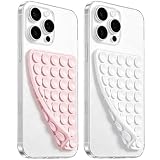
- 【PKYAA Double Sided Silicone Suction Phone Case Mount】PKYAA With Double Sided 40 Strong and Reliable individual suction cups, PKYAA provides a thicken and upgraded universal silicon suction mount for your phone.
- 【Friendly to Content Creators】If you are a content creator or an online influencer, you can create videos anywhere with this suction mount completely hands free with this silicone cell phone mount for cases.
- 【HANDS-FREE & Adhere to Mirrors】This Double Sided silicone suction phone case mount allows you to stick your phone to the mirror easily. No longer holding your phone in one hand to watch video tutorials while making up.
- 【Strong Grip on the Smooth Surface】You can easily hang your phone anywhere with a smooth surface. All you do is you clean off your phone and smooth surface. It is STURDY and it not only sticks to mirrors, it also sticks to windows, it sticks to refrigerators, tiles and other clean, flat surfaces.
- 【Press Down Firmly Every 30 Minutes】Use your palm or fingers to press the phone down firmly and check it's secure before letting go. Apply even pressure for a few seconds to allow the suction cup to adhere properly. To maintain the grip and prevent accidental falls, it's a good practice to periodically reapply pressure to the suction cup.
Rank #4

- [360 ° Flexible Rotation Design] Comes with a rotatable lanyard ring that supports 360 ° free rotation, effectively solving the problem of twisted and tangled lanyards
- [Wide compatibility] The ultra-thin 0.02-inch design does not block the charging port at all, and both wired and wireless charging can be used directly without removing the pad. Compatible with most smartphones such as iPhone, compatible with various wristbands, lanyards, crossbody straps, and keychains
- [Durable and Portable Material] Premium rust-resistant stainless steel material with good flexibility, which not only avoids scratching the phone case, but also has excellent anti rust and anti fading performance
- [Multi scenario Practical] Paired with a lanyard or wristband, hands-free use can be achieved. The phone is within reach and not easily dropped, ideal for daily commuting and outdoor activities. Suitable for full coverage phone cases, does not support half coverage phone cases
- [Quality Service] If you find any damage or other issues with the product upon receipt, please contact us immediately. We will handle it quickly
A practical way to decide
- Choose a basic phone if the child mainly needs calls and texts and the family is not ready for broader app and web access.
- Consider a smartphone if its added functions answer a clear need and the child and caregivers are prepared to manage access and boundaries together.
- Revisit the choice as responsibilities, school, activities, and the child’s skills change; the first decision does not have to be permanent.
Product prices and availability are accurate as of the date/time indicated and are subject to change. Any price and availability information displayed on Amazon at the time of purchase will apply.

