
What’s actually slowing this PC down?
Pick the symptom - the matching free tool is one click away.
Neither AMD EPYC nor Intel Xeon is the right choice for every data center. Choose between specific server configurations by testing your workload and comparing the complete cost and operational fit—not by treating either brand’s benchmark claims or core counts as a universal verdict.
Start with the workload, not the processor brand
Set a measurable capacity target before comparing systems: for example, database transactions per second, virtual machines at an agreed service level, jobs completed per hour, or inference throughput at a defined latency. Then compare systems that meet the same target under equivalent software, memory, storage, and tuning conditions.
This matters because a processor’s core count or a result from one benchmark does not tell you how your application will perform. The relevant question is whether a complete server configuration can deliver your required capacity reliably, within your power, licensing, budget, and operating constraints.
What the current model examples do—and do not—tell you
| Example | What the source establishes | How to use it |
|---|---|---|
| AMD EPYC 9965 | AMD’s October 10, 2024, 5th Gen announcement lists 192 cores, 500 W TDP, and a manufacturer-listed CPU price of $14,813. | Use these as dated, model-specific launch figures, not as a current transaction price or a measure of whole-server power. |
| AMD EPYC 9996 versus Intel Xeon 6980P | AMD’s internal tests dated July 20, 2026, compare a 256-core EPYC 9996 with a 128-core Xeon 6980P in specified workloads. | These are vendor test results for particular configurations. They can suggest workloads to validate, but do not establish a neutral winner or predict results on your systems. |
| Intel Xeon 6+ | Intel’s current product page positions Xeon 6+ for cloud-native, networking, and data center work and states a family maximum of up to 288 E-cores per socket. Intel also lists TDX and SGX among the family’s hardware security features. | Check the exact SKU, server, and feature support. A family maximum is not a specification for every Xeon 6+ processor. |
The examples are not a direct, independently controlled comparison between all current EPYC and Xeon options. AMD’s newer test comparison uses different core counts, and its results are specific to the systems and workloads AMD describes. The EPYC 9965 launch figure is from 2024; do not treat its listed price as a current quote.
The Tool Desk
Outbyte Driver Updater FREEScan for outdated or missing drivers - takes under a minuteDriver Scan →Outbyte PC Repair FREEClear out junk files and repair common Windows errorsFree Scan →#1 Best Overall

- For AMD EPYC 9754 128 Core Bergamo 2.25GHz (100-000001234) EPYC 9004 Series Socket SP5 ZEN4 256MB L3 Bulk / Tray Pack (Unlocked) Server Processor
Compare the system factors that can change the answer
Application performance
Test the software and workload you actually run, including its version, data size, concurrency, and operating conditions. For virtualization, measure the density you can sustain at your required performance and availability. For databases, use representative queries and transaction mixes. For cloud-native services, test request rates and latency at realistic utilization. If accelerators are part of the workload, include them in both configurations.
AMD’s July 20, 2026, internal results report up to 2.9× Redis 8.8 request throughput for EPYC 9996 versus Xeon 6980P. AMD specifies KVM, Ubuntu 24.04, Redis 8.8, workload aggregation, and other configuration details. In a separate result, AMD reports up to 2.6× MySQL 8.4.10 online transaction processing throughput for the same processor models using a HammerDB TPROC-C-derived workload. AMD says that workload is not comparable to published TPC benchmark results. These are AMD-reported figures, not independent guarantees for another server or deployment.
Rank #2

- Dual Processor Support: Supports and includes 2 AMD EPYC processors installed for enhanced computing performance
- Processor Configuration: Features 2 installed AMD EPYC processors for powerful server operations
- AMD Processor Technology: Equipped with AMD processor manufacturer components for reliable performance
- EPYC Processor Type: Utilizes AMD EPYC processor type designed for enterprise-level server applications
- 5th Generation Processing: Powered by 5th Gen AMD EPYC 9115 processors running at 2.60 GHz with hexadeca-core architecture
AMD’s benchmark disclosures also caution that results may not translate directly to physical deployments because platform implementation, firmware, operating environment, memory configuration, and tuning can differ. Prefer independent benchmark submissions when suitable results exist, and validate finalists using the same software and conditions. Treat vendor tests as leads for what to test, not as substitutes for that validation.
Consolidation and software licensing
Estimate how many nodes and licensed cores each option needs to meet the capacity target. More capacity per server may reduce node count, but licensing rules differ by software and contract; fewer servers do not automatically mean lower license costs. Include any migration, recertification, or licensing changes needed to move workloads between platforms.
Recommended Free Tools
Rank #3

- High Performance Server: Features an AMD EPYC 7313 processor with a speed of 1.44 GHz and 32 GB of DDR4 memory for fast performance.
- Expandable Storage: Includes an P408i-a storage controller and 8 SFF drive bays for flexible storage options.
- Modern Design: Has a sleek, modern style with a black finish and ergonomic keyboard for comfortable use.
- Easy Setup: Comes with an 800W power supply and pre-installed operating system for quick installation.
- Reliable Connectivity: Offers multiple USB and Ethernet ports for seamless connectivity to other devices.
AMD’s example for 2,000 virtual machines is a vendor-produced scenario, not a general savings forecast. Its January 18, 2023, analysis compares two-socket EPYC 9654 systems with two-socket Xeon Platinum 8490H systems over three years. It assumes one core and 8 GB per VM and specifies VMware licensing assumptions. Apply the scenario only if its hardware, workload, licensing, and time-period assumptions match your situation; build your own model with current quotes and contract terms.
Power, cooling, and rack limits
Compare measured system-level energy at representative utilization, and account for cooling and any rack power or density limits. A processor’s TDP is not the data center’s power draw: memory, storage, accelerators, fans, power supplies, workload behavior, and cooling all affect the total. A denser configuration may reduce node count but still need validation against facility constraints.
Rank #4

- HPE ProLiant DL145 Gen11 – P87460-005 – SMART CHOICE MODEL – COMPACT EDGE SOLUTION: Preconfigured and factory-tested for fast deployment and cost efficiency. Includes AMD EPYC 8024P (8 cores, 2.40 GHz), 16GB DDR5 ECC SmartMemory, 2 SFF chassis, 480GB SATA 6G Read Intensive SSD, Broadcom 1GbE OCP NIC, and single 700W Platinum PSU—ideal for IoT gateways, retail POS, and light virtualization.
- PERFORMANCE AND MEMORY – EFFICIENT FOR LIGHT WORKLOADS: The AMD EPYC 8024P delivers 8 cores at 2.40 GHz for edge compute tasks. Includes 16GB DDR5 RDIMM ECC (1x16GB) and supports up to 768GB across six DIMM slots—ideal for small-scale virtualization and real-time analytics.
- STORAGE – READY FOR OS AND DATA Includes one HPE 480GB SATA 6G Read Intensive SSD for quick deployment. Supports additional SFF drives for storage flexibility—perfect for edge workloads and local data storage.
- ENTERPRISE DESIGN – POWER AND CONNECTIVITY: Single 700W Platinum hot-plug power supply ensures reliable power delivery. Broadcom BCM5719 OCP NIC offers four 1GbE ports for edge networking and connectivity.
- SECURITY AND MANAGEMENT – BUILT-IN PROTECTION: HPE iLO6 with Intelligent Provisioning, TPM 2.0, Silicon Root of Trust, and secure boot protect against threats. Compatible with HPE OneView and Compute Ops Management for simplified lifecycle management.
Platform compatibility and security
For each exact processor and server, verify that the platform supports your required memory type and capacity, I/O, accelerators, socket configuration, security features, firmware, and management tools. Check OEM validation and certification for your operating systems and applications as well. The sources summarized here do not provide a complete neutral feature matrix across EPYC and Xeon platforms, so confirm these details with the server manufacturer and software vendors.
Operations and lifecycle
Account for the fleet you already operate, staff experience, supply and support availability, firmware and management workflows, and the effort to migrate or standardize. A theoretically faster system can be the worse operational choice if it creates unsupported configurations or costly changes to established processes. Confirm availability and support terms for the exact server configuration before committing.
Best Value
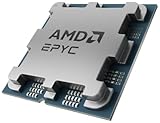
- The processor features Socket AM5 socket for installation on the PCB
- EPYC product line processor for better usability and increased efficiency
- Dodeca-core (12 Core) processor core allows multitasking with great reliability and fast processing speed
- 64 MB of L3 cache memory provides excellent hit rate in short access time enabling improved system performance
- Processor with 3.40 GHz clock speed for reliable and fast execution of instructions to ensure maximum convenience and feasibility
Build a like-for-like comparison
- Define the target: Record the workload metric, minimum service level, expected utilization, and growth allowance each candidate must meet.
- Set platform requirements: List required memory, I/O, accelerators, security capabilities, certifications, management, and support conditions. Remove any configuration that fails a requirement.
- Select server configurations: Ask vendors or OEMs for complete, supportable systems based on exact processor SKUs. Keep memory, storage, networking, software versions, and tuning as comparable as practicable.
- Benchmark representative work: Run the same workloads on each finalist and record throughput, latency, utilization, and energy under the conditions that matter to your service.
- Model total cost: Compare system quotes, power and cooling, software licenses, support, migration, and operating costs over your intended service life. State assumptions and use current commercial terms.
- Validate before rollout: Confirm results, compatibility, and support with the teams responsible for applications, infrastructure, security, procurement, and operations.
How to interpret vendor claims
Manufacturer product pages establish what each vendor says about its products; they are not neutral comparisons. AMD’s published benchmarks and scenario models can be useful when their configurations match your needs, but their disclosures should travel with the result. Intel’s Xeon 6+ positioning and feature statements likewise need verification against the specific SKU and server you are evaluating.
The available material does not establish an independent, apples-to-apples test suite covering every current EPYC and Xeon SKU, a full neutral platform comparison, or current enterprise transaction prices. Where those details matter, request OEM-validated configurations and current quotes, then verify the claims against your workload and support requirements.
Quick Recap
Product prices and availability are accurate as of the date/time indicated and are subject to change. Any price and availability information displayed on Amazon at the time of purchase will apply.

