
Yes—if your essential applications and peripherals work reliably on macOS or in a properly supported Windows virtual machine, and a specific Mac Studio configuration meets your workload’s performance and capacity needs. A Mac Studio is not a drop-in replacement for every PC workstation. Check your exact software versions, plug-ins, licensing, project sizes, display setup and connected hardware before choosing a model or retiring your PC.
Start with the workflow, not the Mac’s headline specifications
A workstation is the combination of the applications you depend on, the projects you handle, and the equipment and services around them. A fast computer can still be the wrong replacement if a required plug-in is Windows-only, a license forbids virtualization, or a specialist device has no compatible driver.
Make an inventory of what must keep working, including exact application versions, plug-ins, add-ins, file formats, collaboration tools, security requirements and peripherals. For each item, establish whether it is supported natively on macOS, supported in a Windows virtual machine on Apple silicon, or requires a Windows PC. Treat technical ability to launch software and the vendor’s support and licensing rules as separate questions.
- Applications: Record names and versions, plus any plug-ins, scripts, macros or add-ins used in production.
- Projects: Note typical and largest project sizes, render engines, model complexity, file handoffs and any work that must remain available offline.
- Hardware: List displays, docks, storage arrays, audio interfaces, capture devices, security keys and other specialist peripherals. Confirm macOS or virtual-machine compatibility with each manufacturer.
- Team workflow: Check shared file formats, fonts, version control, network storage, identity systems and how colleagues exchange deliverables.
Check application and licensing support before estimating performance
Native macOS support is usually the simplest route, but compatibility is product-specific: a vendor may offer one application for Mac while another product in its lineup is Windows-only. Autodesk’s guidance distinguishes Mac-compatible products from products used in virtualized environments; its current compatibility article and virtualization guidance should be checked for the exact product and version you use (Autodesk Mac-compatible software; Autodesk product compatibility guidance).
#1 Best Overall
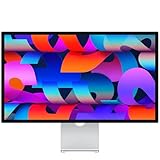
- A SIGHT TO BE BOLD — An immersive 27-inch 5K Retina display, 12MP Center Stage camera with Desk View, advanced mics and speakers, and Thunderbolt 5 ports.* Studio Display is the perfect partner for Mac.
- WITH FLYING COLORS — 14.7 million pixels, 600 nits of brightness, support for 1 billion colors, and P3 wide color make everything spring to life with spectacular detail.
- ADVANCED CAMERA AND AUDIO — The 12MP Center Stage camera helps you look sharp in any light and keeps you in frame during video calls. Desk View lets you share your workspace. And a studio-quality three-mic array ensures you come through clearly.
- SIX-SPEAKER SOUND WITH SPATIAL AUDIO — Four force-cancelling woofers produce bold bass, and two high-performance tweeters deliver accurate mids and crisp highs. And Spatial Audio creates a sophisticated, cinematic soundstage in supported music, video, and games.
- SUPERPOWER YOUR STUDIO — Two Thunderbolt 5 ports let you connect high-speed accessories, daisy-chain up to four displays, and even fast-charge Mac laptops. And two USB-C ports are perfect for USB peripherals or charging your iPhone.
If an application needs Windows, verify that the software vendor supports the combination of Apple silicon, the virtualization product and the Windows version you intend to use. Then check the license independently. Autodesk says, “You may virtualize a product only if the applicable terms and conditions governing your access to and use of that offering expressly permit virtualization” (Autodesk virtualization guidance). A successful installation does not establish vendor support or permission under your license.
What the Revit 2026 example does—and does not—establish
Autodesk’s Revit 2026 system requirements list Parallels Desktop for Mac at the recommended level for Apple computers, Windows 11 as the operating system for an Apple-silicon virtual machine, 16GB of virtual-machine memory and a virtual display adapter. Autodesk also describes its model-size guidance as approximate because models vary (Revit 2026 system requirements).
This is a version-specific requirement example, not a guarantee that every Revit project, add-in or workflow will be supported or perform acceptably in a virtual machine. Check current Autodesk guidance for your exact Revit release and extensions, and test representative projects before depending on the setup.
Match the configuration to memory, storage and display needs
Apple’s 2025 Mac Studio specifications list two chip families, M4 Max and M3 Ultra. They differ in configurable memory, storage and external-display support; the right choice depends on the working set and connected setup you actually need, not just the chip name.
Recommended Free Tools
| Specification | M4 Max | M3 Ultra |
|---|---|---|
| Memory listed on Apple’s 2025 technical specification page | 36GB base; configurable to 128GB | 96GB base; configurable to 256GB |
| Maximum SSD listed on Apple’s 2025 technical specification page | 8TB | 16TB |
| Maximum external displays listed by Apple | Up to five | Up to eight |
| Display caveat | Maximum depends on display resolution, refresh rate and connection; front USB-C ports do not support external displays. | Maximum depends on display resolution, refresh rate and connection. |
Source for the table: Apple Mac Studio (2025) technical specifications. Apple’s March 2025 launch announcement described M3 Ultra configurations with up to 512GB unified memory, while the technical specification page lists configuration options up to 256GB. Those figures conflict; verify the maximum memory available for the specific region and configuration on Apple’s live purchase page before ordering. The launch announcement also describes M3 Ultra SSD capacity up to 16TB (Apple’s March 5, 2025 announcement).
Memory and internal storage are purchase decisions, so size them against your largest realistic workload rather than only your current average. Unified memory is shared by the system and applications; compare the capacity your projects and software need with the exact configuration offered. For active projects that exceed internal storage, plan how external storage connects and whether the enclosure or array is supported by your workflow.
Rank #2

- BRILLLLLLIANT — iMac is the ultimate all-in-one desktop computer, powered by the M4 chip and built for Apple Intelligence.* With a stunning 24-inch Retina display, iMac gives you the space you need in an iconic, colorful design that livens up any room.
- FITS PERFECTLY IN YOUR SPACE — The all-in-one desktop design is strikingly thin, comes in seven vibrant colors, and elevates any space with style.
- BUILT FOR APPLE INTELLIGENCE — Apple Intelligence is the personal intelligence system that helps you write, express yourself, and get things done effortlessly. With groundbreaking privacy protections, it gives you peace of mind that no one else can access your data — not even Apple.*
- SUPERCHARGED BY M4 — Get more done faster with the Apple M4 chip. From editing photos to creating presentations to gaming, you’ll fly through work and play.
- IMMERSIVE DISPLAY — The industry-leading 24-inch 4.5K Retina display features 500 nits of brightness and supports up to 1 billion colors.*
For displays, count the screens and record each one’s resolution and refresh rate before relying on Apple’s maximum-display figures. Map the required connections to the Mac’s supported ports. If you choose M4 Max, do not plan to use its front USB-C ports for external monitors.
Independent reader supportYour contribution helps us test, update, and keep practical guides available for everyone.Compare real performance under the work you do
Workstation performance depends on the application’s processing path. CPU-heavy tasks, GPU rendering, specialized acceleration, large models and sustained workloads can respond differently to the same hardware. A chip-level comparison cannot determine how a particular render engine, plug-in or virtualized application will perform.
Crashes, No Sound, or Screen Glitches?
Random freezes, missing sound and display glitches usually trace back to one bad driver. Find and replace yours safely.Free scan · under a minuteWindows Errors? Fix Them Before They Spread
Repair common Windows errors and clear accumulated junk for a smoother, more stable PC - no reinstall needed.Free scan · no reinstallApple’s 2025 announcement says M3 Ultra can be nearly twice as fast as M4 Max in workloads that take advantage of high CPU and GPU core counts. That is Apple’s claim under the stated workload condition, not an independent comparison against a PC workstation or a guarantee for every application (Apple’s Mac Studio announcement). The available cited material does not establish a workload-matched independent benchmark between a Mac Studio and a named PC workstation, so it cannot show that one will be faster for your projects.
For a business-critical move, test the Mac configuration you would actually buy against the existing PC using representative files and the same software versions. Include the slowest or most demanding steps in the workflow—not only opening a project—and record completion time, responsiveness, reliability and any feature or plug-in differences. A benchmark from a different application or project is not a substitute for that comparison.
Plan for the cost and the transition
Compare the full cost of the working setup, not just the computer: include any required monitor, storage, dock or adapter, Windows and virtualization licenses, and application subscriptions. Apple’s US store listing displayed an M4 Max configuration at $1,999 and an M3 Ultra configuration at $3,999 when accessed October 7, 2026; these are dated US listing prices for the configurations shown, not a universal or guaranteed price (Apple Store US Mac Studio listing).
Before switching a production team, run a limited pilot with representative projects, plug-ins, peripherals and file handoffs. Confirm that collaborators can open and return files as expected, and identify any Windows-only task that needs to remain on a PC. Plan data transfer, file associations, shortcuts and access to shared systems as part of the change rather than treating them as afterthoughts.
Quick Recap
Use a go/no-go checklist before replacing the PC
- Confirm support: Check the software vendor’s current compatibility statement for your exact version, macOS or Windows-on-Apple-silicon setup, and plug-ins.
- Confirm permission: Verify that your license permits virtualization where applicable; technical launchability alone is not enough.
- Size the Mac: Match memory and SSD configuration to the largest expected working set and local project needs, and verify the currently orderable options for your region.
- Check connections: Confirm display count, resolution, refresh rate, ports and peripheral drivers, including the M4 Max front-port display limitation if relevant.
- Test the workload: Run real projects and handoffs on the target configuration, checking performance, features and stability against the current PC.
- Keep a recovery path: Retain access to the Windows workstation until the pilot has passed and any Windows-only workflow has a dependable plan.
Product prices and availability are accurate as of the date/time indicated and are subject to change. Any price and availability information displayed on Amazon at the time of purchase will apply.

