
Optogenetics lets researchers control selected cells with light by combining genetic targeting with light-sensitive proteins called opsins. In neurons, activating an opsin can change membrane currents and electrical activity; optical fibers can deliver light to targets deep in the brain, where tissue scatters it. The method can test how cells and circuits contribute to an outcome, but the result depends on which cells were targeted, which opsin was used, and how light was delivered.
How does optogenetics work?
Optogenetics combines two controls: a genetic method that determines which cells express a light-sensitive tool, and an illumination method that activates that tool. Researchers then measure the resulting activity or downstream effects. The approach is useful for testing causal hypotheses about biological systems, but an observed response does not by itself show that the manipulated pathway is the only mechanism involved. Nature Reviews Methods Primers (2023) reviews the principles and tools; the NIH gives a concise description of the field as combining light with genetically encoded light-sensitive proteins to control cell behavior. NIH Catalyst, September–October 2014
- Target a cell population. Genetic tools are used to make selected cells express an opsin. The targeting strategy sets which cells are capable of responding to light.
- Express the light-sensitive tool. An opsin absorbs light and produces a biological effect. Many neuronal tools affect ion movement across the cell membrane, while other optogenetic tools can regulate signaling pathways or molecular interactions.
- Deliver the activating light. Researchers choose an illumination wavelength and pattern suited to the opsin and target. For deep brain regions, a fiber-optic interface can guide light into tissue.
- Measure what changes. Researchers record neural activity or examine behavior and other biological outcomes, interpreting those results alongside controls and the targeting method.
What are opsins, and how do they affect neurons?
Opsins are light-sensitive proteins used as actuators: absorbing light changes their activity, which can alter a cell’s electrical state or other processes. They are not interchangeable. The direction, magnitude, timing, and cellular consequences of activation depend on the specific tool and experimental context. Nature Reviews Methods Primers (2023)
Channelrhodopsins can excite neurons
Channelrhodopsins are light-gated channels. When activated, they generate photocurrents that can depolarize a neuron and promote firing. The NIH’s account of the foundational channelrhodopsin-2 demonstration describes inserting a light-sensitive gene from pond algae into selected mammalian neurons and using light pulses to trigger firing on a timescale of a few milliseconds. That is a historical description of a particular demonstration, not a performance guarantee for every opsin or experiment. NIH Catalyst, September–October 2014
Do these 3 things before closing this tab:
1Clear out junk files and repair common Windows errors2Fix the driver behind crashes, sound loss and screen glitches3Repair Windows errors before they cause bigger problems#1 Best Overall

- 【Test fiber performance】Single mode dual wavelength (1310nm/1550nm)+adjustable modulation frequency (270/1000/2000Hz) provides stable -5dBm output, suitable for fiber link verification.
- 【Wide compatibility】Compatible with most fiber optic devices on the market through a 2.5mm standard interface and SC/FC/ST. Paired with FC-LC adapter, suitable for 1.25mm LC interface
- 【Multi functional testing】Integrated hidden RJ45 cable tester, supports detecting the on/off, short circuit, and cross line sequence of network cables, suitable for scenarios where both fiber optic and network cable wiring are performed simultaneously.
- 【Practical on-site design】Built in LED work light+backlit display screen (suitable for dark environments); Automatic shutdown+fast charging lithium battery (suitable for outdoor use)
- 【Compact and portable】Lightweight, pocket sized, easy to carry and store for outdoor work
Inhibitory and signaling tools do more than one job
Some inhibitory tools use light-driven pumps or other opsins to alter membrane voltage or ion concentrations, reducing neuronal activity in particular contexts. The wider toolkit also includes proteins designed to control second messengers, G-protein signaling, kinase signaling, and light-dependent molecular interactions. These tools do not all work by directly opening a channel, so the biological effect must be matched to the question being tested. Nature Reviews Methods Primers (2023)
Why are fiber optics used in optogenetics?
Light scatters in brain tissue and does not readily reach deep targets from outside the tissue. An optical fiber can carry light to a chosen deep region, making it a standard delivery approach in basic neuroscience. The fiber’s geometry and optical properties shape the light distribution, so “delivering light” does not mean every nearby cell receives the same illumination. Nature Neuroscience (2025)
Rank #2

- 【Precision optical performance】Operating at single-mode dual wavelength (1310nm/1550nm), the output power remains stable at -5dBm and supports three industry standard modulation frequencies (270Hz/1000Hz/2000Hz) to meet various fiber link testing requirements.
- 【Connector compatibility】Equipped with a 2.5mm universal interface, it can be compatible with SC, FC, ST, and 1.25mm LC fiber optic connectors. Simply insert the adapter to match the fiber optic equipment
- 【Low light operation optimization】Equipped with a high contrast backlit LCD display, it can clearly present test data in dim environments. Paired with the built-in LED work light, it is convenient and fast to use.
- 【Power management system】Powered by a rechargeable lithium battery, the built-in Type-C charging interface (red flashing=charging; stable green=fully charged) provides real-time power status at a glance.
- 【Compact size】Its compact size and lightweight design allow it to fit into tool straps, pockets, or equipment bags, making it an ideal choice for daily on-site maintenance, remote on-site inspections, and emergency repairs.
Fiber geometry changes the illuminated region
A flat-cleaved fiber can create high irradiance near its tip. Tapered fibers can spread light over a larger interface and reduce peak power density, but a larger interface can also increase tissue damage. These are design trade-offs, not a universal recommendation for one fiber type. Light intensity, wavelength, and opsin sensitivity also influence the volume affected and the possibility of heating. Nature Reviews Methods Primers (2023)
What limits an optogenetics experiment?
- Heating: High-intensity illumination can warm tissue and alter neural activity or behavior. Opsin-free animals or tissue exposed to the same light provide a way to test whether light-related effects, including heating, could explain a result.
- Optical access: Scattering limits deep illumination and affects which volume is exposed. Fiber delivery helps reach deep targets but requires an interface placed appropriately for the experiment.
- Targeting specificity: The genetic strategy determines which cells express the tool, while the light pattern and placement determine which of those cells are illuminated. Both constrain what a result says about a circuit.
- Tool and illumination fit: Opsins differ in sensitivity, spectral response, kinetics, and physiological effect. Researchers need to select the actuator and light conditions together for the biological question and target tissue; no single opsin is established as best for all experiments.
- Translation beyond research: Use in cell or animal experiments does not establish a general clinical treatment. Translational applications face distinct delivery and safety requirements compared with brief laboratory manipulations. Nature Neuroscience (2025)
How should optogenetic approaches be compared?
A useful comparison starts with the biological effect sought, then considers the cells and tissue involved, the light delivery design, and the experiment’s controls. The right configuration depends on the question rather than a single winning device or opsin. Nature Reviews Methods Primers (2023)
Free tools Windows power users keep installed
One-click scans. No signup required.
Quick Recap
Best Value

- 1.Fast Fiber Fault Identification: Identify fiber breaks, sharp bends, damaged connectors and routing issues in seconds. The visible red light source helps technicians quickly trace fiber paths and verify link continuity during installation, maintenance and troubleshooting.
- 2.Universal Connector Compatibility: Designed with a universal 2.5mm interface compatible with SC, ST, FC and LC fiber connectors. Suitable for both single mode and multimode fiber networks used in data centers, enterprise cabling, telecommunications and surveillance systems.
- 3.Rugged Aluminum Alloy Construction: Built with a durable aluminum housing for daily field use. The compact design resists wear during transport and repeated operation, making it ideal for technicians, installers and network maintenance professionals.
- 4.Simple One-Button Operation: Easy to use for both professionals and beginners. Quickly verify fiber continuity, inspect patch cords and locate network issues without complicated setup procedures or additional testing equipment.
- 5.Complete Maintenance Tool Kit: Includes a carrying pouch and essential accessories for convenient storage and transport. A practical solution for fiber optic installation, network upgrades, repair work and routine maintenance tasks.
Rank #4
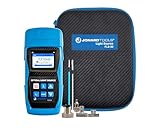
- WHAT'S IN IT: Fiber Optic Light Source, FC Adapter, LC Adapter, SC Adapter, (2) Cleaning Swabs, (3) AA Batteries, Storage Pouch
- HIGH DURABILITY DESIGN: Flush button design makes it easy to use and prevents dust from entering the unit plus shatter-resistant sleeve protects the light source from falls and other damage
- 4 MODULATION OUTPUTS: This optical light source has 4 output modulation frequencies (CW, 270 Hz, 1 kHz, 2 kHz) at 1310 nm and 1550 nm wavelengths for stable and reliable output
- BACKLIT LCD SCREEN: The LCD screen provides a clear viewing display and is backlit, making it ideal for viewing in dark and low light applications
- LIFETIME USE: Jonard Tools makes high quality tools that are designed to last a lifetime
Rank #3

- Komshine Light Source With 2.5mm universal interface FC SC Adaptor; Typical output power: -5dB; Output Stability:±0.05dB/15mins; ±0.1dB
- KLS-35-MS Fiber Optic Light Source with Wavelengths : 850/1300nm+1310nm/1550nm Comes With LED backlight Function
- 7 calibrated wavelengths optic fiber power meter KomShine KPM-35 High Precision FTTH fiber cable test tool with SC Connector (Wavelengths: 850/980/1300/1310/1490/1550/1625nm)
- Fiber Optic Power Meter Measurement Range:-70+6dBm; Comes with Certificate of Qualified; Self Calibration Provided
- Waterproof key suitable for all kinds of outdoor environments; Silicone jacket, anti-drop 2m
| Comparison point | Why it matters |
|---|---|
| Biological effect | Determine whether the experiment aims to excite, inhibit, or regulate signaling or molecular interactions. |
| Cell targeting | Establish which cells express the tool and therefore can respond to illumination. |
| Opsin sensitivity and spectral response | Match the tool’s response to the chosen light conditions and the intended physiological effect. |
| Light delivery geometry and coverage | Account for target depth, scattering, fiber placement, and the area to be illuminated. |
| Timing | Choose illumination patterns appropriate to the tool’s kinetics and the biological question. |
| Heating and tissue effects | Consider intensity-related heating and the trade-off between coverage, peak power density, and tissue damage. |
Product prices and availability are accurate as of the date/time indicated and are subject to change. Any price and availability information displayed on Amazon at the time of purchase will apply.

