
Archaeologists identify ancient wooden tools by combining wood anatomy, an object’s shape and construction, and traces of manufacture or use. They date them by matching tree rings to regional chronologies when possible, or by using radiocarbon and archaeological context. Each method answers a different question: identifying the wood does not prove what the tool did, and dating the tree does not automatically date the tool’s manufacture, use, or burial.
What archaeologists examine to identify a wooden tool
Wood is both biological material and a worked object. Researchers therefore examine what kind of wood survives, how it was shaped or assembled, and whether observed marks are consistent with human work rather than natural damage or later alteration. The French Ministry of Culture describes archaeological wood research through wood identification, dendromorphology—the study of the form of wooden remains—and traceology, the study of traces left by working and use. Its dendrology glossary calls the archaeological study of wood remains produced by humans dendroarchaeology.
Wood anatomy can identify the material
Diagnostic anatomical features can help specialists identify a wood species. For example, the Natural History Museum Vienna describes examining features such as resin ducts in its Hallstatt wood research. The result is an identification of the material, not proof of the object’s purpose: the same species can be used for different objects, and a species identification alone cannot establish how a tool was used.
Shape, construction, and marks reveal how it was made
Morphology and construction help distinguish an implement from an unworked fragment and show how its parts relate. Microscopic examination can document shaping marks, wear, and other traces, while analysts must consider whether marks could instead come from biological activity or later damage. A composite tool may preserve only some of its parts, so surviving components and their connections matter. The Metropolitan Museum of Art, for example, describes a sickle insert in which flint pieces were fitted into a wooden haft and secured with adhesive. The collection record illustrates why the haft, blade, and evidence of assembly can be interpreted together.
#1 Best Overall

- Suitable for archaeological digs, dusting off your old fedora or cleaning your keyboard, this genuine wood-handled brush has dark horsehair bristles for an old world look and feel.
- Overall measurements: 4" x 3 ¾" x 1 ¼" (10cm x 9cm x 3cm)
- Bristle length: 2 ¾" (7cm)
- Brush used by Indy (Harrison Ford) in Raiders of the lost Ark
Residue and wear can suggest function
Residues and use-wear may help researchers infer what material a tool worked and what action it performed. In an experimental study, Bruce L. Hardy and Gary T. Garufi replicated woodworking with stone tools and found that residue distributions considered alongside wear patterns could help identify use-action. Some wood fragments retained anatomical features useful for species identification. These are converging clues, not a guarantee that every tool preserves residues or that one mark uniquely identifies a function. The study appeared in the Journal of Archaeological Science in 1998.
How tree rings date wood
Dendrochronology measures the widths and sequence of annual tree rings, then compares that pattern with a suitable reference chronology. A successful match dates the growth represented by the measured rings. Reference chronologies need to suit the wood being studied; for Hallstatt, researchers needed a chronology that accounted for the elevations where the trees might have grown. The Rijksmuseum describes using oak ring measurements and reference calendars to estimate when and where a tree grew, and notes that woodworking traces can provide corroborating evidence about date and origin. Its dendrochronology overview explains the method’s use in studying wooden objects.
Rank #2

- Portable and Easy to Store: The compact size of each tool makes this dig tool set portable.Each lightweight tool in this kids digging tools set is designed for small hands, making it easy for children to explore and dig wherever they go./Size(wood hammer):14.00X4.00X2.00cm/5.50X1.57X0.79in
- Complete Set for Exploration: This set offers a comprehensive collection of essential archaeological tools, including hammers, chisel, brushes, and magnifying glasses.providing all the essential digging tools for a fun excavation experience
- Stimulates Imagination: By using these tools, little ones can immerse themselves in the role of archaeologists, uncovering hidden treasures in their imaginative world.These digging toys for kids are designed to enhance fine motor skills and observational abilities, making archaeology engaging and educational
- Educational Value: Ideal for educational experiments, these dig tools help learn about archaeology in a hands - on way.helping children explore the fascinating world of archaeology while having fun
- Improve Fine Skills: You can practice skills like careful excavation, precise brushing, and detailed observation, which are for scientific thinking and problem - solving.Exciting Gift Option, This excavation kit for kids makes a fantastic gift for young archaeology enthusiasts, encouraging creativity and a passion for science
A felling year is not automatically a tool date
If the outermost growth edge or bark-side boundary survives, the final ring can establish the tree’s felling year. That is a date for the tree. It does not by itself show when the wood was shaped into a tool, how long the tool was used, or when it entered the archaeological context. Those intervals depend on the individual object and its evidence.
CT scanning can measure rings in some objects
Some objects can be examined without conventional destructive sampling. The Natural History Museum Vienna reports using CT scanning to measure rings in a Hallstatt beech axe handle. It dates the tree used for the handle to a felling year of 1403 BC. For the Christian von Tuschwerk, the museum also reports that more than 100 samples were synchronized into a 282-year mean curve ending in 1245 BC. These are specific results reported by the museum, not dates applicable to wooden tools generally. The museum’s wood-research page describes the analysis.
Recommended Free Tools
Rank #3

- Tough Material Build: Crafted from solid wood and sturdy metal providing a robust framework that withstands enthusiastic pounding without breaking easily
- Complete Digging Kit: Includes five essential pieces featuring a wood mallet metal hammer detailed brush carving chisel and magnifying glass for your young explorer
- Educational Science Toys: Perfectly designed for STEM learning helping children discover fascinating dinosaur bones or hidden gemstones while boosting their motor skills
- Safety First Concentrate: Manufactured in compliance with strict standards these tools are totally safe for children and will not cause any hurt during their pretend play
- Efficiency Booster: The smartly tailored chisel and hammer make cracking hard clay blocks incredibly fast and simple saving your kids valuable energy
When radiocarbon dating and archaeological context are used
Radiocarbon dating is a separate scientific route used in archaeology alongside dendrochronology and other methods. Historic England lists both radiocarbon dating and tree-ring dating among its scientific dating techniques and provides guidance on radiocarbon dating and chronological modelling. Its overview of scientific dating places these methods in the broader work of dating archaeological and historic material. A Nature study of ancient wood also describes sampling for species identification and radiocarbon analysis. The 2023 paper concerns structural wood evidence at least 476,000 years old; that title-level age is not a date for a particular wooden tool.
A radiocarbon result concerns the sampled organic material, interpreted under the method’s assumptions. The archaeological context has its own evidence and date. Researchers assess these results together rather than treating a tree’s age, the object’s history, and its burial as one event. The appropriate method and sample depend on the material and the question; there is no single sample-preparation procedure or universal precision established for every wooden tool.
Quick Recap
Best Value
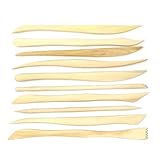
- Package included: 10 x Clay Sculpture Tools
- Length: approx. 15.5cm/6.1inch; Material: wood
- "Smooth surface, comfortable to hold"
- "Used for cutting, carving, modeling, shaping, smoothing, decorating, etc"
- "Suitable for all skill levels, whether professional or beginner"
Rank #4
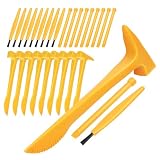
- Realistic and Fun Experience: With realistic look, this kit allows you to experience the joy of discovery through imaginative play,Perfect for classroom science projects or birthday party favors this 10 set excavation tool kit ensures every child has their own hammer chisel and brush for a collaborative archaeology experience. Hammers Size: 15.50X5.30X1.80cm/6.09X2.08X0.71in -Chisel Length: 9.00cm/3.50in-Brush Length: 9.00cm/3.50in
- STEM Learning Resource: Authentic Science Exploration Boost interest in geology and paleontology through hands-on play as these fossils digging tools help children develop patience and fine motor skills while discovering hidden treasures in any excavation kit or gem mine
- Durable Construction: Enhanced Digging Performance Made from PVC material our sturdy tools are designed to withstand repetitive striking against plaster or clay blocks providing a more realistic and satisfying fossil dig simulation for young explorers
- Compact and Portable: A right size for little hands to enjoy the imaginative play of real working toy tools. these accessories are specifically scaled for small hands to improve coordination and control during delicate mineral or dinosaur bone recovery missions, Universal Dig Kit Replacements An ideal replacement set for any dinosaur fossil or gemstone dig kit
- Educational Gift Solution: Aspiring Young Scientists An inspired choice for birthdays or holiday surprises this 10 set archaeology kit is the ultimate gift for boys and girls aged 3 and up who are fascinated by paleontology and history providing parents and educators with a high quality hands-on that sparks lifelong curiosity and a passion for STEM discovery
Which method answers which question?
| Evidence or method | Question it can answer | Important qualification |
|---|---|---|
| Wood anatomy and species identification | What kind of wood is present? | Diagnostic features must survive and be observable. The French Ministry of Culture and Natural History Museum Vienna describe these approaches in their wood-research pages. |
| Morphology and traceology | How was the wood shaped, worked, or damaged? | Researchers must distinguish human working from biological traces and later damage. See the French Ministry of Culture glossary. |
| Residue plus use-wear | What material or action may have been involved in use? | Experimental comparisons support an inference; an individual trace is not necessarily unique. See Hardy and Garufi’s 1998 study. |
| Dendrochronology | When did measured rings grow, and sometimes when was the tree felled? | It requires measurable rings and a suitable reference chronology; a felling year requires the outer edge. See the Vienna museum and Rijksmuseum. |
| Radiocarbon dating | What age does the sampled organic material indicate? | The result concerns the sample and its interpretation; the sources do not establish one protocol for every tool. See Historic England. |
How archaeologists build a defensible interpretation
- Establish what survives. Record the wood, any other components, the object’s shape, and the condition of surfaces and edges.
- Identify material and working evidence. Examine anatomical features, construction, and traces, considering natural and later damage as alternatives to human marks.
- Choose a dating question. Decide whether the aim is to date tree growth, a felling event, sampled organic material, or the archaeological context; those are related but distinct targets.
- Match method to evidence. Use ring measurement when rings can be measured and a suitable chronology exists; consider radiocarbon where appropriate to the sample and question.
- Report the result precisely. State what was dated and distinguish a tree-ring or sample result from the manufacture, use, or deposition date of the tool.
Product prices and availability are accurate as of the date/time indicated and are subject to change. Any price and availability information displayed on Amazon at the time of purchase will apply.

