
The Tool Desk
Outbyte PC Repair FREERepair Windows errors before they cause bigger problemsFix Now →Outbyte Driver Updater FREEFix the driver behind crashes, sound loss and screen glitchesFind Drivers →The safest way to back up a large hard drive collection is to keep separate copies on different devices, store at least one copy off-site, and test that you can restore files. A second folder or partition on the original drive is not a backup: the same drive failure, theft, or corruption can take out both copies.
Build a backup plan with independent copies
A useful starting point is the 3-2-1 approach: keep three copies of your data, on two devices or types of media, with one copy off-site. Backblaze describes this as a common backup framework; it is not a regulatory requirement. Backblaze’s explanation of the 3-2-1 approach outlines the idea.
For a hard drive collection, think of the copies as:
- Primary copy: The drives you normally use.
- Separate local copy: A backup on another physical device, such as an external drive or a NAS.
- Off-site copy: A backup kept at another location, such as a properly vetted cloud service or a rotated drive stored elsewhere.
These copies address different risks. A separate device helps if the original drive fails; an off-site copy helps if theft or a local disaster affects equipment stored together. A NAS can add a separate device on your network, but a NAS that remains continuously accessible is not, by itself, an offline or off-site copy.
Free tools Windows power users keep installed
One-click scans. No signup required.
#1 Best Overall

- SATA DRIVES ONLY — 2.5in & 3.5in: Works with SATA I/II/III hard drives and SSDs. Does NOT support IDE/PATA, M.2 NVMe, M.2 SATA, SAS, or drives already in a USB enclosure. Check your drive's connector before ordering — a bare SATA drive has a wide flat L-shaped edge connector, not a ribbon cable or a small M.2 gold-finger card.
- USB TYPE-A HOST CABLE — NOT A USB-C PORT: The included host cable ends in USB Type-A and plugs into a USB 3.0 Type-A port. If your computer has only USB-C ports, you will need a USB-C to USB-A adapter, which is not included. For stable operation plug directly into the computer — USB hubs and USB 2.0 ports may cause intermittent disconnections.
- REAL-WORLD SPEED, NOT INTERFACE MATH: USB 3.0 with UASP support (UASP-capable host required). Typical mechanical HDD transfer speeds are 100-160 MB/s, which is the drive's own limit, not the port's; SSD speeds vary up to the USB interface maximum. Backward compatible with USB 2.0 and USB 1.1.
- 12V POWER ADAPTER INCLUDED — REQUIRED FOR 3.5in DRIVES: A 12V/2A AC power adapter is in the box and a wall outlet is needed. 3.5in HDDs cannot run on USB power alone — without the adapter the drive will fail to spin up or drop out during use. 2.5in drives are generally bus-powered, but the adapter is recommended for stability.
- PLUG AND PLAY, TOOL-FREE, HOT-SWAP: No drivers on Windows 10/11, macOS, or Linux. Lay-flat bay accepts a bare drive without tools, swaps without rebooting, and an LED shows power and activity. Note: S.M.A.R.T. diagnostics are not passed through the USB bridge, and on macOS a drive may need remounting after sleep. Drive not included.
Measure the collection before choosing storage
Inventory what needs protection
Measure the used space across the collection and identify which files are unique and which are duplicates. Decide whether you need to preserve every drive as-is or only selected files. This helps you estimate the storage required and avoid paying to retain material you do not intend to protect.
Allow for growth and retained versions
Choose backup capacity based on the data you plan to protect, expected growth, and any historical versions you want to retain. There is no universal capacity threshold in the available guidance: the right size depends on your collection and retention plan.
Rank #2
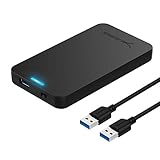
- Tool free design, easy to install,Transfer Rates Up to 480 Mbps when connected to a USB 2.0 port,Transfer Rates Up to 5 Gbps when connected to a USB 3.0 port.
- Suitable for 2.5” SATA/SSD;Supports Standard Notebook 2.5″ SATA and SATA II Hard drives
- Optimized for SSD, Supports UASP SATA III,Backwards-Compatible with USB 2.0 or 1.1
- Hot-swappable, plug and play, no drivers needed
- Operating System:Supported Operating Systems:Mac,Windows;Supported Windows Versions :Windows 7, Windows 8, Windows Vista, Windows XP; Supported Mac Versions: Mac OS X and Higher
Similarly, the cited authorities do not establish a universal consumer hard-drive lifespan or replacement interval. Keep redundant copies and monitor drive health rather than relying on an assumed age at which every drive should be replaced.
Choose where each copy will live
Compare the practical trade-offs before settling on a setup. A local drive can make restores quick, while an off-site copy protects against events that affect the whole location. Cloud backup avoids transporting a drive but depends on upload and download capacity, provider terms, and ongoing service costs.
What’s actually slowing this PC down?
Pick the symptom - the matching free tool is one click away.
Rank #3

- Feature - BENFEI Type-C/Type-A 2.5 inch Hard Drive Enclosure easily hook up your 2.5 inch SATA I/II/III hard drive to transfer files from one PC to another PC, laptop, PS4 or as a USB external hard drive.
- Speed - Up to 5 Gbps data transfer rate with supports UASP SATA III transmission protocol, which is 70% faster than traditional USB3.0. Backward compatible with USB 2.0 or 1.1 ports.
- Design - With USB Type-C/Type-A plug design, provide a easy connection option to laptop/phone/pad. Tool free installation, Plug & Play, No driver needed for this SATA enclosure. Just push out the cover, plug in the drive, close the cover and go. Hot-Swappable.
- Compatibility - BENFEI Hard Drive Enclosure supports Windows, LINUX, MacOS 8.0, and above. Specifically designed for 7/9.5mm thick, 2.5 inches, 6TB HDD & SSD. Compatible with Western Digital, Seagate, Toshiba, Samsung, Kingston, Crucial, Hitachi, and more.
- Warranty - Exclusive BENFEI Unconditional 18-month Warranty ensures long-time protection of your purchase; Friendly and easy-to-reach customer service to solve your problems timely.
| Option | What it can provide | What to evaluate |
|---|---|---|
| External drive | A separate local backup destination; easy to disconnect between sessions. | Usable capacity, expected growth, retained versions, connection and restore time, and how you will store it safely. |
| NAS or other separate device | Another device on your local network that can hold a backup. | Capacity and expansion, maintenance, access controls, retention, and whether another copy is offline and off-site. A continuously accessible NAS alone does not provide those protections. |
| Rotated offline drives | A way to keep a backup disconnected and store a copy at a separate location. | How often you rotate and update drives, where each is stored, and how quickly you could retrieve and restore from one. |
| Cloud backup | An off-site copy without physically transporting a drive. | Upload and full-restore time, recurring cost, retention and versioning, encryption and key recovery, and the provider’s access and deletion controls. |
No option is universally best. You can combine them—for example, a local external drive for routine restores and an off-site copy for local disasters. Seagate advises making a second copy on another medium when moving data from an internal drive to external storage. Seagate’s backup guidance explains this precaution.
Keep local backups isolated when not in use
Disconnect a removable backup drive when a backup is not running. CISA warns: “Avoid leaving the external drive connected when not actively backing up your data as the connection could be used by ransomware to gain access to the drive and delete or corrupt your backups.” See CISA’s backup guidance for its recommendation to keep external drives disconnected between backup sessions.
Rank #4

- 5 Gbps High-speed Transfer: CLAVOOP 3.5 hard drive enclosure supports UASP protocol for faster data transfer over USB 3.0, with tested read speeds up to 336 MB/s. Actual performance may vary depending on your device's capabilities
- Latest Design: Lay-Flat dock station 3.5 external hdd enclosure made from sturdy ABS material with a unique circular top, large ventilation holes, and four non-slip pads to ensure stable and cool operation
- Humanized Design: 3.5 hdd enclosure case built-in shock-proof sponges protect your drive; LED indicators show the 3.5 external hard drive enclosure working status; Auto-sleep function helps save energy—wake the drive with the power button; Plug and play, no tools or drivers required
- Wide Compatibility: HDD Enclosure 3.5 works with 3.5"/2.5" SATA I/II/III HDDs and SSDs up to 20TB to a PC, laptop, and other devices. Compatible with Windows 9/8/SE/ME/2000/XP, Mac OS 8.6 or latest version, Linux, ChromeOS, and gaming consoles like PS5, PS4, Xbox One, and more. (Note: Not compatible with IDE, mSATA, M.2 drives; System compatible hard disk format details see figure)
- Packing List: USB 3.0 to 3.5 sata hard drive enclosure x1 (include 12V/2A DC power adapter x1, USB 3.0 data cable x1, User manual x1); Please confirm your hard drive type before purchasing
Encrypt backups that contain sensitive information. Store recovery credentials separately and securely; encryption is only useful if you can recover the key when needed. CISA recommends offline, encrypted backups of critical data and regular checks of their availability and integrity. CISA’s backup-options guidance also explains why a copy on the same internal drive remains exposed to the same damage, theft, and corruption risks—and why rolling copies can carry corruption or malware forward.
Independent reader supportYour contribution helps us test, update, and keep practical guides available for everyone.Set a schedule and verify restores
Back up as often as the collection changes
Choose a schedule that reflects how frequently new or changed files appear and how much recent work you could afford to lose. The cited guidance does not prescribe one cadence for every collection. For a rotating-drive setup, keep track of when each drive was last updated so an off-site copy does not quietly become stale.
Best Value
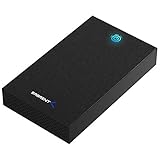
- SATA-Only Compatibility: Fits 2.5" and 3.5" SATA HDDs and SSDs. NOT compatible with SAS, M.2 NVMe, M.2 SATA, NVMe PCIe, or IDE/PATA drives. Note: some 4TB+ 3.5" drives with non-standard PCB height may not seat correctly — verify your drive's physical dimensions before purchasing.
- Tool-Free Setup: Slide, click, and go—no tools or screws needed. Swap drives in seconds without hassle.
- USB 3.0 (USB-A) with UASP: USB Type-A host connection — a USB-C to USB-A adapter is required if your computer only has USB-C ports (not included). Transfer speeds up to 625 MB/s theoretical maximum; typical real-world speeds are 100–180 MB/s for HDDs and up to 400–500 MB/s for SSDs.
- External Power Required: Includes 12V/2A AC power adapter — a wall outlet is needed (not bus-powered via USB). Aluminum shell with internal ABS shock-absorbing tray for durability and heat dissipation.
- Plug & Play — Windows 10/11, macOS & Linux: No drivers needed. LED indicates power and activity status. Note: S.M.A.R.T. diagnostics are not accessible through the USB bridge. Hard drive not included.
Test that files can actually be recovered
- After setting up the backup, select representative files and folders from different drives or parts of the collection.
- Restore them to a separate location rather than checking only that the backup job reported success.
- Open the restored files with the appropriate applications and confirm that their contents are usable.
- For important archives, use checksums or the backup system’s verification feature where suitable to check integrity.
- Repeat restore checks periodically and after significant changes to your backup software or hardware.
CISA recommends regularly testing backup availability and integrity through a disaster-recovery scenario. NIST SP 1800-25 identifies backups, secure storage, integrity checking, audit logs, vulnerability management, and maintenance as methods to help protect data against integrity attacks. Read NIST SP 1800-25.
Write down how to recover
Keep a short recovery note somewhere accessible even if a computer or one drive is unavailable. Record which drive or service holds each copy, what software is needed, where encryption keys or credentials are stored, and the basic restore steps. Review the note when you change drives, software, or services.
Drive statistics can provide context, but not a replacement schedule for your own collection. Backblaze reported a 1.36% annualized failure rate for its observed data-center drive population in 2025. That figure is not a consumer drive-lifetime forecast and should not be generalized to an individual archive drive. Backblaze’s 2025 drive statistics describe the population behind that figure.
Quick Recap
Product prices and availability are accurate as of the date/time indicated and are subject to change. Any price and availability information displayed on Amazon at the time of purchase will apply.

