
What’s actually slowing this PC down?
Pick the symptom - the matching free tool is one click away.
The U.S. Space Development Agency (SDA) develops and fields the Proliferated Warfighter Space Architecture (PWSA), a planned network of satellites and supporting systems in low Earth orbit for defense missions. Its layers describe capabilities—not necessarily separate satellite fleets: Transport moves data, Tracking and Custody supply threat and target information, and Battle Management helps task and distribute that information.
What is the Space Development Agency?
The Space Development Agency is a U.S. defense agency responsible for developing, fielding, and operating the PWSA. SDA describes the architecture as a proliferated low-Earth-orbit system intended to provide space-based capabilities for terrestrial missions and the joint warfighter. Its About Us page and agency overview describe the agency and its mission.
In practical terms, SDA is building an interconnected set of space and ground capabilities rather than relying on a single satellite to do every job. The architecture’s functions include communications, sensing, command and processing, navigation, and ground support.
What does “layer” mean?
SDA defines a layer as “a particular function of the architecture that delivers or enables a warfighting capability.” A layer is therefore a functional category, not a promise of a dedicated constellation. For example, Battle Management software and processing may be hosted on satellites that also serve other PWSA layers, rather than residing on a separate Battle Management fleet. SDA explains this distinction in its FAQ.
Outdated Drivers Are Slowing You Down
One free scan finds every outdated or missing driver and matches the right update for your exact hardware.Free scan · exact hardware matchPC Slower Than It Used to Be?
A free scan shows the junk files, broken settings and background clutter dragging Windows down - then fixes them in one click.Free scan · Windows 10 & 11#1 Best Overall

- 🛰️Solar - Powered Fun with Rotating Satellite🛰️The rotating satellite in this 3D wooden puzzle adds an exciting element to the toy. Without the need for batteries,this assembly building kit can rotate smoothly and quickly even in weak light. Kids can enjoy the fun of seeing the satellite spinning after they complete the assembly.
- 🛠️DIY Assembly for Kids' Skill Development🛠️The solar science kit offers a great DIY experience for kids. As they assemble the rotating satellite model, it helps to develop their hands - on ability, their patience、concentration and logical thinking are also improved during the assembly.Through this process, kids can gain a sense of accomplishment, and it's a great way for them to explore and learn about science.
- ✨Educational and Scientific Value✨This STEM Educational science model kit is a great educational tool. Kids can learn basic science concepts while assembling. It promotes understanding of solar power in a hands - on way, stimulating kids' interest in science and technology, and laying a foundation for future learning.
- 🛸Parent-Child Bonding Space Mission🛸Team up for cosmic connection! This STEM toy kit becomes family quality time – parents guide young engineers to assemble the satellite model 🚀👨👩👧👦. Watch teamwork orbit around solar science learning and 3D puzzle solving!
- 🌟Multi - Scenario Applications🌟This Assembly 3D Building Toy has multiple uses. It's a wonderful source of entertainment, providing hours of fun. This 3D craft kit also doubles as a home decor item. In the classroom, it serves as a practical tool for teaching science concepts, making learning more interesting.Even on the car's dashboard as a front - end decoration, it looks great.
How do the satellite layers work together?
The layer names describe different jobs in a shared architecture. Sensing and data fusion can produce threat or target information; Transport is intended to move data across the network; and Battle Management supports tasking, mission command and control, and dissemination. Navigation, ground infrastructure, and future technology work support the larger system.
This is SDA’s intended architecture flow, not proof that every link is already operational or a guarantee of a particular response time or performance outcome.
Rank #2

- Arouse Curiosity - Flying into space and stepping on the land of the moon, every kid has such a space dream, right? Our toy rocket comprise all kinds of realistic model that fulfill your kids' |curiosity in space. Get ready for an out-of-this-world adventure with our rocket ship toy
- Creative Mounting - Astronauts travelled on the space rover and landed in outer space! Rocket is ready to go in the launch tower, and with a command they shoot straight up into the sky that looks absolutely stunning. These detachable space exploration toys, foster more interest for space exploration
- 6 in 1 Space Adventure Series - Featuring a round pointed rocket with a launch tower, a fearless silver-faced astronauts, a cool space rover, two types of satellites. Let your imagination run wild and cultivate the hands-on ability with this kids space toys
- Premium & Safe - Feel at ease to use our rocket toys for kids that is made of ABS material, safe for kids, Space-themed designs providing endless creative possibilities, allowing for easy disassembly and reassembly, which caters to the children's needs and preferences
- Desirable Present Choice - This space stem toys are the perfect present for kids miniature and lightweight, creating the perfect space experience, might feel like being in a real space scene, and also promotes parent-child interaction
Transport: moving data
The Transport Layer is intended to form a mesh network of communications satellites linked to one another, other space vehicles, and ground stations. SDA describes optical intersatellite links (OISLs) as part of this network. Its purpose is resilient, low-latency military data and communications connectivity. In the overall flow, Transport is the data path that can carry information between space assets and toward ground users.
Tracking: detecting and following missile threats
The Tracking Layer is designed to provide global indications, warning, tracking, and targeting for advanced missile threats, including hypersonic missile systems. It supplies threat-related observations for the architecture’s broader mission. SDA’s layer descriptions are available through its FAQ.
Do these 3 things before closing this tab:
1Scan for outdated or missing drivers - takes under a minute2Repair Windows errors before they cause bigger problems3Fix the driver behind crashes, sound loss and screen glitchesRank #3
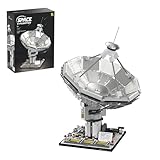
- 【Space Exploration Fun】 Build a detailed radio telescope and satellite communication base, ideal for space lovers and aspiring engineers.
- 【STEM Learning Tool】 This building set encourages STEM skills, enhancing creativity, problem-solving, and critical thinking in kids and adults alike.
- 【Perfect Holiday Gift】 A fantastic Christmas gift for kids (8+), teens, and adults who enjoy space-themed toys, puzzles, and architectural models.
- 【Realistic Design】 With intricate details, this model captures the essence of a space communication base, making it an impressive display piece once completed.
- 【Educational and Entertaining】 Not only fun to build, but also a great way to spark an interest in space exploration and science for all ages.
Custody: maintaining track of time-sensitive targets
Custody is intended to provide 24/7, all-weather custody of time-sensitive targets. SDA describes this function as drawing on multiple SDA and partner constellations, multiple sensing modalities, on-orbit data fusion, and low-latency data transport. Custody is thus a broader function than simply placing one sensor in orbit: it depends on sensing, combining information, and getting that information where it is needed. See SDA’s Custody overview.
Battle Management: tasking and distributing information
Battle Management provides architecture tasking, mission command and control, and data dissemination. It helps manage how the architecture is used and how information is passed along. Because its software and processing may be hosted on satellites in other layers, Battle Management is a clear example of why a layer should not automatically be read as a separate fleet.
Rank #4

- 🚀 15PCS SPACE SHUTTLE SET: This kit consists of 3 rocket, shuttle, 2 astronaut models, moon lander, satellite, launch base period, gas vehicle, armored vehicle, trailer, and flag. Many of the space vehicles are removable and the astronauts are movable, so kids can role-play their cosmic adventures!
- 🚀 DIE CAST METAL SPACE SET: This set for kids is exquisite and a great addition to your outer space collection. Made of sturdy die-cast material and preferred plastics, space rockets model with astronauts is sure to give children hours of imaginative play.
- 🚀 DETACHABLE SHIP TOY: Its innovative design can be disassembled and reassembled, offering hands-on exploration and endless creative possibilities. Kids can use their imagination to disassemble and reorganize these space ships toys to build their own space base!
- 🚀 MAKE LEARNING A BLAST: This spaceship toy is the perfect way for kids to learn about aerospace! With a variety of flexible spacecraft and astronauts, toys for kids 3-5+ provide a great way for children to learn about space exploration, knowledge and imagination.
- 🚀 UNIQUE GIFT FOR KIDS: This assemble space set is the perfect educational toy gift for any child interested in science and the universe! It is the premium choice of gift for kids on birthdays, Christmas, Thanksgiving, Easter and other holidays.
Navigation: an intended GPS-independent capability
SDA describes Navigation as a GPS-independent navigation capability using optical inter-satellite ranging and optical space-to-ground links. It is a planned function of the architecture; the description should not be taken as evidence that a complete operational service is already available.
Ground & Launch: supporting the space architecture
Ground & Launch covers integrated, resilient ground infrastructure intended to support the space architecture. Satellites need ground systems to support operations and connect space capabilities with users and other parts of the mission.
Best Value

- This Space Mission toy set includes a Boeing 747 and a space shuttle, offering authentic representations of iconic spacecraft from both past and present.
- Each toy is individually packaged, making it perfect for gifting or collecting.
- Designed to inspire imaginative play, allowing kids to recreate space missions and aircraft journeys.
- Ideal for children ages 3 and up, encouraging both learning and fun through hands-on play.
- Great for space and aviation enthusiasts, helping to foster an interest in science and exploration.
PWSA Futures: developing later capabilities
PWSA Futures develops and matures mission concepts and technologies that may transition into future tranches. The word “may” matters: a concept or technology under development is not the same as a fielded capability.
Independent reader supportYour contribution helps us test, update, and keep practical guides available for everyone.What are PWSA tranches, and what does spiral development mean?
SDA calls each generation of the PWSA a “tranche.” Its spiral-development approach is intended to deliver capability incrementally in two-year tranches, with each iteration improving on earlier ones and adapting to changes in threats and technology. SDA’s FAQ describes Tranche 0 as a feasibility demonstration, Tranche 1 as initial warfighting capability, Tranche 2 as enhanced capability, and later tranches as continued improvement.
SDA’s overview says it will deliver “a minimum viable product – on time, every two years- by employing spiral development methods, adding capabilities to future generations as the threat evolves.” That is the agency’s stated approach and ambition, not an independently verified schedule record. A tranche label or roadmap description also does not by itself establish that a capability has been launched or is operational.
What is the latest reported Tranche 1 and Tranche 3 status?
The milestones below are distinct: an award is not a launch, and an on-orbit count is not automatically a count of operational satellites. These figures are SDA program announcements, not independent measures of system performance.
| Program item | SDA-reported status |
|---|---|
| Tranche 1 vehicles on orbit | On July 16, 2026, SDA reported 63 Tranche 1 space vehicles on orbit. |
| Planned completed Tranche 1 configuration | In the same July 16, 2026 release, SDA described a planned completed constellation of 154 operational space vehicles: 126 Transport Layer satellites and 28 Tracking Layer satellites, plus four missile-defense demonstration vehicles. |
| Accelerated Tranche 3 Tracking Layer awards | On July 13, 2026, SDA announced two agreements totaling approximately $1.75 billion for 36 vehicles across four orbital planes. The announced mix was 18 missile-warning/missile-tracking variants and 18 missile-defense variants. This was an award announcement, not a report that those vehicles were on orbit. |
The figures and their status descriptions are from SDA’s July 16, 2026 Tranche 1 launch release and July 13, 2026 Tranche 3 award release.
Quick Recap
Product prices and availability are accurate as of the date/time indicated and are subject to change. Any price and availability information displayed on Amazon at the time of purchase will apply.

