
Free tools Windows power users keep installed
One-click scans. No signup required.
Nuclear power has a much higher annual capacity factor than wind or solar in the United States, but that does not by itself prove it is more dependable during every grid emergency. A useful comparison asks how much power each resource can contribute during local periods of stress, how long that stress may last, and how the resources work together with the rest of the grid.
What does “reliable” mean in a power-grid comparison?
Reliability is a system outcome, not a single-generator statistic. For this comparison, the key question is whether the grid has enough available supply to meet demand across the conditions planners must prepare for. The U.S. Department of Energy (DOE) describes this as resource adequacy and emphasizes that regional conditions, supply and demand all matter.
Three terms help separate commonly confused ideas:
- Capacity factor is actual generation divided by the maximum possible generation over a period. It describes how much a plant or fleet produced relative to its potential, not whether it will be producing at the exact hours the grid is under the most strain.
- Capacity contribution, or capacity credit, estimates how much a resource can dependably contribute toward meeting demand during high-stress periods. It depends on the resource’s output profile, local demand, other resources and the season. Thermal generators also have outage and derating risks.
- Dispatchability describes the ability to adjust output in response to system needs. Wind and solar output depends on weather, while dispatch decisions also reflect cost, generator operating characteristics and transmission constraints. Dispatchability matters, but it does not alone determine reliability.
DOE has warned that traditional resource-adequacy tools do not fully capture today’s reliability risks. Comparing resources therefore requires more than ranking their annual output or asking whether they can be dispatched.
What do recent U.S. capacity factors show?
DOE’s March 2025 article reports U.S. 2024 capacity factors of more than 92% for nuclear, 34.3% for wind and 23.4% for solar. Those figures show that nuclear plants generated a larger share of their potential output over the year. They are not probabilities that a resource will avoid an outage, nor do they measure dependable output during a particular peak hour.
#1 Best Overall

- [Ideally Output of 9.36KWH] The power of 9.36KWh per day under 4 hours full sunshine by the 2340W solar panel system, very suitable for home, shed, cabin, farm or other energy backup, and it will provide enough power for portable ac, air condition, TV, refrigerator, coffee maker, microwave and other AC 240V (split-phase)devices.
- [Inverter Parallel Supportable] 10KW max continuous output.Parallel up to 6 unitsfor 60kw output power,120V/240V AC output to meet the power needs of your home's high-power appliances,and come with wifi module.The off-grid inverter has passed UL 1741 certification, and the product meets high industry standards in terms of safety, performance, and market access.
- [Real-time Battery Monitoring] ECO-WORTHY 48V(51.2V) Server Rack Battery supports CAN/RS485 for seamless communication,you can also easily monitor your battery’s status through the mobile app, which supports both Bluetooth and WiFi connections. .UL1973 | UL9540A | CEC- Completed comprehensive testing by Intertek and has officially earned two key North American safety certifications.And has met the standards set by the California Energy Commission,The outstanding performance of ECO-WORTHY products in design, electrical safety, and thermal runaway management, effectively ensuring the safety of your energy storage projects.
- [N-Type 18BB High-Efficiency Solar Cells]The newly upgraded 195W N-Type solar panel measures 58.86×26.18×1.18 inches and achieves a high conversion efficiency of 25%. Its 18 busbar design enhances conductivity, while double-sided generation delivers up to 100Wh of additional energy daily. With IP68 waterproof rating, tempered glass, and corrosion-resistant materials, it ensures a 30-year lifespan.
- [Segmented Charing/Discharging]3 output modes: mains priority and, battery priority, PV priority; uninterrupted power supply. Available in 4 charging modes: Only Solar, Mains Priority, Solar Priority and Mains & Solar hybrid charging. Set a flexible time period for mains charging/discharging according to the local mains condition, and help you save the mains.
| Resource | U.S. 2024 capacity factor reported by DOE | What the figure does—and does not—tell you |
|---|---|---|
| Nuclear | More than 92% | Shows high annual utilization; does not establish availability in every high-stress period. |
| Wind | 34.3% | Shows annual output relative to potential; does not indicate the local contribution at peak demand. |
| Solar | 23.4% | Shows annual output relative to potential; does not indicate the local contribution at peak demand. |
These are U.S. annual figures for 2024, not values to apply automatically to another country, region or future year. Capacity factor is useful for describing realized output or utilization, but capacity contribution is the more relevant measure when asking how a resource helps meet demand under stress.
How much dependable capacity can wind and solar provide?
Wind and solar are not equivalent to zero dependable capacity. Their capacity contribution varies with location, the timing of demand and the output of other resources. In its 2024 report, DOE cites North American Electric Reliability Corporation (NERC) estimates for summer on-peak capacity contribution ranging from 12% to 47% for wind and 40% to 99% for solar across reliability regions.
Rank #2

- System Components:Delivers up to 10kW power output with 120V/240V single-phase split-phase support, making it suitable for smoothly running common household appliances. The system includes 5 × 590W solar panels with a total PV capacity of 2950W, capable of generating up to 11.8 kWh per day under optimal conditions, along with one 48V 314Ah portable LiFePO₄ battery offering 16.1 kWh of energy storage. Complete with necessary cables, this all-in-one solar solution is designed for convenient setup and reliable home power support.
- Upgraded Integrated Battery:ECO-WORTHY 48V 314Ah lithium battery combines advanced safety, high capacity, and smart system compatibility. It features a PACE 200A Battery Management System with multi-layer protection and dual breakers for reliable circuit safety. With a 16.076 kWh energy capacity and support for up to 15 units in parallel (up to 241 kWh), it delivers scalable and dependable power. A 7-inch full-color display, along with Bluetooth, Wi-Fi, and PC connectivity, enables convenient real-time monitoring. Designed to work seamlessly with mainstream inverters via RS485 and CAN communication, the battery also includes built-in wheels and handles for easy installation and mobility
- Keep Home Running 10kW:ECO-WORTHY 10kW AIO solar charge inverter features 48V DC pure sine wave output with 120V or 120V/240V split-phase support, delivering 10,000W continuous power and up to 20,000W peak output. Equipped with dual MPPT controllers, up to 200A battery charging, built-in WiFi monitoring, multiple charging and output modes, time-slot energy management, and comprehensive protection functions, it is compatible with AGM, Gel, Flooded, and lithium batteries, supports battery-free operation, and allows parallel connection of up to six units
- High Power Solar Panel:590W Mono-crystalline Solar Panel (Black). Low power loss in cell connection compared to conventional modules. Improved shading tolerance. Lower internal current, lower hot spot temperature. Heat-strengthened glass minimizes micro-crack impact.
- Shipping Notice: Due to its large size and weight, the 5pcs 590W solar panel/1pc 48V 314Ah battery is securely packed and shipped on a pallet using a truck to ensure safe transportation. Please ensure your delivery address can accommodate truck deliveries.
Those wide ranges are regional estimates, not universal guarantees or a forecast for every grid and year. A resource’s capacity credit depends in part on whether its generation profile aligns with demand and with the output profiles of other resources, especially during high-stress periods such as peak-demand hours. A solar-heavy system, for example, should be evaluated using the hours when its own system faces stress—not an assumption that a national estimate applies locally.
Is nuclear power always available?
No. Nuclear plants generally operate near capacity, but they reduce output for refueling, typically every 18 to 24 months. The U.S. Energy Information Administration says refueling outages mostly occur during lower-demand fall and spring periods. That timing can reduce conflict with seasonal peaks, but it does not make nuclear output literally constant or eliminate the need to account for outages.
Rank #3

- System Components:Delivers up to 10kW power output with 120V/240V single-phase split-phase support, making it suitable for smoothly running common household appliances. The system includes 18 × 590W solar panels with a total PV capacity of 10620W, capable of generating up to 39.36 kWh per day under optimal conditions, along with two 48V 314Ah portable LiFePO₄ battery offering 32.2 kWh of energy storage. Complete with necessary cables, this all-in-one solar solution is designed for convenient setup and reliable home power support.
- Upgraded Integrated Battery:ECO-WORTHY 48V 314Ah lithium battery combines advanced safety, high capacity, and smart system compatibility. It features a PACE 200A Battery Management System with multi-layer protection and dual breakers for reliable circuit safety. With a 16.076 kWh energy capacity and support for up to 15 units in parallel (up to 241 kWh), it delivers scalable and dependable power. A 7-inch full-color display, along with Bluetooth, Wi-Fi, and PC connectivity, enables convenient real-time monitoring. Designed to work seamlessly with mainstream inverters via RS485 and CAN communication, the battery also includes built-in wheels and handles for easy installation and mobility.
- Keep Home Running 10kW:ECO-WORTHY 10kW AIO solar charge inverter features 48V DC pure sine wave output with 120V or 120V/240V split-phase support, delivering 10,000W continuous power and up to 20,000W peak output. Equipped with dual MPPT controllers, up to 200A battery charging, built-in WiFi monitoring, multiple charging and output modes, time-slot energy management, and comprehensive protection functions, it is compatible with AGM, Gel, Flooded, and lithium batteries, supports battery-free operation, and allows parallel connection of up to six units.
- High Power Solar Panel:590W Mono-crystalline Solar Panel (Black). Low power loss in cell connection compared to conventional modules. Improved shading tolerance. Lower internal current, lower hot spot temperature. Heat-strengthened glass minimizes micro-crack impact. [Professional Installation Required]To ensure safety and optimal performance, it is recommended to hire a professional installer. We provide online technical guidance (inquiries are welcome), but installation by non-professional electricians or novices is not recommended, as it may cause safety hazards and a loss of system performance.
- Shipping Notice: Due to its large size and weight, the 18pcs 590W solar panel/2pcs 48V 314Ah battery is securely packed and shipped on a pallet using a truck to ensure safe transportation. Please ensure your delivery address can accommodate truck deliveries.
The relevant comparison is not “nuclear never fails” versus “weather-dependent resources never contribute.” It is how planned and unplanned outages, output patterns and the timing and duration of grid stress affect dependable supply in a particular system.
How should you compare resources for a specific grid?
Use local planning data where possible. A sound comparison examines the same system, planning horizon and reliability conditions for each resource rather than mixing a national annual statistic with a regional peak estimate.
Rank #4
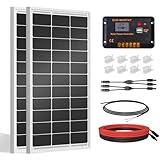
- [Wide Application]: Daily Output 800wh/day under 4 hours full sunshine condition. Perfect for RV, Caravan, Marine, Camper, Electric scooter, Golf Carts, Power wheels, Trolling motor, Tool trailer, Backup power supply for cabin shed home etc.
- [Excellent Performance]: ECO-WORTHY solar panels use high-performance monocrystalline solar cells, which can provide up to 21.5% higher efficiency sufficient light conditions.size:35.2*23.1.37in
- [Durable]: Corrosion-resistant aluminum alloy frame, so that the panel can be used for decades, and can withstand strong wind (2400Pa) and snow load (5400Pa), with a long service life. Ip65 rated junction box provides complete protection.:
- [Complete and Easy]: The back of the pre-drilled and plug-and-play cables allow quick installation, the kit can be connected in series (24V) or parallel (12V) if you need. What you will get: 2 pcs 100W mono solar panel + 2 set of Z mounting brackets + 30A solar controller + 1 pair of 16.4ft 10 awg solar cables + 1 pair of 2-in-1 connectors + 1 pair of 4.92ft tray cable.
- [Support]: 1 year with 24/7 tech support, if any problems or questions about the product,please do not hesitate to let us know through Amazon or call ECO-WORHTY hotline for solution.
- Set the scope. Identify the country, balancing area or reliability region, the planning year, the relevant season and the reliability standard. A U.S. estimate does not establish the capacity value of a resource elsewhere.
- Find the system’s stress periods. Determine when demand is highest and when prolonged stress or difficult seasonal conditions are expected. Compare resource output during those periods, not only across an annual average.
- Compare dependable contribution. Use the local capacity credit or capacity contribution for each resource, including its relationship to demand and to other resources’ generation profiles. Do not treat capacity factor as a substitute for this measure.
- Account for outages and duration. Examine planned and unplanned outage frequency and duration, as well as the magnitude and length of supply shortfalls the system needs to withstand. DOE’s 2025 assessment recommends considering these factors alongside seasonal stress.
- Check flexibility and transmission. Consider how output can ramp or be adjusted, whether transmission can deliver power from other areas, and whether neighboring regions are likely to have supply available at the same time.
- Evaluate the portfolio. Assess nuclear, wind, solar and other available resources together, including storage and its discharge duration where relevant. DOE’s 2024 report emphasizes considering technology options in portfolios; the value of one resource depends partly on what else is in the system.
What is the practical verdict?
For the United States in 2024, nuclear had the highest capacity factor of these three resources, which indicates higher annual utilization. That fact alone cannot settle which resource is more reliable for a particular grid. The answer depends on dependable contribution during local and seasonal stress, outage patterns, resource duration, transmission and the rest of the supply portfolio. A credible comparison uses those system-specific inputs rather than treating a single plant statistic as a verdict.
Quick Recap
Best Value

- COMPLETE OFF GRID SOLAR SYSTEM KIT – 2340W of Clean Power ECO-WORTHY 5KW off grid solar system complete kit includes 12pcs 195W mono solar panels (2340W total), 1pc 48V 5KW off-grid inverter, and 1pc 48V 100AH Cubix lithium battery.Equipped with necessary cables and brackets.
- 12PCS 195W MONO N-Type SOLAR PANELS – High Efficiency & Durable Each 195W monocrystalline solar panel delivers reliable output and is built for roof, ground, or shed mounting. The 2340W solar panel roof kit is ideal for off grid cabins, RVs, homes, and backup power systems.
- 5KW 48V OFF-GRID INVERTER – Stable Power for Off-Grid The 48V 5KW off-grid inverter converts DC power from your solar panels and battery into usable AC electricity. Perfect for powering lights, appliances, TVs, fridges, and other essentials during outages or off-grid living.
- 48V 100AH Cubix LiFePO4 LITHIUM BATTERY – Long-Lasting Storage The 51.2V 100AH server rack LiFePO4 lithium battery offers deep-cycle storage, high safety, and a long lifespan. It stores solar energy for night use and works seamlessly with the included 5KW inverter for whole house storage.
- ECO-WORTHY SOLAR PANEL KIT – Easy Setup & Reliable Support This eco worthy solar panel kit is designed for DIY installation with clear wiring and mounting. Whether you search for solar system, solar kits off grid with battery and inverter, or ecoworthy 5k kit, this complete set is a solid off-grid energy solution.
Product prices and availability are accurate as of the date/time indicated and are subject to change. Any price and availability information displayed on Amazon at the time of purchase will apply.
Recommended Free Tools

