
The Tool Desk
Outbyte Driver Updater FREEFix the driver behind crashes, sound loss and screen glitchesFind Drivers →Outbyte PC Repair FREERepair Windows errors before they cause bigger problemsFix Now →Telescope observations measure the Milky Way as it is today; simulations test how a galaxy like it could have formed. Neither offers a replay of the Galaxy’s history. The strongest explanations come from comparing modeled predictions with survey data in a way that accounts for what telescopes can measure, which stars they observe, and the uncertainty in those measurements.
What can telescope observations reveal?
Telescopes provide measurements of the present-day Galaxy: stellar positions, distances, motions, brightness, and spectra. Those measurements let astronomers map structures and identify patterns that may preserve clues to earlier events. The European Space Agency describes Gaia’s objective as studying the Milky Way’s “content, dynamics, current state and formation history” (ESA Gaia mission science).
Gaia science observations ran from 27 July 2014 through 15 January 2025. Over that period, the mission made more than three trillion observations of two billion stars and other objects, according to the European Space Agency (ESA Gaia mission page). These are repeated measurements, not three trillion different stars.
Stellar motion and chemistry offer different clues
Astrometry—positions, parallaxes and proper motions—helps establish where stars are and how they move. Photometry measures brightness across different bands, while spectroscopy analyzes the light’s wavelengths. Together, these measurements help researchers distinguish stellar populations and study the Galaxy’s structure.
Quick wins for a faster PC:
Clear out junk files and repair common Windows errorsFree Scan →Fix the driver behind crashes, sound loss and screen glitchesFind Drivers →#1 Best Overall

- 【Excellent Optics】Astronomical telescope features 80mm aperture 600mm(f/6.7) focal length-The big aperture can capture more light; high transmission multi-fully coated optical lens can improve light transmittance, reduce the reflection of light. It will bring you more bright and clear images.
- 【Portable & Stable】Our refractor telescope has a backbag, an adjustable aluminum tripod and an upgraded phone adapter. All accessories can be packed into the bag, which is convenient for you to carry and storage for traveling. The tripod is stable and the height can adjust from 17.7" to 52", which is suitable for adults and kids. With the phone adapter, you can take amazing photos through your phone.
- 【Easy to Operate】 This telescope is easy to assemble even for astronomy beginners and kids. You can set up easily with the detail installation manual and video. No tools are required. It’s a great astronomy gift telescope for adults, astronomy enthusiasts, beginners and kids 8-12.
- 【Optimum Magnification】Our telescope for kids and adults is equipped with two replaceable excellent-quality eyepiecesa (20mm and 9mm) for 30X and 66X magnification. A moon filter transmits only 13 percent of the incoming light and improving contrast. Also with 5x24 finderscope, you can locate objects easily. A great option for astronomy lovers to explore the moon, Saturn and Jupiter.
- 【Satisfaction Service】We provide 3 years satisfaction service. If you have any questions about the product and service, please feel free to contact us to get 24-hour technical support from our expert team. Whether observing moon or viewing planets, our telescope can meet your all needs. It’s a great telescope for adults & 8-12 kids & astronomy beginners.
Chemical abundances add another kind of evidence. The GALAH Survey uses stellar spectra to trace elemental enrichment and investigate where stars formed and which merger events may have shaped the Milky Way (GALAH Survey science). Motions and chemical compositions are complementary: a star’s orbit describes how it moves now, while its chemistry can provide clues to its birth environment.
What can formation simulations reveal?
Cosmological simulations evolve modeled matter and galaxies under specified physical processes, including gravity, gas cooling, star formation and feedback. Researchers can use Milky Way-mass simulations to test whether proposed processes—such as mergers—could produce structures resembling those observed (Annual Review of Astronomy and Astrophysics).
Rank #2

- Superior Optics: 400mm(f/5.7) focal length and 70mm aperture, fully coated optics glass lens with high transmission coatings creates stunning images and protect your eyes. Perfect full positive telescope for astronomers to explore stars and moon.
- Magnification: Come with two replaceable eyepieces and one 3x Barlow lens.3x Barlow lens trebles the magnifying power of each eyepiece. 5x24 finder scope with mounting bracket and cross-hair lines inside make locating objects easily.
- Wireless Remote: This refractor telescope includes one smart phone adapter and one Wireless camera remote to explore the nature of the world easily through the screen and take amazing celestial images.
- Adjustable Tripod: This telescope allows for many different viewing positions with a adjustable aluminum alloy tripod and a carry bag, the telescope and tripod can fit inside the bag for easy traveling and storage.
- Satisfaction: Buy with confidence from a leading manufacturer.
A simulation can explore a possible history and show the consequences of its assumptions. It is not a direct observation of the Milky Way’s past, and its results depend on its initial conditions, numerical resolution and prescriptions for physical processes. A simulated galaxy is a modeled counterpart, not the Galaxy itself.
How do astronomers compare simulations with telescope data?
A fair comparison asks what a telescope-like survey would have measured if it observed the simulated galaxy. Researchers can generate synthetic observations from a simulated viewpoint, account for which objects a survey would include, and represent measurement uncertainty. They can then compare those predictions with actual observations rather than comparing idealized model quantities directly with imperfect data.
Rank #3
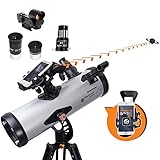
- SMARTPHONE-POWERED SKY TOUR: No experience needed! Just dock your phone, launch the StarSense Explorer app, and follow the on-screen arrows to locate stars, planets, nebulae, and more.
- PATENTED STARSENSE TECHNOLOGY: Unlike other astronomy apps, StarSense Explorer uses sky recognition technology to turn your phone into a celestial navigation system, analyzing star patterns overhead to pinpoint your telescope’s position.
- TONIGHT’S BEST TARGETS, INSTANTLY: The app generates a curated list of the top objects to see based on your time and location. See planets, bright nebulae, galaxies, and star clusters from the city—and even more from dark skies.
- SIMPLE SETUP, SMOOTH TRACKING: Features a manual altazimuth mount with altitude slow motion adjustment with a sliding rod. Follow the on-screen arrows to your target; when the bullseye turns green, you can view it clearly through the eyepiece.
- 114MM REFLECTOR WITH IMPRESSIVE VIEWS: The 4.5" Newtonian reflector with high-reflectivity coatings delivers sharp, vivid views of the Moon, planets like Jupiter and Saturn, and deep-sky favorites like the Orion Nebula and Andromeda Galaxy.
For example, a FIRE study generated nine synthetic Gaia-like surveys from three simulated Milky Way-mass galaxies, using multiple viewpoints from the Sun’s position (FIRE study). A separate Gaia-ESO comparison found that adding scatter to simulated results to mimic observational uncertainty produced more reasonable agreement with observations (Gaia-ESO comparison).
This comparison is informative only when survey selection and uncertainty are handled carefully. A mismatch may indicate a problem with a model, but it can also reflect differences between what the model predicts and what the survey can actually detect or measure.
Rank #4

- Superior Optics: Dianfan astronomy telescope features a focal length of 800 mm and a fully coated 90 mm objective lens. The large aperture gathers more light for brighter, clearer views, high-transmission coatings enhance contrast and color for sharp, vivid images for an enjoyable stargazing experience
- Powerful Magnification: With two eyepieces and a 3× Barlow lens, this telescope offers 32×–240× magnification. It allows you to observe craters and lunar seas on the surface of the Moon. With the 45° zenith mirror, images are upright and correctly oriented for terrestrial viewing, making distant targets details easier to observe. The telescope is ideal for beginners and astronomy enthusiasts
- Quick Setup & Beginner-Friendly: User-friendly design with clear instructions makes assembly simple—ready in about 15 minutes. Smooth focusing helps you quickly locate targets. Perfect for families to enjoy stargazing and explore the night sky together
- Portable & Versatile: Lightweight design with a sturdy stainless steel tripod ensures stable, steady viewing. Easy to carry in the included bag, making it perfect for travel and outdoor adventures. Suitable for stargazing, birdwatching, wildlife observation, and exploring cityscapes
- Professional Astronomical Telescope: The Dianfan 90x800 telescope combines quality , functionality and reliability. It delivers high-resolution views that bring the universe closer. Designed for adults high powered, it inspires interest in astronomy and science while encouraging exploration of the starry sky
What do merger clues say about the Milky Way’s history?
Stellar motions and chemical evidence support a reconstruction in which the Milky Way’s halo and thick disk are linked to more than one process. In a 2020 review, Amina Helmi describes halo-like stars as coming in similar proportions from a heated thick disk and from debris associated with the Gaia-Enceladus merger. The review also reports evidence that the merger may have triggered star formation in the early Milky Way (Helmi, 2020 review).
This is an evidence-based picture, not a complete or uniquely settled account. Reproducing the debris in detail requires tailored hydrodynamical and constrained cosmological simulations, as the review notes. New observations and better-constrained models can refine how particular mergers contributed to the Galaxy’s structure.
Outdated Drivers Are Slowing You Down
One free scan finds every outdated or missing driver and matches the right update for your exact hardware.Free scan · exact hardware matchWindows Errors? Fix Them Before They Spread
Repair common Windows errors and clear accumulated junk for a smoother, more stable PC - no reinstall needed.Free scan · no reinstallBest Value

- BRIGHT, SHARP VIEWS ANYWHERE: Unlike many beginner telescopes, this quality refractor features fully coated glass lenses and a 70mm aperture for crisp, clear views of the Moon, planets, and daytime scenery—all in a lightweight, travel-ready design.
- PERFECT FIRST TELESCOPE FOR BEGINNERS: Designed for adults and kids to enjoy together, this beginner-friendly telescope sets up in minutes and delivers rewarding views with no prior experience required.
- EASY NO-TOOL SETUP: No complicated assembly or tools needed. The full-height tripod and telescope tube set up in seconds and pack neatly into the included backpack—so you’re always ready to observe on the go.
- DUAL EYEPIECES FOR VERSATILE VIEWS: Includes 20mm and 10mm eyepieces for wide and close-up views of celestial and terrestrial targets. Spot craters on the Moon at night or wildlife during the day.
- BONUS BACKPACK AND SOFTWARE: Includes a padded backpack with room for accessories, a finderscope, star diagonal, eyepieces, and a free download of Starry Night software to help you identify celestial objects and plan your next stargazing session.
How should Gaia’s data-release dates be interpreted?
Gaia’s science observations ended on 15 January 2025. The European Space Agency’s page, checked on 7 October 2026, listed Data Release 4 as expected in December 2026, based on 66 months of data, and Data Release 5 as not before the end of 2030 (ESA Gaia mission page). These are planned dates, not guarantees; check the ESA page for current status.
Quick Recap
Which method answers which question?
| Question | Best evidence | What it can establish |
|---|---|---|
| Where are stars, and how do they move now? | Telescope surveys such as Gaia | Measured positions, distances, motions, brightness and spectra, subject to survey coverage and measurement uncertainty. |
| Where might stars have formed? | Spectroscopic surveys, interpreted with motion and other data | Chemical patterns can provide clues to stellar birth environments and enrichment histories; they do not by themselves give a complete record. |
| Could a proposed process produce observed structures? | Formation simulations tested against survey data | Whether a modeled history can produce similar features under its specified assumptions. |
| Which history best fits the Milky Way? | Observations and simulations together | A better-constrained explanation when synthetic observations account for survey selection and measurement uncertainty; not a direct replay of the past. |
Product prices and availability are accurate as of the date/time indicated and are subject to change. Any price and availability information displayed on Amazon at the time of purchase will apply.

