
X-ray crystallography does not photograph atoms. It measures how X-rays diffract when they pass through a regularly ordered crystal, then uses those measurements and a mathematical model to reconstruct electron density and infer the positions of atoms.
How does a crystal turn X-rays into a diffraction pattern?
Repeating order makes the waves interfere
A crystal contains scattering centres arranged in a repeating pattern. When X-rays encounter that ordered arrangement, waves scattered from different parts of the crystal overlap. Depending on their directions, they reinforce one another or cancel. The resulting diffraction pattern records reflections—often seen as spots—with intensities that depend on the crystal structure and the scattering geometry. The International Union of Crystallography (IUCr) explains the basic relationship in its X-ray diffraction educational pamphlet.
Bragg’s law describes the geometry of strong reflections
Strong reflections occur when scattered waves reinforce one another. For planes in a crystal, the condition is expressed by Bragg’s law:
2d sin θ = nλ
- d is the spacing between lattice planes.
- θ is the angle between the incident X-ray wave and those planes.
- λ is the X-ray wavelength.
- n is an integer.
At a matching angle and wavelength, waves scattered by successive planes travel distances that allow them to arrive in step, producing a reflection. Bragg’s law specifies where reflections can occur; it does not, by itself, reveal the complete molecular structure.
What’s actually slowing this PC down?
Pick the symptom - the matching free tool is one click away.
#1 Best Overall
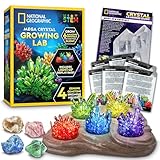
- FAST-GROWING CRYSTALS IN 6 COLORS - Grow blue, red, purple, green, yellow, and glow in the dark crystals! Crystal chemistry has never been so fast (grows in 3 - 4 days), fun, and colorful, making this the perfect educational activity or gift!
- GROWING IS EASY – Easy-to-follow instructions and the 2 included silicone growing chambers make growing your crystals easier than ever!
- NIGHT LIGHT DISPLAY – Show off 5 of your favorite home-grown crystals in the USB-powered (cable included) light-up display! This fun kids STEM activity can help inspire a lifelong love of science and learning.
- INCLUDES REAL CRYSTAL SPECIMENS – Start or expand your rock collection with 4 real gemstone specimens: rose quartz, fluorite, blue calcite, and quartz geode. Learn about the gemstones in the kit with the included full-color Learning Guide.
- AMAZON EXCLUSIVE - Blue Marble has developed this product exclusively for Amazon.
What does a crystallography experiment measure?
In a single-crystal experiment, the crystal is exposed to X-rays and diffraction data are collected across accessible directions. The measurements are reflection intensities. They are evidence about the structure—not a ready-made image of the molecule. The IUCr describes the collection of diffraction data and reflections in its educational explanation of X-ray diffraction.
Each reflection corresponds to a particular direction in reciprocal space, a way of representing the repeating geometry of the crystal. Taken together, the measured reflections provide constraints on the arrangement of scattering matter. Turning those measurements into a map of electron density requires an additional piece of information that the detector does not directly supply: phase.
Rank #2
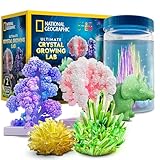
- 5 CRYSTAL-GROWING ACTIVITIES – This ultimate crystal kit lets kids safely grow five unique types of crystals: a mini crystal, a dinosaur-shaped crystal, a glow-in-the-dark crystal, 2 crystal trees, and awesome underwater crystals!
- GLOW-IN-THE-DARK CRYSTAL – Grow a luminous crystal that shines in the dark, making science fun even after the lights go out.
- UNDERWATER CRYSTALS – Kids will love watching 4 vibrant crystals grow right before their eyes in a safe, immersive underwater environment!
- CRYSTAL TREES & DINOSAUR – Grow a sparkling crystal-covered dinosaur figure and 2 colorful crystal trees for an eye-catching display.
- ALL-INCLUSIVE EDUCATIONAL SCIENCE KIT – Includes crystal solutions, crystal-growing stones, display container, dinosaur mold, tree forms, safety gear, kid-friendly instructions & an educational Learning Guide filled with cool facts about crystals!
Why is phase information needed to reconstruct electron density?
A reflection is described by a structure factor, which has both an amplitude and a phase. The measured intensity is related to the amplitude, but routine diffraction measurements do not directly provide the phase. Yet Fourier reconstruction—the mathematical step used to calculate electron density from diffraction data—requires both amplitude and phase.
This missing information is known as the phase problem. Crystallographers use structure-solution methods to estimate or recover phases, then combine them with measured amplitudes to calculate an electron-density map. As the IUCr explains in its discussion of X-ray crystallography, the map is reconstructed from diffraction data; it is not an image captured directly by the experiment.
Free tools Windows power users keep installed
One-click scans. No signup required.
Rank #3

- GROW VIBRANT COLORED CRYSTALS - Grow crystals in 3 amazing colors: blue, purple, and green. With this engaging and educational science experiment for kids, chemistry has never been so fun and colorful!
- NIGHT LIGHT DISPLAY - Show off your crystals on the patent-pending light-up display. With 7 single color modes, rainbow color mode, and 3 brightness levels to choose from, your crystal treasures will shine!
- COMPLETE SCIENCE KIT – Contains all you need! Growing powder, clear seed rocks, growing chamber, light-up display, and easy-to-follow instructions. Our uniquely flexible growing chamber allows you to easily remove your crystals for display without damage!
- START A ROCK COLLECTION – This kit comes with 3 real gemstone specimens, including a geode, green fluorite, and blue calcite, along with a detailed learning guide explaining how crystals grow and more! Makes an excellent STEM gift for boys and girls.
- AWARD-WINNING PRODUCTS - Blue Marble, winner of the Toy Association's prestigious Toy of the Year Award, proudly develops products that foster education, imagination, and creativity, with a U.S. support team to ensure a stellar experience!
How does electron density become a molecular structure?
Interpret the density
Once a useful electron-density map has been calculated, crystallographers interpret its features and propose positions for atoms. The map constrains where atoms can plausibly be placed, but constructing a molecular structure involves interpretation rather than simply tracing a photograph.
Refine the model against the measurements
The proposed atomic model is used to calculate structure factors. Crystallographers compare those calculated values with the observed diffraction data and adjust the model iteratively. This refinement seeks a model consistent with the measurements and the density. Atomic motion and other features affect the density, so it does not necessarily appear as a set of sharp, fixed points.
Rank #4
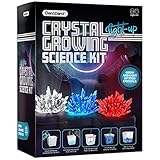
- GROW RED, BLUE AND CLEAR CRYSTALS AND MAKE THEM GLOW: Let your child feel like a real chemist mixing the special ingredients and watching the crystal grow, day by day. And when you're done, display it on the light-up display for all to admire! Follow along with the beautifully illustrated 12-page booklet describing how crystals are formed.
- LET IT GLOW: Growing the crystals is only half the fun. Turn your newly formed crystals into a piece of art by placing them on the included LED Light-up Display and watch the lights burst through the complex crystal formations. It's a truly magical sight at night. (Powered by an included Micro-USB cable).
- KIT INCLUDES: USB Powered LED Light-up Display, Micro-USB Cable, 3 Growing Cups, 3 Crystal Powder Bags (Red, Blue, Clear), 3 Crystal Starters, Mixing Stick, Tweezers, and a gorgeous 12-page instruction and learning guide. Includes everything needed for the young scientist to grow the crystals with ease, and gain a deeper understanding of them.
- FOOL-PROOF SATISFACTION GUARANTEED: This kit has been designed from the ground up to help kids grow beautiful crystals with confidence. With premium ingredients, innovative tools, and a comprehensive step-by-step instruction booklet that adults and children can easily understand and follow, it’s a fun, hands-on activity the whole family can enjoy.
- A FUN AND EDUCATIONAL GIFT FOR ALL AGES: It's not often that a science project can be fun and engaging, but this kit achieves both! It fascinates children as soon as they pull it out of the box and is a perfect STEM project. It fosters a love for science and crystallography in a fun and exciting way.
The final structure is therefore an evidence-constrained model of the crystal: it is inferred from measured diffraction, reconstructed density, and refinement. It should not be described as a direct photograph of atoms.
Independent reader supportYour contribution helps us test, update, and keep practical guides available for everyone.What does resolution tell you about a crystallographic structure?
Crystallographic resolution is tied to the smallest spacing between lattice planes represented by the measured intensities. In practical terms, higher resolution means the data extend to finer spacings, which can make it easier to distinguish neighbouring features in an electron-density map. The IUCr defines resolution in relation to the minimum plane spacing and the measured diffraction data in its crystallographic glossary entry.
Quick wins for a faster PC:
Clear out junk files and repair common Windows errorsFree Scan →Scan for outdated or missing drivers - takes under a minuteDriver Scan →Repair Windows errors before they cause bigger problemsFix Now →Resolution is useful when judging how much detail the data can support, but it is not a complete score for a structure. The interpretation of density and the refinement of the atomic model remain part of determining what the data establish.
Quick Recap
The path from diffraction to a molecular model
- Order: A crystal’s repeating arrangement causes scattered X-ray waves to interfere.
- Measure: The experiment records reflection intensities at accessible diffraction directions.
- Solve phases: Because intensities do not directly provide phase, structure-solution methods estimate or recover it.
- Reconstruct: Amplitudes and phases are used in a Fourier calculation to produce an electron-density map.
- Model and refine: Atoms are placed into the interpreted density, and the model is iteratively checked against the observed data.
Product prices and availability are accurate as of the date/time indicated and are subject to change. Any price and availability information displayed on Amazon at the time of purchase will apply.

