
Free tools Windows power users keep installed
One-click scans. No signup required.
Nearby residents may face months or years of construction noise and truck activity; after a data center opens, cooling and other mechanical equipment can produce continuous, low-frequency noise at some sites. The effects are not inevitable: distance from homes, site and equipment design, construction schedules, road access, and local rules all matter. Available evidence is stronger on construction duration and reported noise than on traffic: it does not establish a typical number of data-center vehicle trips or a routine operational traffic burden.
What changes as a data center is built and operated?
Construction and operation create different kinds of disruption. Construction is temporary in the sense that individual activities end, but a large or phased project can keep work and deliveries going for a long time. Operational noise, by contrast, can be continuous while the facility runs. A proposal or complaint is easier to assess when its phase, source, timing, and location are identified rather than treating every effect as one general “data center impact.”
Construction
Work can include clearing trees, grading, building foundations, erecting structures, and installing equipment. Large projects also bring workers and substantial deliveries. Virginia’s Joint Legislative Audit and Review Commission (JLARC), in its 2024 report chapter on local residential impacts, estimates that one data-center building can take 12 to 18 months to construct and a large campus can take as long as seven years. Concurrent or phased building work may extend the period residents experience disruption.
Construction can mean loud work at the site as well as heavy vehicles on access roads. JLARC recounts residents’ concerns about noise and vehicle activity. In one reported neighborhood example, heavy vehicles damaged the access road and obstructed school buses and emergency vehicles. That is a documented example, not evidence that such damage or obstruction is typical of every project.
What’s actually slowing this PC down?
Pick the symptom - the matching free tool is one click away.
#1 Best Overall

- 【SPECIFICATION】:Dimensions - 12 X 12 X 0.5 inches(cutting tolerance: 2%), pack of 12, covering 11.6 square feet; Material - Polyester Fiber; Density - 9.4lb/ft3; Weight - 0.36 pounds per panel
- 【IMPROVE SOUND QUALITY】: These durable acoustic absorption panels are thickened to more effectively absorb sound energy, reduce reverb, echo and mid high frequency noise; Average absorption coefficient: 0.85; NRC(noise reduction coefficient): 0.97
- 【MULTIPURPOSE】: These sound insulation panels are ideal for sound treatment and decoration on ceiling and wall; Pefect for recording studio, gaming room, home theater, home studio, office, vocal booth, podcast, youtuber and more
- 【ECO-FRIENDLY】: Odorless, Non-toxic, Formaldehyde-free, Class B1 Flame Retardant, Corrosion Resistant, Anti aging, Safe acoustic tiles for indoor use
- 【EASY TO INSTALL】: These sound dampening panels are cuttable and easy to mount using 3M spray adhesive or 3M vhb double sided tape(sold separately)
Operation
Once buildings are in service, cooling and other mechanical systems can create a different sound from construction. JLARC describes data-center noise as potentially continuous and low-frequency, and says it has troubled some neighbors when facilities are near residential areas. Its report also says most facilities do not generate noise complaints, in part because of their location or design. Neither proximity by itself nor the existence of a facility proves that a particular home will experience a nuisance.
What do Virginia’s figures show—and what don’t they show?
JLARC’s 2024 Virginia analysis offers context for two distinct questions: whether residents have regarded operational noise as problematic, and how often data-center properties are close to residentially zoned land. These measures are not a prediction for a particular proposed site.
Rank #2

- High-Efficiency Sound Absorption: These soundproof foam panels for walls provide reliable sound absorption and noise control, featuring an NRC rating of up to 0.95 to efficiently absorb both high- and low-frequency sounds while minimizing echoes and sound reflections. Acoustic wall panels help create a quieter, more comfortable environment for clearer conversations, better recordings, and improved everyday acoustics.
- High Density Material: Crafted from high-density polyester fiber, these slatted soundproof wall panels possess superior density for enhanced sound insulation. Odorless and non-toxic with no harmful emissions, they ensure safe use in any indoor space. The acoustic wall panels’ sturdy design ensures long-term durability, while improving audio clarity, making them an excellent choice for podcasting, live streaming, recording studios, or creating fully immersive listening spaces.
- Effortless Installation: The acoustic panels for walls featured with a strong self-adhesive backing enable quick and hassle-free setup requiring no additional tools. Simply peel and stick to any clean, smooth surface you needed. With a unique 3D slatted panels design, these sound dampening panels can be cut to fit any shape or size—giving you the flexibility to customize your space and unleash your creativity.
- Versatile Applications: Our sound proof panels for walls effectively enhance the acoustic environment by reducing noise transmission and improving sound clarity. Ideal for a wide range of spaces including bedrooms, living rooms, recording studios, home theaters, offices, gaming rooms. Designed to meet the needs of gamers, musicians, audio engineers, podcasters, light sleepers, pet owners, renters, these acoustic panels sound absorbing provide flexible, effective sound control wherever quieter, more comfortable acoustics are needed.
- Package lists: Each package comes with 12 sound proofing panels , each measuring 12"×12"× 0.4", providing a total coverage of 12 ft². These acoustic panels can be installed on walls, ceilings, doors, or corridor. Multiple colors are available for picking, they not only deliver reliable sound control but also serve as a modern decorative element, allowing you to personalize and elevate the look of any space.
| Virginia measure | What it means | Important qualification |
|---|---|---|
| At least 15 operational data centers, or 10 percent of operational sites | Appeared to have generated noise that nearby residents regarded as problematic | JLARC based this estimate on resident groups and government records; it concerns Virginia, not all data centers nationally. |
| 29 percent of operational data-center properties within 200 feet of residentially zoned properties | A property-line-to-property-line proximity measure | The analysis covered eight localities accounting for nearly all Virginia data centers. It does not say how many homes were exposed or whether noise was audible. |
JLARC separately says about one-third of data centers are near residential areas. That broader statement uses a different description and should not be treated as interchangeable with the 29-percent measure, which specifies a 200-foot distance and property-line basis.
What is known about traffic?
The supported traffic concern is primarily construction-related: trucks, workers, deliveries, road wear, and possible interference with access. The reported road and vehicle example above illustrates why routes and timing matter, but it does not establish a typical outcome.
Rank #3

- Sound Absorption Acoustic Panels - Crafted with high-density polyester fiber, our Durbles soundproof wall panels drastically reduce unwanted echo, reverb, and background, making them ideal for home studios, offices, gaming setups and podcast recording spaces.
- Multipurpose Acoustic Panels - More than just your regular soundproofing, our sound absorbing tiles double as bulletin boards, decorative wall pieces, and noise blockers for both home studios and workspaces.
- Sound Dampening Panels Available in Many Colors - Who says soundproof panels have to be boring? With an aesthetic beveled-edge design and five modern colors (White, Gray, Dark Gray, Black, and Beige), these sound wall panels fit right in with your décor, no matter if it’s a home theater or a cozy home office.
- Quick & Effortless DIY Installation - No tools or professional help needed! With a strong self-adhesive backing, these soundproofing panels stick easily to walls in minutes. Need custom sizing? Simply trim them for the perfect fit.
- Planet-Friendly Sound Proof Panels, Safe for Any Space - Made from odorless, non-toxic, and planet-caring polyester fiber, these sound absorbing panels are 100% safe for homes, offices, and professional settings, delivering a healthier acoustic environment.
The available sources do not establish a general daily trip count for data centers, a routine traffic profile after opening, or a construction-to-operation traffic ratio. For a particular project, seek the traffic impact assessment and verify the assumptions behind it, rather than assuming a standard increase in traffic. Useful specifics include truck routes and delivery windows, worker arrival and parking plans, any shuttle arrangements, road-condition baseline, emergency-access analysis, and the sequence of construction phases.
Can noise or traffic be assumed to harm health or home values?
No site-specific causal estimate for health effects from data-center noise, or quantified traffic-related health effects, is established by the sources summarized here. JLARC describes noise as not loud enough to cause hearing damage in its discussion, while acknowledging that some residents report effects on well-being. Reports of residents’ experiences are important, but complaints alone do not establish how widespread an effect is or prove its cause.
Rank #4

- Elevating your projects with our Acoustics Panel, ensuring your Treatments stay in place with surfaces for crafting.
- Each Mats is craft from ABS materials, offering washable, and easy to use workspaces that stands of time.
- For homeowner, craft enthusiasts, and craft hobbyists, these mats caters to anyone look to their processes with ease.
- Whether in studio, or home, these multipurpose Acoustics Panel provide a functional for household use.
- Our Acoustics panel set, adding elegant to your creative space while keep your household organized.
The Pima County Health Department and Johns Hopkins’ 2026 lifecycle review framework includes noise and traffic as potential exposures across siting, construction, operation, and decommissioning. A framework that identifies possible pathways is not proof that every facility causes them. Likewise, a county FAQ asking whether living near a data center affects home values is not evidence of a property-value effect; the sources covered here do not establish one.
How can residents assess an existing noise or access problem?
- Keep a specific log. Record dates, start and end times, the location where you hear or observe the issue, the sound’s character, and what the facility appeared to be doing. For traffic or access problems, note the vehicle type, route, obstruction, and any effect on school or emergency access.
- Use the local complaint process. Contact the relevant local planning, code-enforcement, or noise office and retain copies of reports and responses. Ask what local ordinance applies and how the agency measures compliance, including measurement location, operating conditions, and instrument requirements.
- Treat a personal meter as a log aid, not a ruling. A consumer sound-level meter may help document relative conditions, but by itself it does not prove an ordinance violation. Formal assessments may require calibrated equipment and specified measurement procedures.
- Ask for a response and follow-up. Request the applicable standard, the agency’s findings, and the next step if the issue recurs. A useful process makes it clear whom residents should contact and how complaints are reviewed.
What should neighbors ask about a proposed project?
Local requirements and legal authority vary, so residents should ask planning staff which documents are available and whether project conditions can require studies before construction and verification after completion. The questions below help distinguish a site-specific prediction from a general assurance.
Best Value
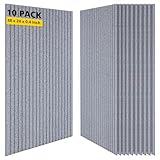
- REDUCING NOISE POLLUTION: Acoustic panels are installed to reduce noise pollution as they eliminate echoes and background sounds not by blocking sound but by absorbing it. High quality acoustic wall panels provide excellent sound absorption, boasting an outstanding NRC value of 0.95 and an average noise reduction factor of up to 80%. By effectively controlling unwanted reverberations and echoes, they provide a clearer and more pleasant sound environment.
- HIGH DENSITY: Wall soundproofing panels have a density of 230kg/m³ and are made of 100% polyester fiber, which is wear-resistant and durable. Ideal for use anywhere in your home or studio. The polyester fibers are dense and uniformly stiff, and their sound absorption properties remain consistent. Helps reduce background noise, echoes, and reverberation time (RT), and reduces standing waves and float.
- STYLISH DECORATIVE: The noise dampening panels feature a creative slotted design and offer a wide range of colors to choose from, which can perfectly match your unique style and interior decor. Acoustic panel can be easily cut into different shapes for DIY wall art. Our soundproof wall panels use felt laminating technology to present vertical stripes in the form of large acoustic panels, which absorb unwanted sound and at the same time serve well as a decorative wall surface.
- ABSORPTION OF ECHOES: For large rooms with high ceilings, the most common problem is echo. Echo creates multiple wavelengths of retracted sound waves that can interfere with conversations in the room. Quality wall sound absorbing panels absorb unwanted sounds, such as echoes and noises from surrounding areas, making other sounds more audible.
- WIDE APPLICATION: Sound panels help reduce unwanted reflected sound in any room of your home or building, they are lightweight and easy to install on smooth walls, doors, and ceilings. Sound blocking panels are suitable for a variety of environments, including homes, bedrooms, offices, recording studios, audio-visual studios and more.
- Siting and nearby uses: What are the property-line distances to homes, schools, and other sensitive locations? How does zoning compatibility account for existing and planned development nearby?
- Noise sources and timing: Does the assessment separate construction equipment from cooling and other mechanical equipment, including generator testing? Does it address predicted levels at neighboring properties, sound frequency, nighttime conditions, schedules, and sound from multiple buildings together?
- Measurement and accountability: Is there a baseline noise study, a modeled assessment before approval, and a post-construction check? What measurement protocol and enforceable limits apply, and who receives complaints and responds?
- Construction logistics: What are the expected schedule and phases, truck routes, delivery times, worker parking plan, and controls for construction noise and dust? How will road condition, school-bus access, and emergency access be protected?
- Traffic assumptions: What project-specific roadway analysis supports the trip estimates, and does it explain worker travel, deliveries, and peak periods separately? Are the routes and assumptions available for public review?
Noise modeling, separation from residential uses, sound limits, measurement rules, construction conditions, and post-build checks are possible tools for local officials, not automatically applicable national requirements. JLARC notes that some localities are uncertain about the extent of their legal authority. As one example of the changing local-policy landscape, the Los Angeles County Board of Supervisors adopted a motion on April 14, 2026 directing departments to examine neighboring-community health, environmental, and safety impacts and propose next steps; the County page stated that its Title 22 then contained no specific data-center rules. That is a local process, not a rule for other jurisdictions.
How should communities weigh disruption against potential benefits?
The Citizens Research Council of Michigan recommends considering proposals case by case. Its analysis distinguishes large hyperscale facilities, which warrant scrutiny for noise, power, and water, from smaller facilities that may be more similar to office buildings. It also identifies construction as the primary economic activity and notes that host communities may benefit from property-tax revenue or community-benefit agreements. Those potential community benefits are separate from whether a particular neighbor experiences noise, traffic, or construction disruption.
Quick Recap
Product prices and availability are accurate as of the date/time indicated and are subject to change. Any price and availability information displayed on Amazon at the time of purchase will apply.

