
Free tools Windows power users keep installed
One-click scans. No signup required.
To identify a CPU bottleneck in AI agent infrastructure, line up agent-run traces with process and container CPU measurements for the same workload interval. CPU pressure is a credible cause when it coincides with slower runs or falling throughput at the process or container doing the work—not simply because a dashboard shows high CPU. Then profile the stage under pressure and check memory, tool execution, initialization and observability overhead as competing explanations.
What counts as evidence of a CPU bottleneck?
A CPU bottleneck is a workload constraint, not a single utilization reading. Look for sustained CPU pressure that overlaps with worse latency or lower throughput, and establish that the pressure is at the agent process or its container. A slow run with low CPU points elsewhere; a busy node does not prove that the agent process is responsible.
There is no universal saturation percentage established by the metrics conventions cited here. Interpret readings in the context of the workload, concurrency, available CPUs and configured container allocation. Compare equivalent runs over the same interval so that latency, throughput and CPU measurements describe the same conditions.
How to run the investigation
-
Establish a representative baseline
Choose a representative mix of agent tasks and concurrency. Record end-to-end latency and throughput alongside CPU time or utilization for the agent process and CPU usage for its container or pod. Use intervals long enough to capture normal variability and relevant bursts; no universal test duration is prescribed.
Outdated Drivers Are Slowing You Down
One free scan finds every outdated or missing driver and matches the right update for your exact hardware.Free scan · exact hardware matchPC Slower Than It Used to Be?
A free scan shows the junk files, broken settings and background clutter dragging Windows down - then fixes them in one click.Free scan · Windows 10 & 11Special offer. See more information about Outbyte and uninstall instructions. Please review EULA and Privacy policy.#1 Best Overall
 MINISFORUM N5 Pro 5-Bay Desktop AI NAS, AMD Ryzen AI 9 HX PRO 370 12-Core/24T CPU, 128GB SSD, 1x10GbE, 1x5GbE, 1xM.2+2xU.2/M.2 Slots, 2xUSB4(8K), 8K HDMI, OCuLink, Network Attached Storage (Diskless)
- Powerful AI Processor: MINISFORUM N5 Pro NAS has next-generation AI technology, AMD Ryzen AI 9 HX PRO 370 processor, Zen 5+Zen 5C architecture, up to 5.1GHz, 12 cores, 24 threads, up to 80 TOPS, bringing unprecedented high performance. Supports multi-user access and concurrent file retrieval, and delivers ultra-fast media decoding. With the support of AMD Radeon 890M, you can play your favorite AAA games with smooth, stunning graphics and zero latency.
- 5-Bay, 188TB Massive Data Storage: N5 Pro desktop AI NAS equipped with five SATA HDD slots: supports 30TB x 5, and 3x M.2 NVMe SSD slots or 1x M.2 NVMe SSD slot + 2x U.2 NVMe SSD slots: supports 8TB + 15TB + 15TB. Network Attached Storage for Video & Content Creators, maximum storage capacity of up to 188 TB. Multiple Raid modes for data security, supports Raid0, Raid1, Raid5/RaidZ1, Raid6/RaidZ2, and mixed drive strategies for hot data and cold backup, speeding reads and cutting storage costs.
- 10GbE+5GbE Network Ports: This AI NAS is equipped with 1x 10GbE high-speed network port and 1x 5GbE network port. 10G + 5G dual ports support link aggregation, delivering 15 Gbps speeds. 10GbE networking powers high-speed transfers for cross-team collaboration, large file handling, and parallel multitasking.
- Expandable DDR5 ECC Memory: MINISFORUM N5 Pro AI NAS has a 2x DDR5 SO-DIMM slot (5600 MT/s), expandable up to 96GB ECC memory. Tailored for NAS applications to ensure maximum data reliability and system stability. ECC Error-Correcting memory technology automatically detects and corrects bit errors in memory, preventing system failures and data corruption, thus protecting vital business files. DDR5 5600 offers 75% more bandwidth than DDR4, ideal for high-concurrency and large file handling, supports more VMs, and provides smoother data. Combining reliability and performance, it's ideal for both business and home use.
- MinisCloud OS, All-in-One APP: MinisCloud OS seamlessly supports Windows, macOS, iOS, and Android with zero learning curve. Built-in features include ZFS snapshots, LZ4 compression, multi-user isolation, Docker apps, AI photo albums, and one-click remote access—fully managed, ready to use.
-
Break each run into stages
Use framework tracing or equivalent spans to see where a run spends time. The OpenAI Agents SDK tracing documentation describes events for LLM generations, tool calls, handoffs, guardrails and custom work. A slow generation span can reflect remote model latency, so it does not by itself demonstrate local CPU pressure. A CPU-heavy tool call or local preprocessing stage is a more direct profiling target.
-
Compare process CPU with host or node CPU
OpenTelemetry defines
process.cpu.utilizationas the change in process CPU time between observations divided by elapsed time and the number of CPUs available to the process; the metric is opt-in in the reviewed conventions. See the OpenTelemetry process metric conventions. The OpenTelemetry Python system metrics instrumentation can expose process CPU time and utilization, context switches and thread count, alongside system CPU measurements.High host CPU with low agent-process CPU can indicate contention from other node workloads. High process CPU while the host is relatively idle can point to a busy process or a constrained container allocation. These are diagnostic clues, not conclusions: validate them against profiles and allocation data.
Rank #2
 UGREEN NAS DH4300 Plus 4-Bay for Beginners, Home Users & Remote Workers
- Entry-level NAS Home Storage: The UGREEN NAS DH4300 Plus is an entry-level 4-bay NAS that's ideal for home media and vast private storage you can access from anywhere and also supports Docker but not virtual machines. You can record, store, share happy moment with your families and friends, which is intuitive for users moving from cloud storage, or external drives to create your own private cloud, access files from any device.
- Smart Photo Backup & AI Album: Automatically back up photos and videos from your phone in real time and keep growing family memories organized with AI-powered photo albums. Semantic search, custom learning, and recognition of people, objects, pets, and similar photos help you quickly find the moments you want. Duplicate photo removal also helps keep your library organized—ideal for families and users with large photo collections.
- User-Friendly App & Easy Setup: Connect quickly via NFC, set up simply and share files fast on Windows, macOS, Android, iOS, web browsers, and smart TVs. You can access data remotely from any of your mixed devices. What's more, UGREEN NAS enclosure comes with beginner-friendly user manual and video instructions to ensure you can easily take full advantage of its features.
- More Cost-effective Storage Solution: Unlike cloud storage with recurring monthly fees, A UGREEN NAS enclosure requires only a one-time purchase for long-term use. For example, you only need to pay $629.99 for a NAS, while for cloud storage, you need to pay $719.88 per year, $1,439.76 for 2 years, $2,159.64 for 3 years, $7,198.80 for 10 years. You will save $6,568.81 over 10 years with UGREEN NAS! *NAS cost based on DH4300 Plus + 12TB HDD; cloud cost based on 12TB plan (e.g. $59.99/month).
- Your Data, You Control:No third-party clouds, no hidden access, UGREEN NAS provides a more secure and private data storage solution. It stores data locally on your private hard drives and does automatic backups. Thus, you can keep full control over it. The advanced encryption is TRUSTe certified in the United States and is awarded the first (and only) ETSI EN 303 645 certification mark for NAS products by TÜV SÜD Group.
-
Check Kubernetes pod usage against its allocation
Compare pod CPU usage with its configured CPU request and limit, as well as node capacity and competing workloads. The OpenTelemetry Kubernetes metric conventions define pod CPU usage in CPU units, derived from CPU-time change divided by elapsed time, and list request- and limit-utilization measures. Some measures in the living conventions have development status.
Special offer. See more information about Outbyte and uninstall instructions. Please review EULA and Privacy policy.A pod can be constrained by its allocation even if the node as a whole is not fully busy. Node-level averages can therefore conceal a workload-level limit.
-
Profile the stage that coincides with pressure
Once traces and CPU measurements point to a stage, use the runtime’s profiler or sampling tools to locate the relevant code path. Where available, distinguish user from system CPU time; use thread count and context switches as additional context. Compare before and after under the same representative workload. The cited documentation defines metrics and tracing capabilities, but does not prescribe one profiler or a universal fix.
Rank #3
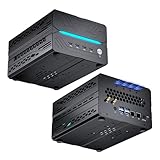 Kinupute AI Server, Mini PC Gaming, Desktop Computer i9-14900F 24 Cores, 64G DDR5, 4T M.2 PCIE4.0 SSD, 4T SATA SSD, Win-11 Pro, GeForce RTX5060Ti 16G, Four Display, 8K@60Hz Outputs, Dual LAN, WiFi7
- [Powerful Processor] Mini Gaming PC equipped with Core i9-14900F, 24 Cores 32 Threads, 36M Cache, Max Turbo Frequency: 5.8GHz, Windows 11 pro (64 Bit).64G DDR5-5600 RAM| 4T M.2 NVME PCIE4.0 SSD| 4T SATA SSD. With GeForce RTX 50 Series GPUs. supporting ray tracing and AI cores. Delivering AI-acceleration in top creative apps. Whether you’re rendering complex 3D scenes, editing 4K video, or Gaming livestreaming with the best encoding and image quality.
- [Powerful Capacity & Storage Expansion] The mini desktop computer is equipped with Dual-DDR5 RAM (dual channel DDR5 high-speed memory, which can support up to 96G RAM), 1 x M.2 2280 PCIE4.0 high-speed SSD, and support add 1 x 2.5-inch SATA HDD/SSD is enough to accommodate system files and massive games, Excellent reading and writing speed greatly shortening your boot time.
- [8K@60Hz Four-Display] Mini PC equipped with GeForce RTX5060Ti 16GB GDDR7 discrete graphics card, supporting ray tracing and AI cores. easy connect 4 monitors, 1×HDMI 2.1b and 3×DisplayPort 2.1b(All Support 8K@60Hz display), It can provide you with a first-class TV experience and realistic picture quality, for your visual home entertainment, streaming video, web browsing, work design and 3D games create a very smooth experience.
- [Functional Interfaces] Mini computer is equipped with 4 x USB 3.2, 4 x USB2.0, 1 x HDMI2.1 port, 3 x DP2.1 ports, 2xRJ-45 Gigabit Network Ethernet, 1 x Fiber Optic PORT, 1 x Audio in/out. Built-in Bluetooth 5.4 and IEEE 802.11be wifi 7, Higher transfer rates and lower latency. Mini PC supports multiple device connection and can be used with servers, monitoring equipment, office equipment, projectors, televisions, etc, Mini desktop computer support automatic power on and Wake On Lan.
- [Warranty & heat dissipation] Warrant: 2 year/24 months. The compact computer size: 8.6*6.6*4.5in, 5.5lb, Inside the chassis are four all-copper turbo fans and eight vacuum heat pipes for powerful cooling performance. Make it can work smoothly and will not cause too much noise.
-
Test memory, tools and initialization as alternatives
Agent work includes tool execution and initialization, not just model calls. A 2026 AgentCgroup preprint reports that OS-level execution—including tool calls and container and agent initialization—accounted for 56–74% of end-to-end task latency in the workloads its authors measured. The same study found memory, rather than CPU, to be the primary bottleneck for multi-tenant concurrency density in its experiments. These are study-specific findings, not general estimates for all agent systems. See AgentCgroup.
-
Check whether observability adds material load
Tracing and logging consume resources. Kubernetes notes that exporting spans adds networking and CPU overhead depending on configuration, and suggests lowering the sampling rate or disabling tracing if it causes a cluster issue; see its system tracing documentation. OpenTelemetry’s API performance guidance warns that excessive logs consume resources and recommends filtering them to bound usage. Its Java agent performance guidance also notes that large span volumes and unnecessary instrumentation can raise overhead. Capture a baseline with current instrumentation, then tune collection if needed and check whether the symptom changes.
Recommended: PC Feels Slow? A Free Scan Shows What's Dragging Windows Down →Recommended: Update Every Outdated Driver on Your PC in One Scan - Free →Special offer. See more information about Outbyte and uninstall instructions. Please review EULA and Privacy policy.
How to compare deployments fairly
When investigating a change or comparing environments, keep the workload and concurrency matched. Compare these dimensions together:
Rank #4

- 【AI Max+ 395 AI Workstation】16 cores, 32 threads, up to 5.1 GHz boost and 80 MB cache. Integrated Radeon 8060S graphics with 40 CUs, RDNA 3.5, delivers performance close to RTX 4060/4070 laptop GPUs. Triple-engine design(CPU+GPU+XDNA 2 NPU) with up to 126 TOPS total, including 50+ TOPS dedicated NPU for local AI inference and machine learning acceleration. Ideal for AI development, content creation, virtualization, data analysis, and demanding multitasking. Compact, high-performance workstation.
- 【256-bit LPDDR5X MAX 128GB】The LPDDR5X onboard memory reaches 8400 MT/s - 1.5x faster than DDR5 SODIMM. Unlock the full potential of your graphics with massive 128GB memory pooling. This system allows you to manually assign up to 128GB of the onboard RAM to serve as video memory (VRAM) directly within the BIOS setup, delivering unparalleled performance for 4K video editing, and AI model training without the need for a discrete graphics card.
- 【Lastest GPU 8060S & XDNA 2 NPU】Built on the RDNA 3.5 architecture, the AMD Radeon 8060S Graphics iGPU features 40 compute units (2,560 stream processors). It delivers performance on par with NVIDIA's mobile RTX 4070, efficient encoding/decoding for AVC, HEVC, VP9, and AV1 video codecs. And It can connect 4 screens via HDMI & DisplayPort & Full Featured USB4 x2 to efficiently handle your tasks and meet your specific needs. Supports 8K/4K resolution displays.
- 【Dual LAN (2.5GbE+10GbE)& WiFi 7】The computer has double LAN, one is 2.5GbE (I226), the other is 10GbE(AQC113). provides more applications, such as firewall, soft routing, multichannel aggregation. Built-in WiFi module, support WiFi 7 and Bluetooth5.4. Known as 802.11be, Wi-Fi 7 promises up to 46Gbps theoretical throughput, making it 4.8x faster than Wi-Fi 6. and computer has 4 built-in NVMe SSD slots, 1 SD card slot, allowing you to expand its storage capacity.
- 【Engineered to Endure】The computer measures 7.13 x 7.24 x 2.99 inches. AI mini pc is encased in a premium all-aluminium chassis. Dual turbo CPU fans deliver silent, ultra-efficient cooling, To enable the computer to maintain stable operation for a long time. We offer up to 2 years warranty and lifetime professional customer service. Please feel free to contact us if any issues happened. thanks
- Agent stage and tool type.
- Process CPU versus pod and node CPU.
- Pod CPU usage versus its configured requests and limits.
- Latency percentiles and throughput at the same concurrency.
- Available CPU-time modes, thread counts and context-switch measures.
- Instrumentation settings and sampling rates.
The cited sources define measures and document observability overhead; they do not provide a universal benchmark across agent frameworks, cloud instance families or hardware models. A performance claim requires matched workload and environment measurements.
What to do with the diagnosis
If CPU pressure aligns with a specific stage and worsening service-level results, use profiling to locate the hot path before changing infrastructure or code. If process CPU is low while latency rises, investigate the stage’s external wait, tool behavior, memory pressure or initialization instead. If pod CPU is high relative to its allocation while node CPU is not, examine the pod’s configured resources and competing workloads. In each case, change one relevant factor at a time and repeat the same workload comparison so the result can be attributed.
Quick Recap
Product prices and availability are accurate as of the date/time indicated and are subject to change. Any price and availability information displayed on Amazon at the time of purchase will apply.

