
The Tool Desk
Outbyte Driver Updater FREEScan for outdated or missing drivers - takes under a minuteDriver Scan →Outbyte PC Repair FREERepair Windows errors before they cause bigger problemsFix Now →A dinosaur fossil’s commercial value depends on factors such as scarcity, completeness, preservation, visual appeal, and buyer demand. Its scientific value is different: it rests on what the specimen can reveal and how well its origin and excavation were documented. A high auction price is not, by itself, proof of scientific importance.
What determines a fossil’s value?
There is no universal formula or standardized grade that converts a dinosaur fossil into a price. Commercial appraisals weigh several features together, and the same specimen can be valuable to a collector for different reasons than it is to a researcher.
- Scarcity and identity: A recognizable species, unusual body part, life stage, or especially rare specimen may attract buyers. Market scarcity is not the same as scientific significance.
- Completeness and which bones survive: The proportion of the skeleton present matters, but so does the identity and condition of the surviving elements.
- Preservation and presentation: Condition, visual impact, and potential for display can affect commercial appeal.
- Demand: Familiarity with a dinosaur, publicity, and the number and resources of interested buyers can influence a sale.
- Documentation and access: Geological context, excavation records, lawful ownership, and the ability of researchers to examine a specimen affect its scientific usefulness and practical standing.
Heritage Auctions lists completeness, popularity, aesthetics, rarity, and marketability among its commercial appraisal factors. Its guidance notes that a specimen described as 60% complete may still command a high price if important parts, such as the head and major bones, are present and intact. That is an auction-house example, not a universal measurement standard. The meaning of any completeness percentage depends on who calculated it and what counts as part of the skeleton.
Why rarity and scientific importance are not the same
“Rare” can mean several things: a dinosaur species is known from few specimens; a particular body part or growth stage is seldom found; preservation is unusual; or complete examples are scarce on the commercial market. Those forms of rarity may interest buyers, but they do not automatically make a fossil scientifically important.
Free tools Windows power users keep installed
One-click scans. No signup required.
#1 Best Overall

- Resin Cast Replica
- 5.5 inches
Researchers ask what evidence a specimen preserves, whether it has features that help identify or distinguish it, and what it can add when compared with other individuals. Additional examples of a species can reveal variation in body size and shape and how the animals grew. Dr. Cary Woodruff, curator of vertebrate palaeontology at the Phillip and Patricia Frost Museum of Science, told the Natural History Museum: “The more individuals of a particular dinosaur species we have, the better we’re able to understand individual variation such as height, body size and shape, as well as how these animals grew.” The Natural History Museum explains the distinction between fossil sales and scientific value.
How completeness, preservation, and restoration affect the specimen
A completeness percentage can obscure important differences. It may not tell you which bones are original, whether the surviving bones belong to one animal, or how much reconstruction was added for display. Ask what the percentage measures and whether it counts only original fossil material.
The Natural History Museum describes fossils modified with filler, paint, or glue, as well as composites assembled from material belonging to more than one animal. A mounted skeleton can therefore include original fossil, restoration, and composite elements in varying proportions. A sales description alone cannot establish which is which; documentation and appropriate expert examination are needed.
Rank #2
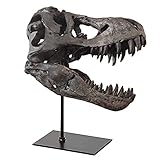
- 【Home Office Desktop Shelf Decor 】Dinosaur head sculptures skull model is hand cast from high-quality solid resin. The surface is made of antique craftsmanship, and the convincing colours and details make it look very realistic and eye-catching. Add some aesthetic to your room
- 【Supplement Your Collection】T-Rex is one of the most popular dinosaurs in the world. For dinosaur lovers or palaeontology lovers, the tyrannosaurus rex skull is a fantastic replica. It will also be a fun teaching tool for any child or teen
- 【Home Decor and Conversation Starter】A lifelike dinosaur skeleton decor. This impressive sculpture looks great on a table or bookshelf. It will be a great conversation starter and conversation piece for any family
- 【Suitable for Many Occasions】This Tyrannosaurus Rex skull replica comes with a metal base. There are 4 non-slip pads on the bottom of the stand to protect the surface of your furniture. It can be placed on various occasions such as office, hallway, TV cabinet, wine rack, living room, etc
- 【Perfect Christmas/Birthday Gift】10.2x 5.9x 11.8 inches.It only takes 2 minutes to complete the installation.Give it as a gift to children, adults, husbands, and friends, no one will refuse it
Heritage Auctions’ example also illustrates why completeness is not a simple ranking: a smaller share of a skeleton may be commercially attractive if the preserved parts are especially important or intact. Conversely, a high percentage does not by itself establish strong preservation, scientific usefulness, or a particular price.
Why provenance and geological context matter
Provenance is the documented origin and chain of custody of a specimen. Geological context records where it was found, including its locality and position in the rock sequence. These are related but distinct: a chain of ownership does not replace field records about the fossil’s setting, and a locality claim does not prove lawful title.
Context helps researchers interpret where and when an animal lived. The American Museum of Natural History says “the information associated with the specimen is as important as the actual fossil”. For a prospective buyer, its acquisition guidance recommends written evidence that the seller has full, unencumbered title and that the specimen was obtained in compliance with applicable laws, including those in its country of origin. Keep invoices, bills of sale, receipts, and transfer documentation.
Rank #3

- Utahraptor was a large theropod dinosaur that lived during the Early Cretaceous period, known for its sharp claws and hunting abilities
- This replica is based on a real Utahraptor fossil discovered in Utah, accurately capturing the shape and detail of the original claw
- The Utahraptor’s curved claw was used for gripping and slashing, making it a key tool for hunting prey
- Cast in durable resin, this 5.5-inch replica offers museum-quality detail and texture
- Made in the USA, this fossil reproduction is perfect for collectors, educators, and dinosaur enthusiasts
Rules vary by country, jurisdiction, and land status, so there is no single answer to whether a fossil can be collected, owned, exported, or sold. In the United States, National Park Service guidance describes fossils as carrying scientific and educational value; the separate federal regulation at 43 CFR §49.600 concerns how scientific value is assessed for penalties. It says “the scientific value of a paleontological resource will be based on the value of the scientific and educational information associated with the resource.” That is a U.S.-specific regulatory standard for penalties, not a general market appraisal formula. The National Park Service discusses threats to fossils on national park lands; the Cornell Legal Information Institute provides the text of 43 CFR §49.600.
How auction prices relate to scientific value
Auction prices reflect a market and the decisions of particular buyers. They can be shaped by competition, presentation, publicity, and collectible appeal, as well as by the specimen’s physical qualities. Auction houses may consider previous sales and completeness, but fossils are not interchangeable commodities with a standard grade and price. One exceptional sale does not provide a reliable price for a tooth, fragment, or less complete skeleton, and it does not establish a fossil’s scientific importance. Scientific American discusses why dinosaur fossils do not have a commodity-style pricing system.
Recommended Free Tools
As reported by a 2026 Geology Today article, Sotheby’s sold the Stegosaurus known as Apex for US$44.6 million in 2024, and the Tyrannosaurus rex known as Gus for US$50.1 million in 2026. The same article reports the Gus sale as exceeding the Apex figure. These are named high-end transactions, not typical values or a basis for estimating another fossil’s worth. The 2026 Geology Today article reports both sale figures.
Rank #4

- IT FROM XUQCAH MATERIAL AND FOIMOJSK PAR ENT AND Thurder LOVER
- Museum Quality Replica
- Please thoroughly read discription
What to check when assessing a fossil
For a comparison or purchase, consider these questions together rather than relying on one headline figure:
- Identity: What taxon is identified, and which features support that identification?
- Original material: What does the stated completeness percentage include? Which parts are original fossil, restored, cast, or composite, and do the bones represent one individual?
- Context: Are locality, geological setting, and excavation records documented?
- Ownership: Is there written evidence of title, acquisition history, and compliance with the laws that apply to the place of origin and transfer?
- Research access: Can researchers examine the specimen, and are records and access likely to remain available?
- Market comparison: Are comparable sales genuinely similar in taxon, condition, originality, documentation, and completeness—and is the comparison relevant to this market?
No simple at-home test can verify authenticity or legality from appearance alone. Ask for documentation and a clear account of restoration and composite construction; seek qualified examination when the distinction matters.
Why access and excavation records matter to science
Private collectors can recover and display important specimens, and private ownership does not automatically prevent research. A specimen may be loaned to a museum or made available to scientists. But access can be limited or withdrawn, making follow-up examination and repeatability harder. Field notes and excavation records also preserve information that may not be recoverable from the mounted bones alone.
Do these 3 things before closing this tab:
1Repair Windows errors before they cause bigger problems2Scan for outdated or missing drivers - takes under a minute3Clear out junk files and repair common Windows errorsThe trade-off is not simply collecting versus science. A fossil’s contribution depends on whether its recovery was documented, whether its ownership and history can be established, and whether researchers can examine it. The Natural History Museum discusses how private sale, access, and documentation can affect scientific study and the public record.
Quick Recap
Product prices and availability are accurate as of the date/time indicated and are subject to change. Any price and availability information displayed on Amazon at the time of purchase will apply.

