
Measure the cable along the route you will actually install—not in a straight line between the two devices. Add the planned service loops and enough slack to pull and terminate the cable without tension, then choose a cable length, construction, and rating suited to that route. A tape measure and a route sketch can prevent both a too-short purchase and excess cable that is difficult to manage.
How to measure an Ethernet cable run
- Mark both endpoints. Identify where the cable starts and ends, and decide where it will travel: along baseboards, through a suitable conduit or raceway, across joists, or by another planned path. Sketch the route and note obstacles, turns, rises, and drops.
- Measure the route in segments. Use a tape measure or another method that follows the path. Measure each straight section and each detour along the intended pathway, then add the segment lengths. The distance between endpoints alone will usually understate the cable needed.
- Add installation allowances. Include the service loops you plan to leave at the endpoints and reasonable slack for pulling, dressing, and terminating the cable without strain. The amount depends on the installation; there is no single allowance that fits every house or termination. Leviton’s Residential Installation Guide recommends service loops and lists a measuring tape among rough-in tools.
- Choose the termination approach. A permanent run commonly terminates at jacks, such as keystone jacks, while a patch cable has plugs. Confirm that the cable and termination hardware are compatible, and have the tool required for that hardware.
- Buy the next practical length above your estimate. Keep a note of the route, measured total, and allowances so you can choose an available length without relying on a guess. Avoid planning to pull a run taut or leaving excess cable in a tight, crushed coil.
In other words, if the route has several sections, calculate it as section lengths + planned service loops + pulling and dressing slack. Do not add an arbitrary fixed number without considering the endpoints and installation method.
Check the route before choosing cable
Length is only one buying decision. Before ordering, identify where the cable will be installed and check the cable manufacturer’s current instructions and applicable local requirements.
- Route exposure: Note whether the cable will be exposed, concealed, outdoors, or pass through a space with special fire-rating requirements. Do not choose a jacket rating based only on the room name. Extreme Networks’ 5520 Series Installation Guide directs installers to consult local building codes when determining where plenum-rated cable is needed. The correct rating depends on your pathway and jurisdiction.
- Cable construction: Check category, conductor type, outer diameter, and compatibility with the planned terminations. Cat 6 is one possible choice for a permanent run, not a universal answer for every installation. The available installation guidance does not establish a complete performance comparison among Cat 5e, Cat 6, and Cat 6A, so match the cable to your equipment and route rather than assuming a higher category is automatically necessary.
- Length and topology: Cables Plus USA’s Cat 6 and Cat 6A Cable Installation Guide summarizes a 100-meter copper link limit associated with TIA-568. Treat that as a standards summary, not permission to exceed the applicable limit for your installed link; confirm the relevant standard, equipment layout, and cable specifications. Cisco’s Converged Plantwide Ethernet Physical Infrastructure Application Guide describes industrial architectures using additional network devices and links. That specialized topology does not make one ordinary copper run longer than its applicable link limit.
- Outdoor details: For an outdoor device, follow the device and cable makers’ weather-sealing and connector instructions. Cisco’s Catalyst 9163E installation guide documents a Cat 6/6A gland procedure for that specific access point; it is not a general instruction for every outdoor Ethernet run.
Route and support the cable without damaging it
- Use broad turns. Avoid sharp bends and right-angle corners. Leviton’s residential guide gives a minimum bend radius of four times the cable diameter for Cat 5e or Cat 6; the selected cable manufacturer’s specification is authoritative for the cable you buy.
- Do not force a difficult pull. Avoid kinks, crushing, sharp edges, and excessive pulling force. Cables Plus USA summarizes 25 lbf as a recommended maximum pulling tension for Cat 6/Cat 6A installations. Check the specific cable’s limit and use a suitable pathway and slow, controlled pulls rather than forcing the cable around an obstacle.
- Support the run and protect the jacket. Use suitable cable supports, such as J-hooks where appropriate, and hook-and-loop straps for bundling. Do not overtighten ties or use staples in a way that compresses the cable. Extreme Networks recommends about 5 to 7.5 cm (2 to 3 inches) of slack at equipment connections for strain relief; that equipment-connection guidance is distinct from the service loops needed at residential terminations.
- Check pathway rules. Keep the route away from electrical wiring and sources of interference where the applicable installation rules require it. Verify that the pathway is permitted under local code and the cable instructions rather than assuming it is acceptable.
Tools and materials to consider
Choose tools based on the route and the termination method, not as a fixed shopping list.
What’s actually slowing this PC down?
Pick the symptom - the matching free tool is one click away.
#1 Best Overall

- Valued Carpenter Pencil Set: You will get 2 pcs solid carpenter pencils with 26 piece 2.8 mm refills, 1 replaceable sharpener, 1 plastic storage box.The complete carpenter pencils combination allows you to finish your work faster and more easily
- Deep Hole Marker Pencil: The deep-hole construction pencils adopts 45mm elongated tip design, which is more convenient to mark in the small hole or in other tight areas that other carpenter markers cannot reach
- Carpenter Pencils with Sharpener: The sharpener is screwed into the top of the work pencil, which won't get lost either. Built-in pencil sharpener that keep the lead with pointed and smooth to Improves line of sight in fine work
- Stronger Solid Lead: This work pencil is matched with a 2.8 mm thick lead , which is much thicker and stronger during the drawing process of construction work, it will not break or damage easily
- Marks on Various Surfaces: 3 colors solid construction pencil can marks on various surfaces,such as metal, plastic, wood, paper etc. Ideals for woodworkers, contractors, craftsmen, builders, merchants and masons
- Tape measure: For measuring the planned route and its separate segments.
- Fish tape: Only for a suitable concealed pathway and when the route can be pulled safely.
- Bulk cable: Bulk Cat 6 Ethernet cable may suit a permanent run after you have established the route, length, conductor type, and rating.
- Supports and straps: J-hooks or comparable supports and hook-and-loop straps can support and bundle cable without crushing it.
- Termination hardware and tool: Use compatible jacks or other termination hardware and the correct punch-down or termination tool.
- Ethernet cable tester: Test the completed termination. Cables Plus USA describes wire-map checks for opens, shorts, and miswiring; Leviton’s guide recommends appropriate Cat 5e/Cat 6 testing.
After buying and installing
Route the cable according to the planned path, keeping bends broad and supports snug rather than tight. Terminate both ends consistently with the hardware instructions; Cisco’s Catalyst 9163E guide, for example, notes that the conductor sequence must match at the opposite end and describes a typical T568B sequence in its device-specific installation context. After termination, use an appropriate tester to check the wiring before relying on the link.
Quick Recap
Best Value
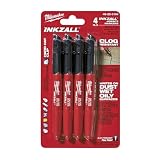
- Milwaukee Ink all Fine Point Marker, Black, 4 Per Pack
- 4 per pack Features Clog Resistant Marker Tip Writes through Dusty, Wet and Oily Surfaces Durable Marker Tip for Writing on Concrete, OSB and Rough Surfaces
- Clog resistant tip writes on dusty, wet and oily surfaces and is optimized for rough surfaces such as OSB, cinderblock and concrete
- Hard hat clip- attaches for easy access
- Quick dry time with reduced smearing and marking
Rank #4

- Long Nib and Deep Hole Marker: Our mechanical carpenter pencil with 45mm nib is designed for easy marking of deep holes or narrow areas. These construction pencils are the great choice for woodworking tools, construction tools, carpenter tools, contractor tools, wood carpentry tools and architect tools
- Extra Refills in 2 Colors for Versatile Marking: The construction mechanical pencil comes with 12 extra 2.8mm refills, including 6 red and 6 black refills. The black refill is suitable for light surfaces, while the red wax is perfect for dark surfaces. Our carpenter mechanical pencil makes sure that you'll have an ample supply for extended use
- Built-in Sharpener: Our construction pencil comes with a built-in sharpener to ensure the mechanical pencil tip is always sharp and ready for use. Never buy an extra pencil sharpener again. A great tool for any woodworker pencil, contractor pencils. The refill can easily be extended or retracted with a simple click of the pencils mechanical, allowing you to work more efficiently and accurately
- Portable Clip Design: Our deep hole construction pencil features a portable clip design, easy to carry and attach to your pocket or tool box, so that you can keep the carpenter pencils mechanical close at hand, making it a convenient tool to have on the go. Great gifts choice for carpenters
- Stronger Pencil Lead: The black refills are made of lead, sturdy and smooth. The red refills are made of wax, clear and light. These marking pencils are much thicker and stronger than normal pencils during the marking process of construction work, suitable for various surfaces, such as glasses, metal, boards, floors, walls, furniture, etc. The written marks can be easily wiped with a wet paper towel when needed
Rank #3

- 【Great Compatibility】This Katerk 1/4 inch hex shank bit holder is specifically designed for 1/4 inch hex shank drill bits. It's compatible with most 1/4 fast hex handles, hex sockets, various electric screwdrivers, and handheld screwdrivers. The bit holder makes it a valuable addition for any handyman.
- 【Secure and Safe】Built with a secure backup nut design, each drill bit holder securely locks onto your bits, ensuring they stay firmly in place. Additionally, our bit holder incorporates a high-quality steel ball rolling design that holds up to several kilograms of weight, ensuring your various drill bits don't fall off.
- 【Easy One-Handed Operation】The bit holder for impact driver allows you to change bits single-handedly, simplifying your workflow. Its multi-color design further allows for quick identification of the drill bit you need.
- 【Compact and Convenient】Thanks to its compact size, this 1/4 inch bit holder is easy to carry around. The bit holder allows for easy attachment to various tools, making this a convenient addition to your construction accessories. The Katerk bit holder is cast from high-quality alloy material, promising a long product lifespan. Despite its rugged strength, the bit holder remains lightweight, making it portable.
- 【Cool Christmas Gift For Men Stocking Stuffers】 This screwdriver bit holder, driver bit holder, impact bit holder, can be given as a gift to your loved one, especially for anyone involved in construction or electrical work. It's a must-have for stocking stuffers for men and women, tools gifts for dad, tech gadgets for men, gifts for dad, gifts for him, gifts for husband, gifts for boyfriend, cool gadgets for men, and cool gifts for dad.
Rank #2

- Ergonomically Designed: Work in tight areas with a compact design that gets into tough spots
- Compact and Lightweight: Both tools are designed to fit into difficult to reach spaces. The 1/4" impact driver has a length of 5.55 in. and weighs just 2.8 lbs, while the 1/2" drill/driver measures only 7.5 in. and weighs 3.6 lbs
- Both the DEWALT impact driver and electric drill driver feature integrated LED work lights with a convenient 20-second delay, ensuring enhanced visibility in dimly lit or challenging work areas
- One-Handed Loading - Keep one hand free with a 1/4 in. hex chuck that accepts 1 in. bit tips
- Power drill cordless with 1/2" single sleeve ratcheting chuck provides tight bit gripping strength, making bit changes faster and more secure

