
Astronomers choose JWST or Hubble by matching the scientific question to the wavelength, instrument, and measurement needed—not by declaring one telescope universally better. Hubble is the option when ultraviolet or visible light is essential; Webb is designed for infrared observations, especially at longer infrared wavelengths. When a study needs both kinds of information, the observatories can complement each other.
What is the first question astronomers ask?
They start with the light the target must be observed in. NASA’s broad mission comparison gives Hubble a wavelength range of 0.1–2.5 microns and Webb a range of 0.6–28.5 microns. The ranges overlap in part, but Hubble reaches ultraviolet and visible light, while Webb extends farther into the infrared. These are mission-level ranges, not a guarantee that every instrument or observing mode can cover every wavelength in them; a proposal must be checked against the specific instrument and mode.

That distinction often determines the choice. A question about ultraviolet or visible properties points toward Hubble. A question that depends on infrared observations—particularly farther into the infrared—points toward Webb. NASA’s comparison explains that resolution depends on both mirror size and observing wavelength, so wavelength is not merely a filter choice: it affects the detail an instrument can distinguish.
How do instrument and measurement affect the choice?
After identifying the wavelength, astronomers ask what data they need: an image, a spectrum, or another measurement the relevant instrument supports. The observatory name alone does not answer that question.
#1 Best Overall
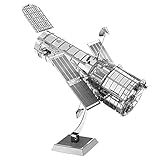
- HOBBY MODEL KIT – Unassembled model packed in an envelope with easy to follow instructions. Ideal for ages 14 and up.
- NO GLUE OR SOLDER NEEDED – Parts can be easily clipped from the metal sheets. Tweezers are the recommended tool for bending and twisting the connection tabs.
- HUBBLE TELESCOPE – 1 Sheet Model with a moderate difficulty level. Assembled Size: 3.00 x 2.00 x 2.50 inches.
- FROM STEEL SHEETS TO 3D – Pop out the pieces and connect using tabs and holes. Includes illustrated instructions.
- HIGHLY DETAILED ETCHED MODEL – Display your 3D model once completed - collect and build them all.
Hubble’s instruments can serve different kinds of observation
Hubble’s Wide Field Camera 3 supports visible/ultraviolet imaging as well as infrared imaging. Its Space Telescope Imaging Spectrograph (STIS) can obtain high-resolution spectra and take spectra from multiple points across a target. Those capabilities make Hubble relevant when the needed measurement falls in its wavelength range and calls for those imaging or spectroscopic functions.
Compare the actual observing mode
For either observatory, the practical comparison is between the instrument and mode that can deliver the required data for the target. Field size and survey strategy matter too: the sources establish broad mission and instrument differences, but do not support a single field-of-view ranking that applies across every instrument and mode. The requested sky area and target configuration therefore need to be assessed for the actual setup.
Rank #2

- HOBBY MODEL KIT – Unassembled model packed in an envelope with easy to follow instructions. Ideal for ages 14 and up.
- NO GLUE OR SOLDER NEEDED – Parts can be easily clipped from the metal sheets. Tweezers are the recommended tool for bending and twisting the connection tabs.
- JAMES WEBB SPACE TELESCOPE - 2.75 Sheet Model with a moderate difficulty level. Assembled Size: 4.13 L x 2.75 W x 2.75 H inches. 1:221 Scale. 62 Pieces
- FROM STEEL SHEETS TO 3D – Pop out the pieces and connect using tabs and holes. Includes illustrated instructions.
- HIGHLY DETAILED ETCHED MODEL – Display your 3D model once completed - collect and build them all.
How should astronomers weigh resolution and sensitivity?
Mirror size is one factor, but it is not a universal performance score. NASA says Webb’s primary mirror has six times Hubble’s light-gathering power. That mirror-level comparison is useful context for Webb’s observations, including work on dimmer signals at longer infrared wavelengths; it does not mean Webb is six times better for every target, wavelength, or observing mode.
Resolution also depends on the wavelength observed. A telescope’s ability to distinguish detail changes with wavelength as well as mirror size, so the relevant question is how the particular setup performs at the wavelength of interest. Astronomers must consider expected signal, required detail, and instrument mode together rather than using a single mirror-size multiplier to choose.
The Tool Desk
Outbyte PC Repair FREEClear out junk files and repair common Windows errorsFree Scan →Outbyte Driver Updater FREEScan for outdated or missing drivers - takes under a minuteDriver Scan →Rank #3
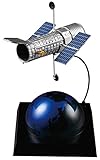
- Sprue Brothers Hasegawa 1:200 Hubble Space Telescope 'The Repair 20th Anniversary', HAS52326
When might astronomers use both observatories?
A study may need information that spans more than one wavelength band. Hubble can establish ultraviolet or visible properties, or help select and plan a Webb observation; Webb can then add infrared information. Combining observations in different bands can reveal aspects of a target that either observatory alone would not show.
Using both is not automatic: it depends on whether the added data answer a real part of the scientific question. NASA’s Hubble material describes Hubble observations as potentially complementing Webb observations, rather than treating the missions as mutually exclusive choices.
Rank #4
- Set Includes 4 Kits: Hubble Telescope - Apollo Lunar Rover
- Assembly required - Simply pop out the pieces and connect tabs and holes
- Ages 14+ - Moderate
- Hubble Telescope = 3" x 2" x 2.5" when assembled - Easy Difficulty Level
- Apollo Lunar Rover = 3.55" x 1.77" x 2.28" when assembled - Moderate Difficulty Level
What does a comparison of exposure times show—and not show?
A NASA comparison of the Hubble Ultra Deep Field illustrates why an image-specific result should not be turned into a general speed ranking. The Hubble Wide Field Camera 3 image required 11.3 days of exposure; the Webb image required 0.83 days. NASA’s asset page describes the Webb data as using MIRI with five filters—F182M, F210M, F430M, F460M, and F480M—and gives October 11, 2022, as the observation date. The image was released April 12, 2023, and NASA notes that areas in the Webb image reveal previously invisible red galaxies.
Those durations belong to these particular images, instruments, filters, and field; the listed setups are not identical. They do not establish how quickly either telescope will observe another target or deliver a different measurement.
Quick wins for a faster PC:
Scan for outdated or missing drivers - takes under a minuteDriver Scan →Clear out junk files and repair common Windows errorsFree Scan →Best Value
How do proposals and observing time shape the decision?
Scientific suitability is only part of the practical choice because observatory time is limited and competitively allocated. For Hubble, NASA describes a proposal process in which scientific peer-review panels assess whether the requested science requires Hubble’s combination of sensitivity, resolution, instrumentation, and wavelength range. Successful programs proceed to more detailed planning for implementation and scheduling; the Space Telescope Science Institute handles Hubble selection, scheduling, data processing, and archiving.
These Hubble process details should not be assumed to apply identically to Webb. Proposal requirements and availability are mission- and cycle-specific. As one dated example, NASA’s JWST Cycle 6 call was published July 22, 2026. It set a September 30, 2026 proposal deadline and planned observations to begin July 1, 2027. The deadline had passed by October 7, 2026, so those dates describe Cycle 6 rather than an open application or the schedule for a later cycle.
A practical decision sequence
- Identify the required wavelength. If ultraviolet or visible light is essential, evaluate Hubble. If the science needs infrared coverage, especially at longer wavelengths, evaluate Webb.
- Specify the measurement. Decide whether the study needs imaging, spectroscopy, or another supported measurement, then identify an instrument and observing mode that can provide it.
- Match performance to the target. Assess expected signal and required angular detail at the relevant wavelength. Do not treat a mission-level mirror comparison as a universal outcome prediction.
- Check field and target configuration. Make sure the selected instrument and mode suit the desired sky area and the way the target must be observed.
- Consider complementary coverage. If the science requires ultraviolet/visible and infrared information, determine whether observations from both observatories add distinct, useful data.
- Establish feasibility and availability. Check the relevant proposal documentation and cycle deadlines, and confirm the observatory is suitable for the requested science.
The resulting choice is specific to the observation: the observatory that can deliver the needed wavelength and measurement, at suitable detail and sensitivity, is the one that fits.
Quick Recap
Product prices and availability are accurate as of the date/time indicated and are subject to change. Any price and availability information displayed on Amazon at the time of purchase will apply.
What’s actually slowing this PC down?
Pick the symptom - the matching free tool is one click away.

