
What’s actually slowing this PC down?
Pick the symptom - the matching free tool is one click away.
You can include media stocks as part of your equity holdings, but owning several media companies—or a media-focused fund—does not by itself diversify a portfolio. Start with your overall mix of stocks, bonds, and cash, then check how your stock holdings are spread across companies and industries. There is no universal media-stock percentage: the appropriate allocation depends on your circumstances, including your time horizon and tolerance for risk.
What diversification means for a portfolio
Asset allocation is how you divide a portfolio among broad asset categories, such as stocks, bonds, and cash. Diversification is how you spread exposure across investments, both between those categories and within them. The U.S. Securities and Exchange Commission (SEC) explains these concepts in its Investor.gov Tips for 2026 (March 31, 2026) and its Beginners’ Guide to Asset Allocation, Diversification, and Rebalancing.



For a portfolio that includes media stocks, this distinction matters: adding a media company changes the holdings inside your stock allocation. It does not, on its own, create balance among asset categories or reduce concentration in a particular industry.
How much of a portfolio should be in media stocks?
There is no source-backed universal percentage or standard media-sector target. The SEC’s Investor.gov guidance says, “The asset allocation decision is a personal one,” and identifies investment timeframe and risk tolerance as relevant factors. Your goals and capacity to withstand losses also matter when considering how much exposure to any one company or industry is appropriate. This article is educational, not an individualized allocation or a recommendation to buy a security.
#1 Best Overall
Think of media exposure as one possible slice of the stock portion of your portfolio, not as a substitute for a complete allocation plan. A higher concentration in a sector means more of your portfolio depends on companies in that sector; whether that fits your situation is a personal decision.
Review your portfolio before adding media exposure
Use this sequence to see what you already own and where a new holding would fit. It focuses on exposure rather than the number of tickers or funds in your account.
Rank #2
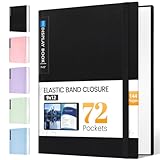
- 72-Pocket Large Capacity Portfolio: The art binder includes 72 bound (non-refillable) top-loading clear sheet protectors, displaying up to144 pages. Fits 9”x12" letter size or smaller. Measures 12 7/8" (L) x 9 11/16" (W) x 1 1/2" (G).
- Elastic Band for Secure Protection:For total peace of mind, a sturdy elastic band keeps your portfolio securely fastened. Your important papers stay put, organized, and protected from damage.
- High Transparency & Tailor-Made Spine Title: Our presentation book with crystal clear PP sheet protectors offers complete transparency for checking through and organizing. You can label and identify your watercolors, sketches, scrapbook, art pieces, sheet music, certificates, and other projects by customizing the reversible spine insert.
- Archival Grade & Heavy Duty Cover: Made from robust yet light weight, polypropylene which is archival quality, acid-free and non-glare, and water-proof. Thickened and sturdy cover won’t easy to crack and keeps your clear sleeves from being damaged.
- Multi-Function: Not only suitable for long-term storage but also for displaying your paintings, photos, artwork, drawing, stencils. Great gift for students, teachers, office workers, secretaries, musicians, painters, etc.
- Identify your broad asset mix. Estimate how much is in stocks, bonds, cash, and any other significant asset categories. Compare that mix with your goals, time horizon, and comfort with risk.
- List direct stock holdings. Note each company and consider its industry. Several media names may still leave your stock allocation concentrated in one industry.
- Read each fund’s objective or mandate. Check whether a mutual fund or ETF is broad-market, focused on a sector, or otherwise limited in scope. A fund label or share of a fund does not guarantee broad diversification.
- Inspect fund holdings and overlap. Look at the largest holdings in each fund. If the same companies appear across multiple funds, your actual exposure may be more concentrated than the number of funds suggests. Investor.gov recommends checking top holdings for this reason.
- Consider concentration, costs, and your circumstances together. Compare the breadth of exposure and overlap of the options you are considering, review fund expenses, and ask whether the resulting risk fits your time horizon and risk tolerance. Current holdings and fees vary by fund and should be checked in its latest materials.
Ways to hold media stocks—and their trade-offs
These approaches differ in breadth and concentration. None is automatically right for every investor, and the SEC materials do not provide current comparative fee figures or returns.
| Approach | Exposure | What to check |
|---|---|---|
| One media company | Exposure to one company within the stock allocation. | How the holding affects company and industry concentration alongside your other investments. |
| Several media companies | Exposure to multiple companies, but still potentially concentrated in one industry. | Whether company count disguises a large combined sector allocation. |
| Broad-market mutual fund or ETF | A pooled investment that may hold many companies and industries; actual breadth depends on its objective and holdings. | Its mandate, top holdings, overlap with other funds, and expenses. |
| Media- or industry-focused fund | Sector exposure that may be narrow rather than broad diversification. | The fund’s focus and holdings, plus how much sector exposure you already have. The SEC cautions that a narrowly focused fund may not provide diversification. |
The SEC notes that many investors find mutual funds or ETFs easier to use for diversification than selecting individual stocks or bonds. But a pooled investment is not automatically diversified. Investor.gov states, “But a mutual fund or ETF won’t necessarily provide diversification, especially if it is narrowly focused (such as on one industry sector).” Review the fund’s actual mandate and holdings rather than assuming that owning a fund resolves concentration.
Quick wins for a faster PC:
Fix the driver behind crashes, sound loss and screen glitchesFind Drivers →Repair Windows errors before they cause bigger problemsFix Now →Scan for outdated or missing drivers - takes under a minuteDriver Scan →Revisit the allocation over time
Portfolio weights can change as investments rise or fall in value. The SEC’s Investor.gov guidance on asset allocation and diversification describes rebalancing approaches that include reviewing at regular intervals or when allocations move beyond thresholds an investor has set. These are options to consider, not a prescribed schedule or threshold. Any approach should fit your goals and circumstances.
Diversification can help spread investment exposure, but it does not guarantee a profit or prevent losses. No particular media company is endorsed here.
Quick Recap
Best Value
Rank #4
Product prices and availability are accurate as of the date/time indicated and are subject to change. Any price and availability information displayed on Amazon at the time of purchase will apply.

