
Select a plate-fin heat exchanger from the actual process duty and operating envelope—not from a headline pressure rating or core size. Give suppliers complete data for every stream and operating case, then require a project-specific rating that confirms heat duty, pressure drop, flow distribution, materials, mechanical limits, and the applicable code and certification basis.
What a plate-fin heat exchanger is suited to
A plate-fin exchanger routes fluids through layers of passages separated by parting sheets, with fins adding heat-transfer surface. In its description of brazed aluminum heat exchangers (BAHX), Chart Industries describes alternating layers of corrugated fins separated by parting sheets, edge-sealed with side bars, and fitted with stream ports.
This construction is commonly considered for large gas-to-gas and gas-to-liquid duties, including cryogenic service, where a compact footprint and low pressure drop can matter. Alfa Laval cites gas processing, compressor cooling, industrial heat pumps, energy storage, and refrigeration as applications for its plate-fin products; those are manufacturer-stated examples, not proof that a particular unit fits a given process.
Plate-fin is a candidate technology, not an automatic choice. It is most useful to evaluate when its compactness and gas-service capabilities address a real project constraint. The supplier still needs to demonstrate that the selected core can meet the required duty and hydraulic limits across all relevant operating cases.
What’s actually slowing this PC down?
Pick the symptom - the matching free tool is one click away.
#1 Best Overall

- High Thermal Efficiency: Turbulent-flow design moves the two media in opposite directions and creates strong turbulences for superior heat transfer rates and efficiency. Our heat exchanger series have been certificated by CE.
- Energy Optimized: This heat exchanger stainless can heat water to the preset temperature, which is super energy-saving with no electricity consumption and no oxygen consumption.
- Robust Construction: This 40 plate heat exchanger features 316L stainless steel sheets, which are brazed together at the edges and the matrix of contact points for a reliable and rugged part to form a durable, integral piece that can withstand high pressure and temperature. Four thickened MNPT ports for your easier installation.
- Compact Design: Corrugated plate design of this plate chiller wort allows for substantially smaller build and footprint at an equivalent or better performance compared to other heat transfer devices – resulting in significant space savings.
- Highly Versatile: This heat exchanger beer offers the highest level of thermal efficiency and durability in a compact &lightweight unit, ideal for industrial oil cooling, refrigerant evaporators, and condensers, residential and light commercial HVAC hydronic systems.
Build the process brief before asking for a design
Prepare a separate data row for every stream and every materially different operating case. Use consistent units and identify whether each flow is mass or volumetric; include the reference conditions if volumetric flow is reported. The following is an engineering brief synthesized from the performance variables covered by Chart Industries and Alfa Laval, not a universal vendor form.
| Data to provide | What to specify |
|---|---|
| Fluid and composition | Fluid name, composition, phase, and known contaminants or corrosive species. |
| Flow | Mass or volumetric flow for each stream and each operating case. |
| Thermal duty | Inlet and required outlet temperatures, required heat duty, and required temperature approach where specified. |
| Pressure | Operating pressure, design pressure, and allowable pressure drop for each side. |
| Temperature and design conditions | Operating and design temperatures, plus ambient conditions relevant to the installation. |
| Operating envelope | Normal operation, startup, shutdown, turndown, cycling, and credible upset cases. |
| Physical and project constraints | Footprint, connections, installation limits, inspection and cleaning needs, documentation, jurisdiction, and required certification. |
State whether the exchanger handles condensing, boiling, flashing, or two-phase inlet flow. These conditions affect both thermal performance and the way fluid divides among passages, so they should not be left implicit in a single average duty.
Evaluate thermal duty and pressure drop together
Do not accept a design solely because it has enough nominal heat-transfer area. Passage geometry and pressure loss influence the result, and headers and distributors affect how evenly fluid reaches the passages. Chart Industries’ BAHX paper explains the relationship between heat-transfer coefficient and pressure drop and emphasizes flow distribution; equal pressure drop across parallel paths does not ensure equal flow.
Rank #2

- 【Premium Quality】Our plate heat exchanger is made of high quality 316L stainless steel which are brazed together by 99.9% copper at the edges for a reliable and rugged part to form a durable, integral piece that can resist leakage and withstand high pressure and temperature.
- 【Convenient For Use And Energy Saving】Smooth Thread makes a easy, quick, flexible hookup. Highly conductive and super-thin stainless steel plates make good performance and economy for heating transfer and cooling without electricity consumption and oxygen consumption.
- 【Product Parameter】250,000 - 330,000 BTU CAPACITY: Depending on the application, this product can produce 250kBtu to 330kBtu per hour. 30 PLATES; 4"x 12", 1" MPT: 30 brazed plates work to efficiently heat water for your application.
- 【Multiple Applications】AB water heat exchanger offers the highest level of thermal efficiency and durability in a compact & lightweight unit, perfect for domestic water heating, Floor Heating, Snow Melting, District or Zone Heating Systems, Outdoor Wood Furnaces, Hydraulic and Lube Oil Coolers, Radiator Heating, Hydronic Heating, Solar Heating, Wood Boiler.
- 【Product Support】 Quality-focused manufacturing backed by responsive support for product questions, selection and installation guidance.
Give the supplier the allowable pressure drop on each side alongside the required duty and outlet temperatures. Ask for the rated thermal and hydraulic performance at the specified operating cases, including the pressure-drop basis. A design that meets the temperature target while exceeding the allowable pressure loss is not a satisfactory match.
The Tool Desk
Outbyte PC Repair FREERepair Windows errors before they cause bigger problemsFix Now →Outbyte Driver Updater FREEScan for outdated or missing drivers - takes under a minuteDriver Scan →Give two-phase flow and distribution a separate review
For a condensing, boiling, flashing, or two-phase stream, request an explicit review of headers, manifolds, distributors, and channel-by-channel flow allocation. Liquid and vapor have different densities; their distribution can become uneven, and actual performance can then differ materially from a simulation. Chart Industries highlights this risk in its BAHX technical paper, particularly around headers and manifolds.
Ask the supplier to identify the assumptions used to model phase distribution and to explain how the design addresses maldistribution for the project’s flow range. The point is not merely whether the unit can transfer the calculated heat in an idealized case, but whether the flow arrangement can deliver that performance under the actual operating conditions.
Rank #3

- High-Quality Materials: Made of 316L stainless steel with 99% copper brazing at edges and contact points, forming a robust and leak-resistant unit that withstands high pressure and temperature. UL and CE certified for reliable quality.
- Efficient Heat Transfer: The high-conductivity stainless steel plates feature an asymmetrical herringbone pattern, creating intense pressure turbulence for efficient heating/cooling. With up to 99% heat efficiency, it generates 780-1080K BTU per hour, saving pump power and electricity, reducing overall application costs.
- Large Heat Exchange Area: The heat exchanger features 5”x12” plates with up to 80 plates, providing excellent heat transfer performance for maximum efficiency. Suitable for operating temperatures from -292℉ to 392℉.
- Tight and Leak-Proof: To eliminate the possibility of micro-leaks, the heat exchanger uses high-pressure vacuum brazing and undergoes helium leak testing, ensuring long life and high reliability.
- Stable Installation: Includes two stainless steel brackets made of 304 stainless steel, offering excellent rust resistance and stability for easy and secure mounting of the heat exchanger.
Shortlist construction only after checking the project envelope
Published ratings can help identify which construction families merit discussion, but they are not universal limits or approval for a specific duty. Alfa Laval’s current product pages give the following manufacturer-stated family figures:
| Construction or technology | Published figures | How to interpret them |
|---|---|---|
| Alfa Laval brazed plate-and-fin | Up to 100 bar (1,450 psi) and 200°C (392°F) | Manufacturer-stated limit for its brazed plate-and-fin family; confirm the exact model, materials, service, and design basis. |
| Alfa Laval diffusion-welded plate-and-fin | Up to 200 bar (2,900 psi) and 540°C (1,000°F) | Manufacturer-stated limit for its diffusion-welded plate-and-fin family; not a limit applicable to all suppliers or designs. |
Before choosing between construction types, ask the supplier to confirm the exact unit’s pressure and temperature envelope against the fluid, materials, core and joint construction, operating cycles, and applicable design code. A family-level maximum does not establish allowable conditions for every combination of pressure, temperature, fluid, or cycling.
Free tools Windows power users keep installed
One-click scans. No signup required.
Chart Industries’ technical paper describes BAHX examples with fin heights of 6–10 mm and fin spacing of 1–3 mm. These are dimensions in the examples discussed in that paper, not standard dimensions for every plate-fin exchanger.
Rank #4
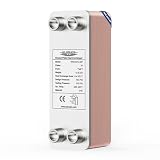
- Excellent Quality: This brazed plate heat exchanger is made of high-quality SS316L stainless steel, brazed with copper in a vacuum environment, ensuring a reliable and robust component. It offers superior resistance to high temperatures, high pressures, corrosion, and leaks, playing an excellent role in supporting various refrigeration, heating, high-temperature, and high-pressure industrial fields.
- Heat-transfer Efficiency increased by 99%: The heat exchanger adopts a fishbone corrugated design, which increases the intensity of the turbulence and creates various support points that reduce the secondary side pressure, resulting in a rapid increase in channel heat transfer efficiency by 99%.
- Convenient to Use and Energy Saving: The smooth threads allow for quick and flexible disassembly and installation. Ultra-thin stainless steel plates provide excellent performance and economy in heating and cooling, improving energy efficiency and reducing operating expenses.
- Product Parameter:Model WHE4X12-30P can produce up to 366000 btu per hour depending on different applications. 8.4 sq.ft heat transfer area,4"x12"-30 plates with 1"MPT.
- One-year limited warranty: The stainless steel heat exchanger provides exceptional thermal efficiency and durability in a compact, lightweight design and ALORAIR offers a one-year limited warranty covering manufacturing defects.
Verify materials, fouling, and serviceability
Provide fluid chemistry and contamination details, including corrosive species, particulates, deposits, and any known fouling tendency. Request written confirmation of material compatibility and the supplier’s fouling assessment for the actual service. Alfa Laval describes stainless steel in its diffusion-welded design and notes the absence of gaskets in its brazed design; neither statement is a universal material-compatibility table or a cleaning procedure.
Discuss inspection, cleaning, maintenance access, reliability expectations, and documentation before procurement. The reviewed manufacturer and engineering material does not establish a general cleaning method for all plate-fin units, so obtain the procedure and serviceability limits for the proposed design rather than assuming the core can be cleaned like another exchanger type.
Independent reader supportYour contribution helps us test, update, and keep practical guides available for everyone.Compare plate-fin with alternatives on the project need
Compare supplier and technology proposals against the same duty cases, pressure-drop limits, approach temperatures, flow asymmetry, cycling, materials, cleanability and inspection needs, documentation, schedule, footprint, and lifecycle cost. Plate-fin equipment can be compelling when compact, efficient gas service is central, but the quote should make its assumptions and limitations visible.
Best Value

- Durable Material: This wort chiller is made of 304 stainless steel plates with 99.9% copper brazed. Using this plate chiller can reduce oxidation in your homebrew heat exchange
- Quickly Chilling Beer Wort: This compact heat exchanger is designed for chilling your beer/ wort/water. Compared with the immersion chiller, our heat exchanger has 20 brazed plates and cools wort within minutes rather than several hours
- Easy To Clean Out: The heat exchanger can't be dissembled to clean. So firstly you can run 5 gallons of cleaning solution through this chiller. Then running some clear water through the wort chiller. After done, dry the chiller before storage
- Can Work With Water Pump: The wort-in port of the chiller connect your mash tun, the wort-out port connect your fermenter, the wort can be transferred by a wort pump. One side of the water hose connects to your water tap and the other side connects to the water-in port of our plate chiller. Using another hose to connect the water-out port of the chiller to remove the warm water
- Multifunctional Usage: Using for cooling wort/beer/water. It's perfect to use in the lab, for beer brewing, or for any application that requires the exchange of heat between two fluids. Please install a filter for the wort to prevent clogging of the wort chiller. Cannot be used for viscous liquids
A printed-circuit heat exchanger (PCHE) may be worth comparing for clean, high-pressure duties, but it is a different technology rather than a default plate-fin replacement. Alfa Laval describes its PCHE as using etched channels and diffusion-welded plates, and lists a product-family range of up to 1,250 barg and −196°C to 800°C for 316/316L stainless steel. Treat these as manufacturer-stated PCHE figures, not as plate-fin ratings or evidence that a PCHE is suitable for every high-pressure service.
Send a supplier-ready inquiry and require written confirmation
Include the complete process brief and request a project-specific rated performance proposal. A useful inquiry asks the supplier to confirm the following in writing:
- Thermal rating for each stated operating case and the basis for the required heat duty and outlet temperatures.
- Pressure drop on each side at the quoted conditions, including the limits and assumptions used.
- Flow distribution approach, with specific treatment of any two-phase or phase-change streams.
- Exact construction, materials, and compatibility with the stated fluid composition and contaminants.
- Operating and design pressure and temperature limits, including the stated cycle and upset conditions.
- Footprint, connections, installation constraints, and inspection, cleaning, maintenance, and documentation provisions.
- Applicable code, certification, and inspection route for the installation jurisdiction and service classification.
The applicable code and certification regime cannot be determined without the installation geography, service classification, and project requirements. Resolve those with the project engineer and supplier before procurement; do not infer approval from a product-family rating.
Quick Recap
Product prices and availability are accurate as of the date/time indicated and are subject to change. Any price and availability information displayed on Amazon at the time of purchase will apply.
Recommended Free Tools

