
The Tool Desk
Outbyte PC Repair FREERepair Windows errors before they cause bigger problemsFix Now →Outbyte Driver Updater FREEFix the driver behind crashes, sound loss and screen glitchesFind Drivers →iTechGuides is reader-supported. When you buy through links on our site, we may earn an affiliate commission. As an Amazon Associate I earn from qualifying purchases. Learn more
AI can help Formula 1 strategists estimate when to pit and compare possible race scenarios, but public sources do not show that software autonomously makes a team’s pit call. The clearest current example is Formula 1’s 2026 Strategy Insight, a fan-facing graphic that uses live data and predictive analysis to explain why a team might extend a stint or react to an undercut threat.
What AI does in F1 race strategy
Race strategy involves weighing changing conditions against possible outcomes. Machine-learning models can process live and historical data to estimate tyre performance, likely pit windows, and the consequences of different choices. Those outputs support analysis; they are estimates, not guarantees that a particular option will work.
Formula 1’s 2018 account of its AWS programme described training deep-learning models on more than 65 years of historical race data and streaming real-time data. It said the models could generate race predictions and explain strategy, including estimating when a pit window might open or close and when a tyre change could be advantageous. That announcement describes F1’s published programme at the time; it does not establish that every team uses the same system. Formula 1’s 2018 announcement quoted Director of Innovation and Digital Technology Pete Samara: “By leveraging Amazon SageMaker and AWS’s machine learning services, we are now able to deliver these powerful insights and predictions to fans in real time.”
Recommended Free Tools
F1’s 2026 Strategy Insight is a newer public example. Formula 1 says it combines live timing, telemetry, and historical race data to explain strategic choices such as extending a stint or responding to an undercut threat. The analysis considers tyre performance, pit windows, Safety Car risk, and rival behaviour, with historical modelling used to compare current conditions with earlier scenarios. It is designed to explain choices in real time for viewers, not to document the private decision systems of individual teams. Formula 1’s 2026 Strategy Insight announcement
#1 Best Overall

- RACE WITH REAL-TIME DATA - The built-in 4.3 inch IPS LCD display shows up to 69 critical telemetry items with dynamic skins that adapt to your game, giving you the same cockpit awareness as professional drivers so you can make faster, smarter decisions every lap in your sim racing setup.
- CARBON FIBER BUILT FOR SPEED - A genuine 21 layer carbon fiber faceplate delivers the perfect balance of rigidity and lightweight feel, ensuring every ounce of Force Feedback reaches your hands without distortion, so your formula wheel feels as responsive and precise as the real Ferrari SF1000 race car replica it was modeled after.
- TOTAL COMMAND AT YOUR FINGERTIPS - With up to 25 fully programmable action buttons including 7 rotary encoders, you gain unlimited configuration possibilities for every racing simulator scenario, letting you fine tune brake bias, differential, and engine modes without ever taking your eyes off the track or losing precious time.
- IMMERSIVE OFFICIALLY LICENSED DESIGN - Officially licensed by Ferrari with iconic labeling and authentic markings, this steering wheel delivers unrivaled realism whether connected natively or via wireless telemetry, transforming your sim racing cockpit into a true Formula One experience that looks and feels absolutely spectacular.
- PREMIUM MAGNETIC PADDLE SHIFTERS - Swap between the included 100% aluminum interchangeable magnetic paddle shifters for lightning quick gear changes, plus two customizable analog paddle shifters give you extra control for clutch biting points and advanced driving techniques on your racing wheel and pedals setup.
How AI can inform a pit-stop decision
A model’s useful role is to compare plausible options as race conditions change. The answer to “when should the driver pit?” depends not only on tyre age but also on the time lost by stopping, track position, rival actions, and the chance that a Safety Car or yellow flag changes the calculation.
Estimate the pit window
A pit window is an estimated period when stopping may be worthwhile. F1’s broadcast-facing Pit Window insight uses tyre compound, lap times, and the spread between cars. The estimate can change as pace, gaps, or race conditions change; it is not a fixed appointment. AWS’s overview of F1 insights also describes Predicted Pit Stop Strategy, based on historical data, and Pit Strategy Battle, which shows how strategic changes affect outcomes.
Rank #2

- Official life-size replica of the steering wheel from the Ferrari SF-25 race car
- Interactive 4.3-inch / 109-mm IPS LCD display and 21 LEDs to display race information
- 25 action buttons and 7 encoders with authentic markings
- 100% carbon fiber faceplate: rigid and lightweight
- Super-responsive T-Chrono Paddles push/pull paddle shifters, plus customizable analog paddle shifters
Compare tyre pace and durability
Tyres involve a pace-versus-stint-length trade-off. AWS’s 2020 explanation says softer compounds offer more grip and handling but degrade faster, while harder compounds last longer but can limit cornering speed and traction. A strategy model can help compare the likely performance over a stint against the cost and timing of changing tyres; it cannot make tyre degradation predictable in every circumstance. AWS’s 2020 explanation of machine learning in F1
Quick wins for a faster PC:
Repair Windows errors before they cause bigger problemsFix Now →Scan for outdated or missing drivers - takes under a minuteDriver Scan →Clear out junk files and repair common Windows errorsFree Scan →Account for the cost of stopping
A fresh set of tyres may improve pace, but a pit stop costs time and can let a rival gain position. AWS put the average pit-stop time cost at around 20 seconds in its 2020 technical post. That is a dated approximate figure, not a current universal or circuit-specific measurement; the actual strategic cost depends on the race and circumstances.
Rank #3
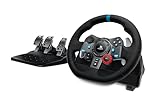
- Immersive Gaming Experience: Perfect for PlayStation 5, PS4 and PC gaming titles, the Driving Force simulates the feeling of driving a real car with precision steering and pressure-sensitive pedals
- Premium Control: The Driving Force feedback racing wheel provides a detailed simulation of driving a real car, with helical gearing delivering smooth, quiet steering and a hand-stitched leather cover
- Customizable Pedals: These pressure-sensitive nonlinear brake pedals provide a responsive, accurate braking feel on a sturdy base - with adjustable pedal faces for finer control
- 900-Degree Rotation: Lock-to-lock rotation of the Driving Force means you can turn the wheel around two and a half times, hand over hand on wide turns - just like a real F1 race car
- Up Your Game: Take your racing simulation to the next level with Driving Force accessories like the Driving Force Shifter or desk and rig mounts
Anticipate rivals, traffic, and interruptions
Models can compare an early stop with staying out, including whether pitting exposes a car to an undercut threat or places it in traffic. A Safety Car or yellow flag may change the value of stopping, while car spread and rival behaviour affect how much track position is at stake. These factors are why a forecast should be read as conditional on available data, not as a certain prediction.
What F1’s public data claims do—and do not—show
The public-facing products make strategy concepts visible to fans, but they are not a transparent window into each team’s private race operations. The public sources cited here do not identify a current team’s internal AI model, disclose its performance, or establish whether any model has authority to make a binding pit call.
Rank #4

- Immersive Gaming Experience: Perfect for Xbox and PC gaming titles, the Driving Force simulates the feeling of driving a real car with precision steering and pressure-sensitive pedals
- Premium Control: The Driving Force feedback racing wheel provides a detailed simulation of driving a real car, with helical gearing delivering smooth, quiet steering and a hand-stitched leather cover
- Customizable Pedals: These pressure-sensitive nonlinear brake pedals provide a responsive, accurate braking feel on a sturdy base - with adjustable pedal faces for finer control
- 900-Degree Rotation: Lock-to-lock rotation of the Driving Force means you can turn the wheel around two and a half times, hand over hand on wide turns - just like a real F1 race car
- Up Your Game: Take your racing simulation to the next level with Driving Force accessories like the Driving Force Shifter or desk and rig mounts
AWS’s 2020 post reported 300 sensors on each race car and 1.1 million data points per second. Those are figures from that dated account, not newly verified current specifications. Formula 1’s 2025 announcement described 23 data-driven F1 Insights at that time; that count refers to broadcast insights, not the number of AI systems used by teams.
How to read a strategy comparison
When an insight graphic or analyst compares possible plans, look for the same factors across each option rather than treating a predicted outcome as a promise:
Best Value

- Collector’s item. Detachable Ferrari 150th Italia racing wheel replica for the Thrustmaster T300RS (PS3 & PS4); T500RS (PS3, PS4, Xbox One & PC); and TX Wheel (Xbox One & PC), all sold separately
- A precise, robust and realistic racing wheel
- Full-size replica of the Formula 1 Ferrari 2011 racing wheel, under official license by Ferrari
- Reinforced scratched-brushed metal face is heavier and more solid compared to plastic, ensuring optimum stability and inertia
- Rubber-textured wheel offering a realistic and comfortable grip
- Tyre pace and degradation: how the expected pace changes over the stint and how long the tyres may remain competitive.
- Stop timing and time lost: when the stop is projected and how much time it costs in the pit lane.
- Rival response: whether a stop could create an undercut opportunity for another car or prompt a counter-stop.
- Traffic and car spread: whether the driver is likely to rejoin behind rivals or into clear track.
- Safety Car and yellow-flag sensitivity: how an interruption could alter the cost or timing of stopping.
Formula 1’s 2025 Real-Time Race Track experience uses Amazon Nova to analyse custom track designs and produce projected metrics, two viable strategies, pit timing, tyre recommendations, and weather adjustments. It is an interactive demonstration of strategy concepts for fans, not evidence that actual team decisions are made by that product. Formula 1 described the experience as a way to bring fans closer to the sport through cloud technology and AI. Formula 1’s 2025 announcement
Quick Recap
Product prices and availability are accurate as of the date/time indicated and are subject to change. Any price and availability information displayed on Amazon at the time of purchase will apply.

