
Windows Errors? Fix Them Before They Spread
Repair common Windows errors and clear accumulated junk for a smoother, more stable PC - no reinstall needed.Free scan · no reinstallCrashes, No Sound, or Screen Glitches?
Random freezes, missing sound and display glitches usually trace back to one bad driver. Find and replace yours safely.Free scan · under a minuteThe most reliable way to tell crocodilian fossils from dinosaur fossils is to examine several bones together—especially the pelvis, sacrum and limbs. Dinosaurs held their legs beneath the body and had at least three fused vertebrae in the sacrum; crocodilians had a sprawling stance. A tooth or armor plate can offer clues, but neither is conclusive by itself.
Start with the whole skeleton, not a single bone
Crocodilians and dinosaurs are both archosaurs, a broad group of reptiles. That shared ancestry means “prehistoric reptile” is not enough to identify a fossil as a dinosaur. The Natural History Museum, London, describes dinosaur identification as relying particularly on modifications to the hips and legs, which are best assessed when bones are preserved together. (Natural History Museum: Where did dinosaurs come from?)
| Feature | Crocodilian clues | Dinosaur clues | What can limit the comparison |
|---|---|---|---|
| Leg posture | Limbs angled out from the body in a sprawling stance. | Legs positioned beneath the body in an upright stance. | A detached limb bone may not show how the animal held its body. |
| Pelvis and sacrum | The cited museum comparison says reptiles may have up to two vertebrae fused into the sacrum. | At least three fused sacral vertebrae, with a stronger connection between hips and backbone. | The relevant vertebrae and their relationship to the pelvis must be preserved. |
| Teeth | In the Smithsonian guide to Hell Creek fossils, crocodilian teeth are commonly conical, with paired ridges offset to one side; rear teeth may be shorter and blunter. | Tooth shapes vary among dinosaur groups; some dinosaurs had rounded, crocodile-like teeth. | Shape overlaps, so a tooth alone may not identify the animal. |
| Bony armor | The Hell Creek guide describes crocodilian scutes as flat plates, often rectangular or oval, with a keel and deep, spaced pits on top. | Some dinosaur groups also had bony armor. | Armor alone does not distinguish a crocodilian from an armored dinosaur; the scute details are examples from a particular fossil setting. |
| Vertebrae | The Hell Creek guide describes crocodilian neck and back vertebrae as procoelous: concave at the front and convex at the rear. | Sacral structure can help identify dinosaurs when enough of the spine and pelvis remains. | Vertebrae differ by body region and taxon; tail vertebrae may have different shapes. |
The museum’s practical distinction is that reptiles have up to two vertebrae fused into a sacrum, while a dinosaur needs at least three. This is useful only when the relevant part of the backbone is available to inspect. (Natural History Museum: Where did dinosaurs come from?)
How to assess a fragmentary fossil
- Identify what kind of bone you have. A tooth, scute, vertebra, limb bone and pelvic element each preserve different evidence. Avoid assigning an animal based on a vague resemblance.
- Look for multiple anatomical clues. For a possible dinosaur, check whether the pelvis, sacrum and limbs support an upright, under-the-body stance. For a possible crocodilian, assess tooth details, scute form and vertebrae together.
- Check locality and geological context. The Smithsonian identification guide covers latest Cretaceous microfossils from the Hell Creek Formation of northeastern Montana. Its illustrated examples are useful comparisons, not a universal key for every crocodilian or dinosaur fossil. (Smithsonian National Museum of Natural History: Illustrated Guide to latest Cretaceous Vertebrate Microfossils)
- Keep the identification cautious if evidence is incomplete. If the diagnostic bones are missing or clues conflict, describe what is supported—such as “crocodilian-like tooth” or “possible dinosaur”—rather than stating a definitive identification.
Why teeth and armor can mislead
Tooth shape overlaps
Crocodilian teeth are often described as conical, but that shape is not exclusive to crocodilians. Baryonyx, a dinosaur, had rounded teeth described by the Natural History Museum as crocodile-like. That overlap is why the shape of one tooth cannot settle the identification. (Natural History Museum: How did Baryonyx change what we knew about spinosaurs?)
Free tools Windows power users keep installed
One-click scans. No signup required.
#1 Best Overall

- Resin Cast Replica
- 5.5 inches
Bony armor is not exclusive to crocodilians
Crocodilian scutes can be recognizable by their plate-like form, keel and pitted upper surface, as illustrated in the Smithsonian’s Hell Creek guide. But some dinosaurs were armored too. Look for the particular structure and its anatomical context, not simply the presence of bone plates.
Independent reader supportYour contribution helps us test, update, and keep practical guides available for everyone.When the evidence cannot settle the question
Fossils may preserve too little anatomy for a confident identification. The Natural History Museum notes that fragmentary Nyasasaurus material is difficult to classify with certainty, illustrating why careful fossil interpretation can leave some cases unresolved. Geological context and comparisons with better-preserved specimens can help, but they cannot restore features that were never preserved. (Natural History Museum: Where did dinosaurs come from?)
Rank #2
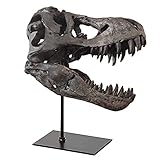
- 【Home Office Desktop Shelf Decor 】Dinosaur head sculptures skull model is hand cast from high-quality solid resin. The surface is made of antique craftsmanship, and the convincing colours and details make it look very realistic and eye-catching. Add some aesthetic to your room
- 【Supplement Your Collection】T-Rex is one of the most popular dinosaurs in the world. For dinosaur lovers or palaeontology lovers, the tyrannosaurus rex skull is a fantastic replica. It will also be a fun teaching tool for any child or teen
- 【Home Decor and Conversation Starter】A lifelike dinosaur skeleton decor. This impressive sculpture looks great on a table or bookshelf. It will be a great conversation starter and conversation piece for any family
- 【Suitable for Many Occasions】This Tyrannosaurus Rex skull replica comes with a metal base. There are 4 non-slip pads on the bottom of the stand to protect the surface of your furniture. It can be placed on various occasions such as office, hallway, TV cabinet, wine rack, living room, etc
- 【Perfect Christmas/Birthday Gift】10.2x 5.9x 11.8 inches.It only takes 2 minutes to complete the installation.Give it as a gift to children, adults, husbands, and friends, no one will refuse it
Other superficial clues are weak: living in water, being large, looking reptilian or having armor does not by itself make a fossil crocodilian or dinosaur. A defensible identification rests on a combination of anatomy and context.
Quick Recap
Rank #4

- IT FROM XUQCAH MATERIAL AND FOIMOJSK PAR ENT AND Thurder LOVER
- Museum Quality Replica
- Please thoroughly read discription
Rank #3

- Utahraptor was a large theropod dinosaur that lived during the Early Cretaceous period, known for its sharp claws and hunting abilities
- This replica is based on a real Utahraptor fossil discovered in Utah, accurately capturing the shape and detail of the original claw
- The Utahraptor’s curved claw was used for gripping and slashing, making it a key tool for hunting prey
- Cast in durable resin, this 5.5-inch replica offers museum-quality detail and texture
- Made in the USA, this fossil reproduction is perfect for collectors, educators, and dinosaur enthusiasts
Product prices and availability are accurate as of the date/time indicated and are subject to change. Any price and availability information displayed on Amazon at the time of purchase will apply.
Recommended Free Tools

