
SpaceX has shown that a Falcon 9 first-stage booster can return and fly again dozens of times: on August 25, 2026, booster B1067 completed its 37th mission. That is strong operational evidence for repeated booster reuse, not proof that the entire Falcon 9 is reusable or that each reflight saves a specific amount of money.
What SpaceX’s reuse record actually proves
In its August 25, 2026 report, Space.com reported that Falcon 9 booster B1067 flew its 37th mission during the rocket’s 100th flight of 2026. The booster landed on an Atlantic drone ship about 8.5 minutes after liftoff. Space.com also reported that six boosters had each flown more than 30 times, and that Falcon 9 flew 165 missions in 2025.
These dated milestones show reuse operating repeatedly at substantial scale, rather than only succeeding in a one-off landing demonstration. The figures describe flights reported by August 25, 2026; they are not a permanent record or a maximum lifetime for a booster.
Which parts of Falcon 9 are reused?
Falcon 9’s first stage performs the initial powered ascent, separates, and returns under its own control. It lands either at a terrestrial landing zone or on an ocean drone ship. After inspection and any needed refurbishment, a recovered booster may be assigned to another mission.
#1 Best Overall

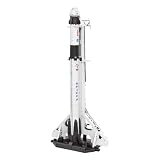
- Extremely exquisite Falcon 9 STRONGBACK rocket model (For collection or display, not a toy! Children should not buy it)
- First-stage super heavy-duty booster is made of precise aluminum alloy tubes. Other parts constructed with High-quality imported laser-formed photosensitive resin-it rocket material
- The proportional model:1:233
- Actual height: 32cm (the core diameter is 24mm, the real rocket is 9 meters in diameter) This ratio is the best choice for desktop placement
- Note: This model is not a toy model, it is not recommended to buy for children, please buy with caution to avoid unnecessary trouble for your shopping
The second stage continues the payload’s journey. The FAA says it either remains in orbit or disintegrates during atmospheric reentry; it is not recovered as part of Falcon 9’s reuse system. The FAA’s Falcon program description explains this distinction. So a booster’s 37 missions do not mean 37 complete rockets were recovered and reflown.
How reuse supports launch cadence
Reusing a recovered first stage means SpaceX can return that hardware to service instead of manufacturing a new booster for every launch. This can support a high launch cadence, though reuse alone does not establish how many launches will occur: schedules, payloads, weather, operational readiness, and regulatory approvals also matter.
Rank #2

- Name:Falcon 9 + Dragon Material::Alloy+resin
- Size:Approximately 30x2cm (11.8*1 inch) Function: Static desktop display
- For collection or display, Not suitable for children to play with Handmade, there may be minor flaws
- Model is a highly Simulated SpaceX Falcon9 Dragon+F9 Starship Heavy Falcon Falcon 9 Biock 5 rocket model. The main body of the first-stage rocket is precision aluminum alloy tube, and the rest of the rocket materials are made of high-quality imported resin-with excellent laser forming ability and long-lasting preservation
For example, an FAA page describing an October 2025 environmental review at Vandenberg discusses up to 100 Falcon launches per year across SLC-4 and SLC-6. That is an assessed level in a review, not a count of launches actually completed. The same FAA program page provides information on Falcon launch and recovery activities.
What the evidence says about cost
NASA’s Launch Services Program says that reusability lets SpaceX refly Falcon 9’s most expensive parts and drives down the cost of access to space. That supports the broad claim that reuse can reduce costs. NASA’s description of launch-service rockets does not provide an audited current refurbishment cost, a per-flight saving, or a comparable current launch-price calculation. The flight record therefore demonstrates operational reuse, but it cannot by itself quantify the savings.
What’s actually slowing this PC down?
Pick the symptom - the matching free tool is one click away.
Rank #3
- HOBBY MODEL KIT – Unassembled model packed in an envelope with easy to follow instructions. Ideal for ages 14 and up.
- NO GLUE OR SOLDER NEEDED – Parts can be easily clipped from the metal sheets. Tweezers are the recommended tool for bending and twisting the connection tabs.
- SPACEX FALCON 9 - 3 Sheet Model with a Moderate difficulty level. Assembled Size: 3.00 L x 1.50 W x 7.00 H inches. 84 Pieces.
- FROM STEEL SHEETS TO 3D – Pop out the pieces and connect using tabs and holes. Includes illustrated instructions.
- HIGHLY DETAILED ETCHED MODEL – Display your 3D model once completed - collect and build them all.
Falcon 9 reuse is not Starship reuse
Falcon 9 has an operationally reused first stage and an unrecovered second stage. SpaceX describes Starship as a fully and rapidly reusable system, with milestones involving launch, return, catch, and reuse. That is a separate program and design objective; it should not be treated as evidence that Falcon 9 is fully reusable or that Starship has Falcon 9’s established reflight record.
Quick Recap
Best Value

- Name:1:233 Falcon 9+Dragon Launch Station Set Material::Alloy+resin
- Size:Approximately 30x4cm (11.8*1.5inch) Function: Static desktop display
- For collection or display, Not suitable for children to play with Handmade, there may be minor flaws
- Model is a highly Simulated SpaceX Falcon9 Dragon+F9 Starship Heavy Falcon Falcon 9 Biock 5 rocket model. The main body of the first-stage rocket is precision aluminum alloy tube, and the rest of the rocket materials are made of high-quality imported resin-with excellent laser forming ability and long-lasting preservation
Rank #4

- Extremely exquisite SpaceX Falcon 9 rocket model (For collection or display, not a toy! Children should not buy it)
- First-stage super heavy-duty booster is made of precise aluminum alloy tubes. The rest of the rocket is made of high-quality imported resin.Extremely good laser shapeability& long-lasting shelf life
- The proportional model:1:233
- Actual height: 32cm (the core diameter is 24mm, the real rocket is 9 meters in diameter) This ratio is the best choice for desktop placement
- Note: This model is not a toy model, it is not recommended to buy for children, please buy with caution to avoid unnecessary trouble for your shopping
Product prices and availability are accurate as of the date/time indicated and are subject to change. Any price and availability information displayed on Amazon at the time of purchase will apply.

