
Do these 3 things before closing this tab:
1Fix the driver behind crashes, sound loss and screen glitches2Repair Windows errors before they cause bigger problems3Scan for outdated or missing drivers - takes under a minuteiTechGuides is reader-supported. When you buy through links on our site, we may earn an affiliate commission. As an Amazon Associate I earn from qualifying purchases. Learn more
The source article titled “4 self-hosted services that made my home network more useful, not more complicated” actually names five services: Pi-hole, Homepage, Uptime Kuma, Jellyfin, and Immich. Each solves a different problem, but each also adds some maintenance or a new point of failure. The practical approach is to choose one that meets a specific need, then add others only when your setup calls for them. The descriptions below reflect Nick Lewis’s article, published by Yahoo Tech on September 25, 2026.
What does each service do, and what does it add?
| Service | Everyday use | Main setup or operating trade-off |
|---|---|---|
| Pi-hole | Blocks domains on configured DNS blocklists for devices using it. | Network DNS can fail if its host goes down and no secondary DNS server is configured; it cannot block every first-party ad. |
| Homepage | Provides a dashboard for links to self-hosted services and live stats. | Configuration uses YAML. |
| Uptime Kuma | Checks services and devices, keeps response-time history, and can send alerts. | If it shares hardware with monitored services, the same outage can take down both. |
| Jellyfin | Organizes and plays a personal media library on supported devices. | Remote access needs a deliberate network setup; 4K transcoding calls for capable hardware. |
| Immich | Manages a photo and video library, with automatic phone backups and natural-language search using local models, as described in the article. | Uses multiple containers and several gigabytes of RAM; the service is not itself a second copy of the library. |
Which service fits the problem you want to solve?
Pi-hole: reduce access to blocklisted domains
Pi-hole acts as a DNS sinkhole: when a device asks to resolve a domain on a configured blocklist, Pi-hole can prevent that lookup. This can apply across devices that use it for DNS, including phones, smart TVs, consoles, and IoT equipment. The article describes potential benefits for reducing ads, trackers, scam or phishing sites, and known malware command domains.
DNS filtering has limits. Ads served from the same domain as the content—YouTube is one example in the article—may not be separable by a domain blocklist. There is also a network dependency to plan for: if the Pi-hole host fails, DNS may stop working for devices relying on it. Configuring a secondary DNS server can provide a fallback, though the article does not describe a particular setup or guarantee how a device will use that fallback.
Recommended Free Tools
Homepage: make services easier to find
When self-hosted services accumulate, their IP addresses and port numbers can become a nuisance to remember. Homepage puts links and live service statistics in one dashboard. The article says its widgets can retrieve information from services such as Pi-hole, Jellyfin, and Immich.
#1 Best Overall

- 【Advanced Home Data & Media Hub】For advanced home users who need phone backup, file storage, and centralized data management. Centralize family photos, 4K videos, movies, computer backups, and personal files in one place while running multiple apps for home entertainment and everyday data management. Suitable for households with growing digital libraries and multiple NAS use cases.
- 【Built for Creators, Media Servers & Advanced Apps】Powered by the Intel N100 Quad-Core CPU, 8GB DDR5 RAM, 2.5GbE networking, and dual M.2 NVMe slots, DXP2800 handles large files and heavier workloads with ease. Run Docker, virtual machines, and media server applications compatible with Plex—ideal for content creators, tech enthusiasts, and advanced home users managing 4K videos, RAW photos, personal media libraries, and multiple NAS apps.
- 【Up to 80TB for Growing Digital Libraries】 Supports up to 80TB of storage using two HDD bays and two M.2 NVMe SSD slots for family photos, movies, RAW photos, 4K videos, work files, and device backups. AI photo management supports recognition of people, objects, scenes, and locations, album organization, and duplicate photo detection. HDDs and SSDs are not included.
- 【AI-powered Home Surveillance】Turn DXP2800 into a centralized home surveillance hub by connecting compatible network cameras and storing recordings locally on your NAS. AI-powered features include Face Recognition, People Detection, and Pet Detection, helping advanced home users review important events more efficiently while managing home surveillance and personal data in one place.
- 【One data Center Across Your Devices】Keep files from desktops, laptops, phones, tablets, and other devices together instead of scattered across cloud accounts and external drives. Access, back up, organize, and share data across Windows, macOS, Android, iOS, web browsers, and compatible smart TVs—ideal for creators and advanced home users working across multiple devices.
The stated setup cost is YAML configuration. Homepage addresses navigation and at-a-glance visibility; it is not a substitute for checking whether a service is actually available or fixing an outage.
Uptime Kuma: notice when services stop responding
Uptime Kuma can check HTTP endpoints, TCP ports, ping responses, and Docker containers. It can send alerts through Discord, Telegram, or email, while response-time history may help reveal a service or device that is becoming unreliable.
Rank #2

- Entry-level NAS Personal Storage:UGREEN NAS DH2300 is your first and best NAS made easy. It is designed for beginners who want a simple, private way to store videos, photos and personal files, which is intuitive for users moving from cloud storage or external drives and move away from scattered date across devices. This entry-level NAS 2-bay perfect for personal entertainment, photo storage, and easy data backup (doesn't support Docker or virtual machines).
- Set Your Devices Free, Expand Your Digital World: This unified storage hub supports massive capacity up to 64TB.*Storage drives not included. Stop Deleting, Start Storing. You can store 22 million 3MB images, or 2 million 30MB songs, or 43K 1.5GB movies or 67 million 1MB documents! UGREEN NAS is a better way to free up storage across all your devices such as phones, computers, tablets and also does automatic backups across devices regardless of the operating system—Window, iOS, Android or macOS.
- The Smarter Long-term Way to Store: Unlike cloud storage with recurring monthly fees, a UGREEN NAS enclosure requires only a one-time purchase for long-term use. For example, you only need to pay $459.98 for a NAS, while for cloud storage, you need to pay $719.88 per year, $2,159.64 for 3 years, $3,599.40 for 5 years. You will save $6,738.82 over 10 years with UGREEN NAS! *NAS cost based on DH2300 + 12TB HDD; cloud cost based on 12TB plan (e.g. $59.99/month).
- Blazing Speed, Minimal Power: Equipped with a high-performance processor, 1GbE port, and 4GB RAM on Board, this NAS handles multiple tasks with ease. File transfers reach up to 125MB/s—a 1GB file takes only 8 seconds. Don't let slow clouds hold you back; they often need over 100 seconds for the same task. The difference is clear.
- Let AI Better Organize Your Memories: UGREEN NAS uses AI to tag faces, locations, texts, and objects—so you can effortlessly find any photo by searching for who or what's in it in seconds. It also automatically finds and deletes similar or duplicate photo, backs up live photos and allows you to share them with your friends or family with just one tap. Everything stays effortlessly organized, powered by intelligent tagging and recognition.
Where Kuma runs matters. If it shares a host with the services it monitors, a hardware or host outage can disable both the monitored service and the monitor. A separate low-power device can reduce that shared-failure risk, although it does not eliminate other causes of monitoring or network outages.
Free tools Windows power users keep installed
One-click scans. No signup required.
Jellyfin: organize and play a personal media library
Jellyfin is described as a free, open-source media server, with apps for TVs and phones as well as browser access. The article presents it as a way to organize and play a personal library without ads, trackers, analytics, or subscriptions.
Rank #3

- Your Personal Streaming Server - Build your own Netflix-style media library and stream 4K movies, shows and photos to any device without monthly fees
- Create Your Own Cloud - Store your entire photo, video and music collection; access from anywhere with fast 282 MB/s transfer speeds
- Creator-Grade Backup Solution - Protect your irreplaceable content with automated backups to cloud services, external drives and remote NAS
- Multi-Layered Data Protection - Combine RAID redundancy, automated backups and snapshot technology to prevent data loss from any cause
- Smart Home Surveillance - Support up to 30 IP cameras with AI detection, instant alerts and secure remote monitoring
Remote access requires a network-access method such as a VPN or reverse proxy. The article recommends WireGuard or Tailscale as safer and easier options; that is the article author’s recommendation, not an independently verified comparison here. For 4K transcoding, the article recommends a capable CPU with Intel Quick Sync or a dedicated GPU. The server’s hardware needs therefore depend on whether your playback setup requires transcoding.
Immich: manage and back up photos from phones
Immich is a self-hosted photo and video library. The article describes automatic phone backups and natural-language search powered by local models. It also notes that Immich runs multiple containers and uses several gigabytes of RAM, so it brings more host and service complexity than a simple link dashboard.
Rank #4
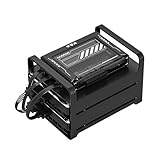
- 【Build Your Own NAS & Homelab — Not Just Storage】 More than a traditional NAS, ZimaBlade 7700 is a flexible x86 mini server for building your own homelab, personal cloud, or Docker host. Perfect for DIY NAS, self-hosting, container apps, and even retro systems — not limited like typical ARM-based NAS devices.
- 【x86 Platform — Broad Compatibility, Real Freedom】 Powered by an Intel quad-core x86 processor, it runs a wide range of operating systems and software with native compatibility. Ideal for Linux, Docker, CasaOS, and more — designed for flexibility and experimentation rather than locked-down appliance use.
- 【16GB RAM for Smooth Multi-Service Workloads】 Handle file sharing, media streaming, backups, and multiple lightweight services at once. Optimized for low-power, always-on operation — a great fit for home labs and personal servers running 24/7.
- 【Smooth 4K Media Streaming — Plex Direct Play Ready】 Stream your personal media library smoothly with Plex and similar media servers. Supports 4K playback on compatible devices via direct play, delivering a reliable home media experience without the need for heavy transcoding.
- 【Complete 2-Bay NAS Kit — Ready to Build】 Includes power supply, 16GB RAM, metal drive cage for 2 HDD/SSD, and dual SATA cables — everything you need to start building your own NAS right out of the box.
Most importantly, a photo library managed by Immich is not automatically a second backup just because it is self-hosted. Keep another copy of the library. A service that organizes data and a separate copy that can restore it serve different purposes.
How should you choose what to run first?
- Choose Pi-hole if DNS-based blocking addresses a clear annoyance, and you are prepared to plan for DNS availability.
- Choose Homepage when the main frustration is finding and opening services you already run.
- Choose Uptime Kuma when you have enough services or devices that discovering outages promptly matters. Consider whether its host would fail alongside the systems it monitors.
- Choose Jellyfin if you want a self-hosted personal media library and can plan for remote access and any transcoding your playback requires.
- Choose Immich if phone photo and video management is the goal and you can provide the service’s host resources plus a separate copy of the library.
Nick Lewis’s article recommends starting with one service and adding others as needs emerge. It singles out Pi-hole as a quick-benefit starting point, and says dashboards and monitoring become more useful as the number of services grows. Those are the author’s judgments, not measured comparisons of setup time or benefit.
Best Value

- Secure private cloud - Enjoy 100% data ownership and multi-platform access from anywhere
- Easy sharing and syncing - Safely access and share files and media from anywhere, and keep clients, colleagues and collaborators on the same page
- Automated Backup Protection - Set-and-forget backups for Macs, PCs and mobile devices to multiple destinations including cloud and external drives
- Home Security System - Record and monitor your property 24/7 with support for multiple IP cameras and remote viewing
- 2-Year Warranty - Reliable hardware backed by Synology's expert customer support team and ongoing software updates
Keep self-hosting useful rather than burdensome
Every service adds something to maintain: a DNS dependency, a configuration file, an alerting system, remote-access decisions, or a data-protection responsibility. A small setup can stay manageable by choosing services for problems you actually have rather than installing all five at once. When you add a service, identify what happens if its host goes down and, for important data, how you would restore a separate copy.
Quick Recap
Product prices and availability are accurate as of the date/time indicated and are subject to change. Any price and availability information displayed on Amazon at the time of purchase will apply.

