
iTechGuides is reader-supported. When you buy through links on our site, we may earn an affiliate commission. As an Amazon Associate I earn from qualifying purchases. Learn more
If you need several model providers behind one application interface, an LLM gateway can centralize routing and selected operational controls. The right choice depends less on a feature checklist than on where you want the control plane to live, how your applications authenticate, and what you need to observe or govern. This comparison uses the products’ official documentation available on October 7, 2026; it is not a hands-on test or a common benchmark.
What an LLM gateway does—and what it does not
Apache APISIX describes an AI gateway as “a traffic control layer between applications and model providers.” In practice, a gateway can sit between an application and one or more model APIs to handle selected traffic-management tasks, such as routing, retries, rate limits, or request logging.
It is not a substitute for application authorization, orchestration, tool selection, or evaluating whether a model produces suitable answers. Those responsibilities remain with your application and the systems around it. Decide which controls belong at the gateway before comparing products; otherwise, a longer feature list can obscure whether a product fits your architecture.
The Tool Desk
Outbyte Driver Updater FREEFix the driver behind crashes, sound loss and screen glitchesFind Drivers →Outbyte PC Repair FREEClear out junk files and repair common Windows errorsFree Scan →How the five gateways differ
The table summarizes the emphasis and deployment details stated in each product’s official documentation. These descriptions do not establish that features behave equivalently across products or are available in every edition or configuration.
#1 Best Overall

- ▶ FLAGSHIP AMD RYZEN AI MAX+ 395 MINI PC – Packing 16 Zen 5 cores, 32 threads (via SMT), 64MB L3 cache, and a 5.1GHz boost clock. Delivers 126 TOPS total AI compute – including a 50 TOPS XDNA 2 NPU, 25% above Microsoft Copilot+ standard. Run 70B+ LLMs locally, keep data private, and tackle 8K editing, compiling, and rendering simultaneously. Recognized as the "most powerful x86 APU" for AI – a true game‑changer for creators, researchers, and power users.
- ▶ AMD RADEON 8060S iGPU – DESKTOP‑GRADE GAMING & CREATION – No discrete GPU needed. With 40 RDNA 3.5 compute units and dynamic memory allocation (up to 96GB), play AAA titles at 1440p high settings, accelerate 8K video exports in DaVinci Resolve, or generate AI art locally. Outperforms RTX 4060 laptop GPUs in benchmarks – all in a silent, compact chassis that fits anywhere.
- ▶ 128GB LPDDR5X‑8000MHz + 2TB SSD + DUAL M.2 SLOTS – Onboard 128GB memory at 8000MHz offers 45% more bandwidth than LPDDR5 for blazing‑fast AI loading and seamless multitasking. GPU shares this pool to run 70B+ LLMs with ease. Pre‑installed 2TB PCIe 4.0 SSD, plus a second M.2 slot for expansion up to 8TB or RAID. Store massive datasets, 8K footage, and game libraries – scale as your needs grow.
- ▶2.5GbE + Wi-Fi 7 + BT 5.4 — The mini computers come with 2.5GbE LAN ports enable firewall, link aggregation, soft routing, and NAS applications. Built-in Wi-Fi 7 and Bluetooth 5.4 offer stable, high-speed wireless connections for projectors, printers, monitors, speakers, and more—ideal for a versatile, clutter-free workspace.
- ▶QUAD 8K DISPLAY OUTPUT & DUAL USB4 – M5 Mini PC drives four 8K@60Hz monitors via HDMI 2.1, DP 1.4, and dual USB4 (40Gbps, Thunderbolt 4 compatible, PD & DP Alt Mode). HDMI and DP each support 8K@60Hz; USB4 handles both video and high‑speed data. Perfect for immersive gaming, professional video walls, or complex multitasking – plus charge devices directly from USB4 ports.
| Gateway | Documented emphasis | Deployment or evaluation point |
|---|---|---|
| Helicone | OpenAI-compatible gateway, request logging, observability, fallbacks, unified billing, and use of your provider keys. | Clarify hosted versus self-hosted operation, data handling and retention, identity attribution, and fallback controls. |
| LiteLLM | One OpenAI-format interface to more than 100 LLMs, with documented retries and fallbacks; its self-hosted proxy includes virtual keys, cost tracking, and an admin UI. | Check required provider and feature support, identity boundaries, operational needs, and release and security practices. |
| Kong AI Gateway | Unified control for LLM, MCP, and A2A traffic, with routing, load balancing, access controls, analytics, and provider integrations. | The current quickstart creates a Konnect control plane and a local Docker data plane. Confirm deployment, licensing, edition, and regional constraints. |
| Apache APISIX | AI plugins for provider proxying and routing, token limits, retries, caching, prompt controls, and observability. | Its documentation describes operator-controlled deployment and Apache 2.0 licensing. Verify the maturity and exact behavior of the plugins you need. |
| Agent Router (formerly Envoy AI Gateway) | An open-source project built on Envoy for AI traffic, with documented goals around provider connectivity, policy, rate limiting, failover, security, and observability. | Current documentation uses the name Agent Router. Check its current version, compatibility matrix, configuration model, and roadmap. |
Which gateway fits each operating model?
Helicone: when request visibility is central
Helicone’s official quickstart emphasizes an OpenAI-compatible gateway with automatic request logging, observability, fallbacks, unified billing, and bringing your own provider keys. That emphasis may suit teams seeking a shared view of model traffic alongside gateway functions. Before adoption, establish whether the deployment option you plan to use meets your data-handling requirements, including retention and who can attribute requests to users or applications.
LiteLLM: when a common interface and self-hosted proxy matter
LiteLLM documents an OpenAI-format interface to more than 100 LLMs, along with retry and fallback logic. Its self-hosted proxy documentation describes virtual keys, cost tracking, and an admin UI. The stated model count is a vendor figure and can change; verify support for the specific providers, endpoints, and features your applications depend on. Also assess how proxy administration and identity boundaries will work in production.
Rank #2

- EVOLUTION AMD RYZEN AI MAX+ 395 MINI PC - GMKtec EVO-X2 is the next evolution in AI mini PC Ryzen Strix Halo series. Thanks to AMD Simultaneous Multithreading (SMT) the core-count is effectively doubled, to 32 threads. Ryzen AI Max+ 395 has 64 MB of L3 cache and can boost up to 5.1 GHz, depending on the workload. The Ryzen AI Max+ 395 is currently rated as the "most powerful x86 APU" on the market for AI computing.
- AI NPU with XDNA 2 ARCHITECTURE - Powered by 16 “Zen 5” CPU cores, 50+ peak AI TOPS XDNA 2 NPU and a truly massive integrated GPU driven by 40 AMD RDNA 3.5 CUs, the Ryzen AI MAX+ 395 is a transformative upgrade and delivers a significant performance boost over the competition. The Ryzen AI Max+ 395 excels in consumer AI workloads like the llama.cpp-powered application: LM Studio. Shaping up to be the must-have app for client LLM workloads, LM Studio allows users to locally run the latest language model without any technical knowledge required and unleash their creativity and productivity.
- AMD RADEON 8090S iGPU GAMING PC - The AMD Radeon RX 8060S offers all 40 CUs with up to 2.9 GHz graphics clock and uses the new RDNA 3.5 architecture. The powerful iGPU is positioned between an RTX 4060 and 4070 laptop GPU and therefore enables gaming in FHD at maximum details in most demanding games. The 8060S can also utilize the full 64GB pool, which is perfect for running LLMs such as Deepseek 32B, which runs comfortably on this machine.
- EIGHT CHANNEL LPDDR5X - LPDDR5X is a new ground breaking memory small form factor installed on-board. With blazing speeds up to to 8000MT/s, it runs 1.5x faster than the DDR5 SODIMMs; 90% better performance over DDR5 SODIMMs in video conferencing and photo editing; 30% better performance in productivity apps; 4% better performance in digital content workloads.
- QUAD SCREEN 8K DISPLAY SUPPORT - EVO-X2 AI Mini PC support 4-screen 4K/8K output via HDMI 2.1 (8K@60Hz), DisplayPort 1.4 (4K@60Hz), and dual USB 4 40Gbps Transfer speed (supporting PD3.0/DP1.4/DATA). Ideal for gaming, video editing, and multitasking, it provides expansive and crisp multi-display support.
Kong AI Gateway: when Kong’s control plane is already part of the plan
Kong’s current documentation covers LLM, MCP, and A2A traffic, as well as routing, load balancing, access controls, analytics, provider integrations, budgets, and cost controls. Its quickstart is a concrete deployment example, not a claim that every installation uses the same setup: it creates a Konnect control plane and a local Docker data plane, and requires a Konnect access token. Confirm the intended Kong and Konnect arrangement, and check licensing and feature availability for the edition and region you will actually use.
Windows Errors? Fix Them Before They Spread
Repair common Windows errors and clear accumulated junk for a smoother, more stable PC - no reinstall needed.Free scan · no reinstallCrashes, No Sound, or Screen Glitches?
Random freezes, missing sound and display glitches usually trace back to one bad driver. Find and replace yours safely.Free scan · under a minuteApache APISIX: when you want an operator-controlled deployment
APISIX documents deployment in infrastructure the operator controls and publishes AI-related plugins for provider proxying, routing, token rate limiting, retries, caching, prompt controls, and observability. Its documentation identifies Apache 2.0 licensing. Some examples are specific to particular configurations: for instance, the documented RAG flow uses Azure OpenAI and Azure AI Search. Do not treat that example as proof that the same flow applies unchanged to every provider or environment. Validate plugin behavior and the operating work your team will own.
Rank #3
- [Powerful Processor] Mini Gaming PC equipped with Core i9-14900F, 24 Cores 32 Threads, 36M Cache, Max Turbo Frequency: 5.8GHz, Windows 11 pro (64 Bit).64G DDR5-5600 RAM| 4T M.2 NVME PCIE4.0 SSD| 4T SATA SSD. With GeForce RTX 50 Series GPUs. supporting ray tracing and AI cores. Delivering AI-acceleration in top creative apps. Whether you’re rendering complex 3D scenes, editing 4K video, or Gaming livestreaming with the best encoding and image quality.
- [Powerful Capacity & Storage Expansion] The mini desktop computer is equipped with Dual-DDR5 RAM (dual channel DDR5 high-speed memory, which can support up to 96G RAM), 1 x M.2 2280 PCIE4.0 high-speed SSD, and support add 1 x 2.5-inch SATA HDD/SSD is enough to accommodate system files and massive games, Excellent reading and writing speed greatly shortening your boot time.
- [8K@60Hz Four-Display] Mini PC equipped with GeForce RTX5060Ti 16GB GDDR7 discrete graphics card, supporting ray tracing and AI cores. easy connect 4 monitors, 1×HDMI 2.1b and 3×DisplayPort 2.1b(All Support 8K@60Hz display), It can provide you with a first-class TV experience and realistic picture quality, for your visual home entertainment, streaming video, web browsing, work design and 3D games create a very smooth experience.
- [Functional Interfaces] Mini computer is equipped with 4 x USB 3.2, 4 x USB2.0, 1 x HDMI2.1 port, 3 x DP2.1 ports, 2xRJ-45 Gigabit Network Ethernet, 1 x Fiber Optic PORT, 1 x Audio in/out. Built-in Bluetooth 5.4 and IEEE 802.11be wifi 7, Higher transfer rates and lower latency. Mini PC supports multiple device connection and can be used with servers, monitoring equipment, office equipment, projectors, televisions, etc, Mini desktop computer support automatic power on and Wake On Lan.
- [Warranty & heat dissipation] Warrant: 2 year/24 months. The compact computer size: 8.6*6.6*4.5in, 5.5lb, Inside the chassis are four all-copper turbo fans and eight vacuum heat pipes for powerful cooling performance. Make it can work smoothly and will not cause too much noise.
Agent Router: when Envoy is a natural foundation
The project formerly called Envoy AI Gateway is now named Agent Router. Its official project page says the code and maintainers are the same and that migration is not needed. The documentation describes an Envoy-based project for connecting to hosted and self-managed models, with policy, rate-limiting, failover, security, and observability objectives. Check current compatibility and configuration details against your own deployment rather than assuming that stated project goals guarantee a particular policy or failover behavior.
How to choose for an enterprise deployment
- Map the control plane and deployment boundary. Decide whether the gateway must run in infrastructure your team controls, whether an existing platform should manage it, or whether a hosted option is acceptable. Identify where configuration, credentials, and telemetry will reside.
- List the exact provider interfaces your applications need. Include model endpoints and any provider-specific features, not just provider names. Compare those requirements with current compatibility documentation and test the application changes needed to adopt the gateway’s API format.
- Define failure and routing behavior. Specify which conditions trigger retries or fallback, which destinations are eligible, and how to prevent retries from amplifying an outage or exhausting quotas. Confirm how routing and load balancing behave for your configuration.
- Set identity, quota, and cost requirements. Decide how requests map to users, teams, or applications; who may change policies; and whether limits must apply by key, tenant, model, or another boundary. Verify that analytics and budget controls expose the attribution you need.
- Set logging and retention rules before enabling broad capture. Determine which request and response details may be recorded, who can access them, how long they are retained, and what your organization must exclude. Confirm these controls for the selected deployment and contract.
- Run a representative pilot. Exercise your provider mix, traffic patterns, error cases, and policy rules. Measure latency and throughput in your own environment, test failover and recovery, and review the operational effort needed for upgrades and incident response.
What the available evidence cannot establish
The official documentation supports comparing intended features and operating models, but it does not provide a neutral, common scorecard across all five gateways. No comparable, independently reproducible benchmark across them was established, and this article reports no hands-on measurements. Feature presence alone does not prove equivalent behavior under your workload.
Rank #4

- Next-Gen Processing Power: Powered by the AMD Ryzen 7 8845HS processor (8 Cores, 16 Threads, Zen 4 architecture) and Radeon 780M graphics. Effortlessly handles fluid 4K/8K real-time media transcoding, multiple operating system virtualizations (PVE/ESXi), and simultaneous background tasks without a stutter.
- Secure Local AI & Privacy: Features an integrated Ryzen AI NPU delivering up to 38 TOPS of total processing power. Deploy 8B/14B Large Language Models (LLM) locally, run automated programming assistants, and enjoy lightning-fast AI photo recognition—all completely offline, keeping your sensitive data 100% secure.
- Pro-Studio Collaboration: Engineered with dual 2.5GbE network ports and optimized high-speed architecture. Eliminate transmission bottlenecks so multiple video editors, photographers, or 3D designers can collaborate, render, and share heavy assets directly from the NAS in real time.
- Massive Docker Ecosystem: Seamlessly deploy and run over 20+ Docker containers simultaneously. Perfect for hosting your home assistant, private web servers, automated downloaders, and personal databases with enterprise-level stability.
- Futuristic Heat Dissipation: Designed with an advanced cooling system tailored for continuous, high-load hardware operation. Enjoy high-speed read and write speeds across multiple drive bays while maintaining whisper-quiet operation in your home or studio.
Project maturity, production readiness, and security posture also require more than a feature page. Review current release activity, security advisories, compatibility matrices, supported deployment options, and the maintenance or support arrangements relevant to your organization. Confirm licensing and edition-specific features against the terms that apply to your planned deployment.
Recommended Free Tools
Quick Recap
Best Value

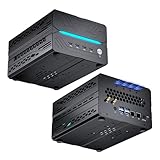
- AMD RYZEN AI MAX+ 395 MINI PC – THE NEXT GENERATION AI WORKSTATION --- GMKtec EVO-X3 introduces the next evolution of desktop AI computing powered by AMD Ryzen AI Max+ 395 processor. Featuring 16 cores and 32 threads, Zen 5 architecture, TSMC 4nm FinFET process, up to 5.1GHz boost frequency, and 64MB L3 cache, EVO-X3 delivers flagship-level performance for AI applications, professional creation, gaming, and demanding multitasking. With up to 126 TOPS AI performance, this compact AI workstation brings powerful local computing to your desktop.
- AMD XDNA 2 NPU – 50 TOPS DEDICATED AI ENGINE FOR LOCAL AI --- Equipped with AMD XDNA 2 architecture NPU delivering up to 50 TOPS AI acceleration, EVO-X3 enables efficient local AI processing for generative AI, AI assistants, image creation, content production, and intelligent workflows. By processing AI tasks directly on-device, it helps reduce cloud dependency, improve response speed, and enhance data privacy. Run advanced AI applications locally with smoother performance and greater control over your data.
- AMD RADEON 8060S GRAPHICS – RDNA 3.5 POWER WITH DESKTOP-CLASS PERFORMANCE --- EVO-X3 features AMD Radeon 8060S Graphics with 40 Compute Units and up to 2900MHz frequency based on advanced RDNA 3.5 architecture. Delivering graphics performance comparable to RTX 4070-class laptop GPUs, it provides smooth 1080P high-quality gaming, accelerated video editing, 3D rendering, and creative workloads. Experience powerful integrated graphics performance without the size and power consumption of a traditional desktop tower.
- EIGHT CHANNEL LPDDR5X - LPDDR5X is a new ground breaking memory small form factor installed on-board. With blazing speeds up to to 8000MT/s, it runs 1.5x faster than the DDR5 SODIMMs; 90% better performance over DDR5 SODIMMs in video conferencing and photo editing; 30% better performance in productivity apps; 12% better performance in digital content workloads.
- 128GB LPDDR5X 8000MT/s MEMORY – MASSIVE BANDWIDTH FOR AI AND CREATIVE WORK --- Equipped with up to 128GB LPDDR5X memory running at 8000MT/s, EVO-X3 provides exceptional bandwidth for large AI models, professional software, content creation, and heavy multitasking. The unified memory architecture allows more flexible resource allocation between CPU and GPU, making it ideal for local AI inference, large model deployment, video production, engineering applications, and advanced creative workflows.
Product prices and availability are accurate as of the date/time indicated and are subject to change. Any price and availability information displayed on Amazon at the time of purchase will apply.

