
Free tools Windows power users keep installed
One-click scans. No signup required.
iTechGuides is reader-supported. When you buy through links on our site, we may earn an affiliate commission. As an Amazon Associate I earn from qualifying purchases. Learn more
The best AI writing tool depends on the job: ChatGPT is the strongest all-around choice, Claude suits long-form drafting and revision, Jasper is built for on-brand marketing teams, Grammarly excels at editing, and Writesonic is aimed at SEO-focused content workflows. No single tool is best for every writer.
AI writing tools now cover several different categories. General-purpose assistants can brainstorm, analyze documents, outline articles, and draft copy. Marketing platforms add brand controls and campaign templates. Editing assistants improve text inside browsers and applications, while SEO platforms combine content generation with search research and optimization.
The shortlist below treats “best” as a use-case decision rather than a universal ranking. For most solo creators, starting with a free ChatGPT or Claude plan is sensible. Add Grammarly when polishing existing drafts is central to your work, choose Jasper when a team needs consistent marketing language, and consider Writesonic when search-driven production justifies a specialist platform.
Key takeaways
- ChatGPT is the best all-around AI writing tool for brainstorming, drafting, rewriting, document analysis, and format conversion.
- Claude is the better fit for long-form drafting, style-sensitive revision, and work based on large or numerous source documents.
- Jasper is designed for marketing teams that need reusable brand voice, terminology, campaign workflows, and governance.
- Grammarly is primarily an editing and communication layer for grammar, clarity, tone, and rewriting across supported applications.
- Writesonic is the specialist choice for SEO-oriented content workflows and AI-search-visibility work, but its higher cost may not suit occasional writers.
What are AI writing tools?
AI writing tools are software products that use generative or language-model technology to help create, revise, organize, or evaluate written content. The category includes flexible chat assistants, dedicated marketing-copy platforms, inline editing applications, SEO content systems, and specialist tools for fiction, academic work, or technical documentation.
#1 Best Overall

- Reliable Plug and Play: The USB receiver provides a reliable wireless connection up to 33 ft (1), so you can forget about drop-outs and delays and you can take it wherever you use your computer
- Type in Comfort: The design of this keyboard creates a comfortable typing experience thanks to the low-profile, quiet keys and standard layout with full-size F-keys, number pad, and arrow keys
- Durable and Resilient: This full-size wireless keyboard features a spill-resistant design (2), durable keys and sturdy tilt legs with adjustable height
- Long Battery Life: MK270 combo features a 36-month keyboard and 12-month mouse battery life (3), along with on/off switches allowing you to go months without the hassle of changing batteries
- Easy to Use: This wireless keyboard and mouse combo features 8 multimedia hotkeys for instant access to the Internet, email, play/pause, and volume so you can easily check out your favorite sites
Common uses include topic ideation, content briefs, outlines, first drafts, headlines, introductions, calls to action, product descriptions, email copy, social-media variations, summaries, tone changes, reading-level adjustments, and repurposing one piece of content into several formats.
A general chatbot and a dedicated writing platform are not interchangeable. A chatbot usually offers greater flexibility and may cost less, but the user must design more of the workflow. A specialist platform may provide templates, campaign management, brand voice, collaboration, SEO scoring, or publishing integrations that a general assistant does not provide automatically.
AI assistance should not be confused with autonomous publishing. Generated prose can be fluent while containing unsupported claims, outdated information, invented citations, or language that does not fit the intended audience. The most reliable workflow uses AI to accelerate research organization, drafting, and revision while a person remains responsible for evidence, judgment, originality, and publication.
Quick wins for a faster PC:
Clear out junk files and repair common Windows errorsFree Scan →Fix the driver behind crashes, sound loss and screen glitchesFind Drivers →Repair Windows errors before they cause bigger problemsFix Now →How were the five best AI writing tools selected?
The five best AI writing tools in this comparison were selected by workflow role, not by pretending that unlike products are identical competitors. The evaluation framework considers draft quality, editing quality, control, research support, workflow features, specialized value, ease of use, price-to-value, privacy and governance, and output risk.
| Criterion | What it means for a buyer |
|---|---|
| Draft quality | Coherence, specificity, structure, factual restraint, and tone. |
| Editing quality | Whether the tool improves an existing draft without flattening the writer’s voice or changing its meaning. |
| Control | Instructions, style references, reusable prompts, brand voice, and terminology controls. |
| Research support | Web search, citations, source uploads, document analysis, and evidence handling. |
| Workflow | Templates, projects, collaboration, integrations, export, and publishing support. |
| Specialized value | Useful advantages for marketing, editing, long-form writing, SEO, or other defined jobs. |
| Price-to-value | Whether free access or paid features justify the subscription for the intended workload. |
| Privacy and governance | Data controls, workspace administration, retention considerations, and suitability for confidential material. |
| Output risk | The likelihood of hallucinated facts, generic phrasing, overconfidence, repetition, or meaning drift. |
This is an editorial shortlist based on documented product positioning and current comparison coverage, not a claim that every product was tested under identical prompts and plans. Product features, model access, limits, plan names, and prices can change, so verify the vendor’s live information before buying.
Which AI writing tool is best for each job?
| Tool | Best for | Main strength | Main limitation | Pricing signal |
|---|---|---|---|---|
| ChatGPT | General content creation | Broad, flexible workflow for many formats | Requires careful prompting and fact-checking | Free tier; Plus $20/month; Pro $200/month on current OpenAI pricing information |
| Claude | Long-form writing and revision | Natural prose and document-heavy work | Less specialized for SEO and campaign operations | Free; Pro $20 monthly or $17/month annual equivalent |
| Jasper | Brand-controlled marketing | Brand voice, campaign workflows, and team governance | Premium pricing and unnecessary complexity for casual users | Secondary 2026 reports vary at roughly $39–$69/month; verify the official plan |
| Grammarly | Editing and polishing | Inline corrections, clarity, and tone support | Not a complete research-first content system | Free and paid plans; check the current official plans page |
| Writesonic | SEO-focused content creation | Search-oriented research, generation, and optimization | Can be costly and formulaic for low-volume writers | Secondary 2026 coverage reports an entry signal around $79/month; verify before purchase |
OpenAI and Anthropic pricing in the table comes from their current pricing information. Jasper and Writesonic figures are less consistent across secondary coverage, while Grammarly’s exact plan prices were not supplied in the research dossier; treat those figures as publication-time verification items rather than permanent prices. Annual billing, regional pricing, taxes, usage limits, team-seat requirements, and promotions can change the effective cost.
1. Why is ChatGPT the best all-around AI writing tool?
ChatGPT is the best all-around AI writing tool for writers who need one flexible assistant for ideation, outlining, drafting, research support, revision, summarization, and content repurposing. ChatGPT can help turn a rough idea into a brief, convert source material into an outline, rewrite text for a different audience, summarize uploaded documents, and transform an article into email, social, or presentation formats.
Outdated Drivers Are Slowing You Down
One free scan finds every outdated or missing driver and matches the right update for your exact hardware.Free scan · exact hardware matchPC Slower Than It Used to Be?
A free scan shows the junk files, broken settings and background clutter dragging Windows down - then fixes them in one click.Free scan · Windows 10 & 11ChatGPT’s broad usefulness is its main advantage. A writer can use one workspace for content planning, tables, analysis, document work, brainstorming, and drafting rather than moving immediately between a writing app, a research assistant, and a formatting tool. Available features such as file uploads, web-search workflows, projects, memory, and custom GPTs depend on the product version, region, and plan, so check OpenAI’s current ChatGPT pricing and plan information before relying on a particular feature.
OpenAI’s current consumer pricing information lists Free, Plus, Pro, Team/Business, and Enterprise offerings. The current pricing signal is $20 per month for Plus and $200 per month for Pro; business pricing is separate. OpenAI also explains that ChatGPT subscriptions and API billing are separate, so paying for Plus does not automatically provide API credits.
Who should choose ChatGPT?
- Solo creators who work across blog posts, emails, social posts, and planning.
- Freelancers who need a flexible assistant for different clients and formats.
- Small businesses that want to try a free plan before subscribing.
- Teams already using OpenAI’s wider productivity features.
What are ChatGPT’s limitations?
ChatGPT can produce plausible but unsupported claims, and fluent writing is not evidence that a statement is true. Output quality depends on the model, instructions, source material, and task. Usage limits can apply to paid plans, and ChatGPT is not automatically a complete SEO research or brand-governance system. Organizations handling confidential client material should review the relevant consumer, business, or enterprise data policies before uploading it.
ChatGPT is a particularly good starting point when the buyer wants broad capability rather than a specialized production line. ChatGPT is a poorer fit when a marketing department needs centralized brand controls or when an SEO team needs built-in keyword research and optimization scoring.
The Tool Desk
Outbyte Driver Updater FREEFix the driver behind crashes, sound loss and screen glitchesFind Drivers →Outbyte PC Repair FREERepair Windows errors before they cause bigger problemsFix Now →Rank #2

- KEYBOARD: The keyboard works for Windows with hot keys that enable easy access to Media, My Computer, Mute, Volume up/down, and Calculator
- EASY SETUP: Experience simple installation with the USB wired connection
- VERSATILE COMPATIBILITY: This keyboard is designed to work with multiple Windows versions, including Vista, 7, 8, 10 offering broad compatibility across devices.
- SLEEK DESIGN: The elegant black color of the wired keyboard complements your tech and decor, adding a stylish and cohesive look to any setup without sacrificing function.
- FULL-SIZED CONVENIENCE: The standard QWERTY layout of this keyboard set offers a familiar typing experience, ideal for both professional tasks and personal use.
2. Is Claude better for long-form writing and revision?
Claude is a strong choice for long-form drafting, document analysis, and revision when preserving tone, structure, and meaning matters more than having a complete marketing or SEO platform. Claude is suited to working from supplied documents, summarizing source material, developing extended drafts, and revising prose with attention to style.
Claude’s appeal is its writing-focused experience and document-heavy workflow. Long-form writers, editors, researchers, technical writers, and professionals can use Claude to compare source material, identify gaps, reorganize a draft, or produce a revision brief before changing the actual copy. Projects and available research or Google Workspace connections can help organize recurring work, but features and access vary by plan.
Anthropic’s current pricing page lists a free plan, Claude Pro at $20 monthly or $17 per month when billed annually, Max plans starting at $100 per month, and Team pricing at $25 per person per month with annual billing or $30 monthly. Anthropic lists a five-member minimum for Team. See Anthropic’s current Claude pricing and plan structure before subscribing because plan limits and model access are volatile.
Who should choose Claude?
- Long-form writers and editors who revise substantial drafts.
- Researchers working from supplied reports, notes, or other documents.
- Technical and professional writers who need cautious, structured revisions.
- Users who prioritize natural-sounding prose and style-sensitive editing.
What are Claude’s limitations?
Claude may be less convenient than a dedicated marketing platform for campaign templates, centralized brand operations, and multi-channel production. Claude also is not primarily an SEO research and scoring system, so SEO publishers may need another product. Free and paid usage limits can affect heavy users, and Claude-generated facts and citations still require independent verification.
Choose Claude over ChatGPT when the central task is sustained drafting or revision from a large body of source material. Choose a different category when the central task is inline grammar correction, coordinated brand publishing, or search-optimization automation.
3. Is Jasper worth it for marketing teams?
Jasper is best understood as a marketing-content operating layer rather than simply another chatbot. Jasper is designed for campaign production, reusable brand knowledge, brand voice and style controls, marketing templates, collaboration, and governance across multiple content channels.
Jasper can be useful when several writers or marketers create advertisements, landing pages, emails, social posts, product messaging, and other campaign assets. The value is not just generating one paragraph faster; the value is reducing variation in terminology, tone, positioning, and approved messaging across a team.
Secondary 2026 comparison coverage reports conflicting Jasper plan signals in approximately the $39–$69-per-user monthly range, depending on plan and billing period. Those figures should not be treated as permanent. Verify the live offering at Jasper’s official pricing page and review the main Jasper product information before publication or purchase.
Who should choose Jasper?
- Marketing departments producing content across several channels.
- Agencies managing multiple brands or clients.
- Startups that need consistent messaging while several people publish content.
- Organizations that value reusable brand controls, approvals, and team governance.
What are Jasper’s limitations?
Jasper usually costs more than a general-purpose assistant and may be excessive for occasional writers or one-off blog posts. Brand controls can improve consistency, but brand controls do not eliminate factual review or editorial approval. Jasper’s marketing orientation may be less useful for fiction, academic writing, personal journaling, or manuscript editing. Product positioning and plan names have changed over time, so confirm the current package rather than relying on an old comparison.
Jasper is worth considering when inconsistent team output has a real operational cost. Jasper is poor value for a solo writer who produces a small amount of copy and can maintain a style guide manually with a general-purpose assistant.
4. Why is Grammarly best for editing and polishing?
Grammarly is best for improving existing writing through grammar, spelling, punctuation, clarity, concision, tone, and rewriting assistance. Grammarly is primarily an editing and communication assistant, even though Grammarly also provides generative writing features.
Rank #3

- 【Ergonomic Design, Enhanced Typing Experience】Improve your typing experience with our computer keyboard featuring an ergonomic 7-degree input angle and a scientifically designed stepped key layout. The integrated wrist rests maintain a natural hand position, reducing hand fatigue. Constructed with durable ABS plastic keycaps and a robust metal base, this keyboard offers superior tactile feedback and long-lasting durability.
- 【15-Zone Rainbow Backlit Keyboard】Customize your PC gaming keyboard with 7 illumination modes and 4 brightness levels. Even in low light, easily identify keys for enhanced typing accuracy and efficiency. Choose from 15 RGB color modes to set the perfect ambiance for your typing adventure. After 30 minutes of inactivity, the keyboard will turn off the backlight and enter sleep mode. Press any key or "Fn+PgDn" to wake up the buttons and backlight.
- 【Whisper Quiet Design】Experience near-silent operation with our whisper-quiet gaming switch, ideal for office environments and gaming setups. The classic volcano switch structure ensures durability and an impressive lifespan of 50 million keystrokes.
- 【IP32 Spill Resistance】Our quiet gaming keyboard is IP32 spill-resistant, featuring 4 drainage holes in the wrist rest to prevent accidents and keep your game uninterrupted. Cleaning is made easy with the removable key cover.
- 【25 Anti-Ghost Keys & 12 Multimedia Keys】Enjoy swift and precise responses during games with the RGB gaming keyboard's anti-ghost keys, allowing 25 keys to function simultaneously. Control play, pause, and skip functions directly with the 12 multimedia keys for a seamless gaming experience. (Please note: Multimedia keys are not compatible with Mac)
Grammarly’s main distinction is inline, cross-application help. Writers can receive suggestions while working in supported browsers, email tools, documents, and workplace applications instead of copying every passage into a separate chatbot. Grammarly can help a professional make an email clearer, help a freelancer polish client copy, or help a team maintain a consistent communication standard.
What’s actually slowing this PC down?
Pick the symptom - the matching free tool is one click away.
Grammarly works best as an editing layer alongside a general writing tool. A writer might brainstorm and draft with ChatGPT or Claude, then use Grammarly to spot mechanical problems, tighten sentences, and review tone. Current comparison coverage emphasizes Grammarly’s cross-platform inline editing advantage rather than positioning Grammarly as a complete research and content-strategy environment.
Who should choose Grammarly?
- Professionals writing emails, reports, proposals, and workplace documents.
- Freelancers polishing client work before delivery.
- Teams that need consistent communication quality across applications.
- Writers who already have a draft and want fast, contextual feedback.
What are Grammarly’s limitations?
Grammarly is less suited to producing deeply researched, original long-form content from a blank page. Automated suggestions can standardize distinctive prose, and AI rewrites can change meaning, qualifications, cultural context, or audience level. Compare every important rewrite with the original. Grammarly’s exact premium, business, feature, and usage limits vary by plan, so check the current Grammarly plans page.
Grammarly’s AI-detection features should not be treated as definitive proof of authorship. Detection scores are probabilistic and cannot establish who wrote a passage with certainty.
5. Is Writesonic the best AI writing tool for SEO?
Writesonic is the best fit in this shortlist for SEO-oriented content workflows, including search-focused briefs, content generation, optimization, and positioning around AI-search visibility. Writesonic is more structured around content discovery and search performance than open-ended creative drafting.
Recommended Free Tools
Writesonic can help SEO publishers, growth teams, businesses, and agencies organize keyword- and competitor-informed workflows, produce blog or landing-page drafts, and optimize content for search-oriented coverage. The trade-off is that a structured SEO workflow can encourage formulaic writing if the user follows keywords and competitor headings mechanically instead of adding subject expertise and original analysis.
Recent comparison coverage describes Writesonic’s shift from a basic AI writer toward an SEO and AI-search-visibility platform. Secondary 2026 coverage reports an entry signal around $79 per month, but the figure must be checked against Writesonic’s official pricing page because product packaging, included usage, and plan positioning can change. The Writesonic product site is the appropriate place to confirm current capabilities.
Who should choose Writesonic?
- SEO publishers producing search-driven content at meaningful volume.
- Content agencies managing structured optimization workflows.
- Growth teams that need more than a blank-page drafting assistant.
- Businesses willing to pay for specialist search and content-discovery features.
What are Writesonic’s limitations?
Writesonic may be expensive for occasional writers, and SEO automation can produce repetitive or over-optimized articles. Search optimization is not the same as subject-matter expertise, reader value, factual accuracy, or guaranteed rankings. Generated claims, statistics, and citations require verification, and many users may still need separate tools for final editing, fact-checking, and brand-voice control.
Choose Writesonic when SEO research and production structure are central to the workflow. Choose ChatGPT or Claude when the work is mostly open-ended writing, and choose Grammarly when the main need is polishing an existing draft.
Do these 3 things before closing this tab:
1Scan for outdated or missing drivers - takes under a minute2Repair Windows errors before they cause bigger problems3Fix the driver behind crashes, sound loss and screen glitchesWhich tool is best by use case?
| Use case | Best starting point | Why | Important qualification |
|---|---|---|---|
| Best free general option | ChatGPT or Claude | Both provide free access for evaluating basic drafting and revision workflows. | Free plans have feature and usage limits that can change. |
| Blog posts and general content | ChatGPT | Broad support for ideas, outlines, drafts, summaries, and repurposing. | Research and facts require verification. |
| Long-form documents | Claude | Strong fit for extended drafting, document analysis, and revision. | SEO research may require another tool. |
| Marketing teams | Jasper | Brand voice, reusable knowledge, templates, and team workflows. | Higher cost makes it unsuitable for many casual users. |
| Editing and rewriting | Grammarly | Inline grammar, clarity, concision, and tone assistance across supported apps. | Review rewrites for meaning and voice. |
| SEO content operations | Writesonic | Search-oriented briefs, generation, and optimization. | Optimization does not guarantee rankings or AI-search inclusion. |
| Fiction | A specialist such as Sudowrite | Fiction-specific tools may better support story development than general content platforms. | Sudowrite is an alternative, not one of the five general-content picks. |
| Manuscript editing | Grammarly or ProWritingAid | Editing-focused tools are more relevant than SEO generators. | Neither replaces a human developmental editor. |
| Google Workspace-centered writing | Google Gemini | Workspace integration is its principal differentiator in current comparison coverage. | Evaluate the exact Google account and plan features. |
Specialist alternatives include Sudowrite for fiction, ProWritingAid for manuscript-level editing, Google Gemini for people working primarily in Docs, Drive, and Gmail, Copy.ai for go-to-market operations, and QuillBot for paraphrasing and summarization. Those alternatives solve narrower problems and should not be treated as direct substitutes in every workflow.
How should you use an AI writing tool without producing generic content?
A staged workflow produces more reliable content than asking an AI system to generate and publish a complete article in one step.
Rank #4
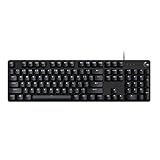
- Take your gaming skills to the next level: The Logitech G413 SE is a full-size keyboard with gaming-first features and the durability and performance necessary to compete
- PBT keycaps: Heat- and wear-resistant, this computer gaming keyboard features the most durable material used in keycap design
- Tactile mechanical switches: Uncompromising performance is always within reach with this wired gaming keyboard
- Premium color, material and finish: Elevate your gaming setup with this backlit keyboard featuring a sleek, black-brushed aluminum top case and white LED lighting
- 6-Key rollover anti-ghosting performance: Experience reliable key input with this anti-ghosting keyboard versus non-gaming mechanical keyboards
- Define the reader and outcome. State the audience, business or search goal, desired action, required expertise, and evidence standard.
- Create a brief. Include the working title, primary question, supporting questions, claims requiring sources, tone, reading level, internal links, and product references.
- Use AI for ideation and structure. Ask for competing angles, an outline, missing objections, and questions the draft must answer. Reject unsupported statistics rather than allowing the tool to fill gaps.
- Supply reliable source material. Prefer official documentation, research papers, company filings, government or regulator pages, and first-party product information.
- Draft section by section. Give the tool one section’s purpose, the relevant facts, and explicit constraints. Require uncertainty to be labeled and terminology to remain consistent.
- Run a separate editing pass. Check logic, repetition, transitions, voice, and meaning. Grammarly or an equivalent editor can assist, but editing suggestions should not be accepted blindly.
- Fact-check important claims. Verify numbers, dates, prices, product capabilities, legal or medical claims, and quotations against primary sources.
- Complete a human editorial pass. Add original analysis, replace generic examples, confirm that the article answers the reader’s question, and check for accidental plagiarism or confidential-data leakage.
Useful prompts are specific about evidence and uncertainty. For example: “Create an outline from these supplied sources. Put each factual claim beside the source that supports it, mark unsupported claims as questions, and do not invent statistics.” A source-constrained prompt is safer than asking for a confident article on a subject without references.
Independent reader supportYour contribution helps us test, update, and keep practical guides available for everyone.What are the main trade-offs when choosing an AI writing tool?
General-purpose assistants versus specialist platforms
General-purpose assistants are flexible, often less expensive, and useful across many formats, but they require more setup and review. Marketing platforms provide templates, brand controls, and team workflows at a higher cost. Editing assistants are excellent for polishing existing copy but weaker at research and content strategy. SEO platforms support search-oriented production but can overemphasize keywords and generate repetitive articles.
When is a paid plan worth it?
A free plan is usually enough to evaluate output quality, tone control, basic rewriting, and whether the interface fits the writer’s process. A paid plan becomes easier to justify when the buyer needs higher usage limits, larger files or longer context, research tools, project organization, collaboration, administration, brand controls, or specialized SEO and marketing workflows.
Compare total workflow cost, not just the subscription. A low-cost tool may be expensive if every output requires extensive rewriting and fact-checking. A premium team platform may save time when several people repeatedly produce on-brand material, but the same platform may be poor value for a solo writer with low monthly volume.
How should privacy affect the decision?
Do not paste confidential client information, unpublished strategy, personal data, trade secrets, or proprietary source material into a consumer tool without reviewing data-training policies, retention controls, workspace settings, administrative access, and vendor terms. Consumer, business, enterprise, API, and regional policies may differ.
OpenAI’s business pricing information describes business-data handling and lists workspace administration and security features, but the applicable policy depends on the edition and geography. Review OpenAI’s business pricing and data-use information directly before using a business workspace for sensitive material.
What failure modes should writers watch for?
- Factual errors: AI systems can confidently state incorrect facts, merge separate events, use outdated product information, or fabricate citations. Verify any claim affecting trust, money, safety, law, or reputation.
- Generic AI voice: Empty introductions, repetitive headings, vague productivity claims, formulaic pros and cons, and filler transitions make content feel interchangeable. Replace generic language with concrete evidence, examples, and human analysis.
- Over-optimization: Keyword stuffing, competitor-matching headings, thin pages, and search-engine language can reduce reader value. SEO software can assist with structure but cannot guarantee rankings or inclusion in AI-generated search answers.
- Meaning drift: A rewrite can remove a legal or technical qualification, change the intended audience, simplify an important distinction, or turn a cautious statement into a definite one. Compare every consequential rewrite with the original.
- Academic-integrity violations: Students should check institutional rules. AI may be appropriate for brainstorming, tutoring, or revision where permitted, but generated work should not be disguised as independent authorship.
- False certainty about detection: AI detectors and “humanizer” tools do not reliably establish authorship. Detection scores are probabilistic, not definitive evidence.
- Originality and copyright concerns: Review output for copied or near-copied language, attribute quotations, avoid requesting imitation of a living author’s exact style, and add original reporting or analysis.
Are AI writing tools worth paying for?
AI writing tools are usually worth paying for when a writer uses them frequently, needs higher limits or document capacity, saves meaningful editing time, or depends on collaboration, brand governance, or SEO workflow features. A free general-purpose assistant may be sufficient for occasional brainstorming, basic rewriting, and short drafts.
For many individuals, the best-value setup is one general assistant—ChatGPT or Claude—plus an editing layer such as Grammarly if the writer regularly polishes emails, reports, or client copy. A premium marketing suite becomes more defensible when inconsistent team output costs more than the subscription. An SEO platform becomes more defensible when the business produces enough search-driven content to use its research and optimization features regularly.
No subscription removes the need for a brief, reliable sources, fact-checking, human judgment, or editorial accountability. The buyer should measure time saved after review, not the number of words generated.
Final verdict: which AI writing tool should you choose?
Choose ChatGPT if you want the broadest writing and content workflow, or choose Claude if long-form drafting, document analysis, and revision are your priorities. Add Grammarly when editing and cross-application polishing matter most.
Choose Jasper when a marketing team or agency needs consistent brand voice, reusable campaign knowledge, and governance across multiple contributors. Choose Writesonic when SEO research, content optimization, and AI-search visibility are central enough to justify a specialist platform.
Best Value

- 【65% Compact Design】GEODMAER Wired gaming keyboard compact mini design, save space on the desktop, novel black & silver gray keycap color matching, separate arrow keys, No numpad, both gaming and office, easy to carry size can be easily put into the backpack
- 【Wired Connection】Gaming Keybaord connects via a detachable Type-C cable to provide a stable, constant connection and ultra-low input latency, and the keyboard's 26 keys no-conflict, with FN+Win lockable win keys to prevent accidental touches
- 【Strong Working Life】Wired gaming keyboard has more than 10,000,000+ keystrokes lifespan, each key over UV to prevent fading, has 11 media buttons, 65% small size but fully functional, free up desktop space and increase efficiency
- 【LED Backlit Keyboard】GEODMAER Wired Gaming Keyboard using the new two-color injection molding key caps, characters transparent luminous, in the dark can also clearly see each key, through the light key can be OF/OFF Backlit, FN + light key can switch backlit mode, always bright / breathing mode, FN + ↑ / ↓ adjust the brightness increase / decrease, FN + ← / → adjust the breathing frequency slow / fast
- 【Ergonomics & Mechanical Feel Keyboard】The ergonomically designed keycap height maintains the comfort for long time use, protects the wrist, and the mechanical feeling brought by the imitation mechanical technology when using it, an excellent mechanical feeling that can be enjoyed without the high price, and also a quiet membrane gaming keyboard
The most useful answer to “What is the best AI writing tool?” is therefore conditional: the best tool is the one that matches the stage of the workflow you need to improve, fits your volume and budget, and leaves enough time for human verification and original thinking.
Frequently Asked Questions
What is the best free AI writing tool?
ChatGPT or Claude is the best starting point for most people who want a free general-purpose AI writing tool. Both can support basic brainstorming, drafting, summarization, and rewriting, although free plans have changing feature and usage limits.
Can AI writing tools write a complete blog post?
AI writing tools can produce a complete blog-post draft, but the draft should not be treated as publication-ready. A reliable process supplies source material and a detailed brief, writes section by section, verifies claims and citations, and includes a human editorial pass.
Which AI writing tool produces the most natural writing?
Claude is the strongest fit in this shortlist for readers who prioritize natural long-form prose and style-sensitive revision, while ChatGPT is more flexible across formats. “Natural” is an editorial judgment rather than a universal measurable ranking, and both tools need a strong brief and human review.
Is AI-generated content bad for SEO?
AI-generated content is not automatically bad for SEO, but search optimization does not guarantee useful or high-quality content. Keyword stuffing, thin pages, copied competitor structures, unsupported claims, and formulaic writing can harm readers and credibility, so human expertise, evidence, and original analysis remain essential.
Can AI writing tools replace human writers?
AI writing tools can accelerate ideation, outlining, drafting, rewriting, and repurposing, but they do not replace human responsibility for expertise, factual verification, originality, judgment, and audience understanding. Human review is especially important for content involving money, safety, law, medicine, reputation, or confidential information.
Are AI writing tools safe for confidential information?
AI writing tools should not receive confidential information until the buyer reviews the relevant consumer, business, enterprise, or API data policies, retention controls, workspace settings, and vendor terms. Consumer and business protections can differ by plan and geography.
Quick wins for a faster PC:
Repair Windows errors before they cause bigger problemsFix Now →Scan for outdated or missing drivers - takes under a minuteDriver Scan →Clear out junk files and repair common Windows errorsFree Scan →Which AI writing tool is best for rewriting?
Grammarly is the best fit for fast inline rewriting, clarity, concision, grammar, and tone assistance across supported applications. ChatGPT and Claude are better when a rewrite requires substantial restructuring, document context, or a detailed explanation of the desired voice.
Which AI writing tool is best for fiction?
A fiction-specific tool such as Sudowrite may be a better choice than the five general-content tools for story development. ChatGPT and Claude can still help with brainstorming and revision, but Jasper and Writesonic are primarily oriented toward marketing and SEO workflows.
Do paid AI writing plans include unlimited usage?
Paid AI writing plans should not be assumed to provide unlimited unrestricted usage. Plans can include rate limits, credits, model-specific caps, fair-use conditions, abuse guardrails, or changing allowances, so review the vendor’s current plan terms before subscribing.
Is API access included with a consumer AI writing subscription?
API access is not automatically included with a consumer ChatGPT subscription. OpenAI states that API usage is billed separately from ChatGPT subscriptions, and other vendors may also separate application subscriptions from developer access.
Recommended Free Tools
The Bottom Line
Bottom line: Start with ChatGPT or Claude for general writing, add Grammarly for editing, choose Jasper for brand-controlled team marketing, and choose Writesonic for SEO-heavy content operations. Treat every tool as an assistant—not an autonomous publisher—and budget for source verification, editing, and human judgment.
Quick Recap
Product prices and availability are accurate as of the date/time indicated and are subject to change. Any price and availability information displayed on Amazon at the time of purchase will apply.

