
The Tool Desk
Outbyte PC Repair FREEClear out junk files and repair common Windows errorsFree Scan →Outbyte Driver Updater FREEFix the driver behind crashes, sound loss and screen glitchesFind Drivers →iTechGuides is reader-supported. When you buy through links on our site, we may earn an affiliate commission. As an Amazon Associate I earn from qualifying purchases. Learn more
xMEMS announced µCooling integration for enterprise E3.S and laptop NVMe M.2 SSDs on May 29, 2025. The solid-state micro-blower is designed to direct airflow at NAND flash and controller hotspots from inside a drive, rather than relying only on a heat spreader or system fan. The performance figures published with the announcement are xMEMS thermal-modeling results, not independent tests; the release forecast production for Q1 2026, but current company information does not confirm that volume production began or identify shipping SSD models.
What xMEMS announced for SSDs
The announcement describes µCooling as an in-drive active thermal-management component for two form factors: E3.S enterprise SSDs used in data-center infrastructure and NVMe M.2 SSDs in laptop PCs. The goal is to move air locally over heat-producing NAND and controller ICs, addressing heat where it is generated instead of depending solely on passive heat spreading or airflow from the host system. xMEMS’s May 29, 2025 announcement presents this as an integration opportunity for SSD designers, not a consumer cooler that can be attached to an existing drive.
That distinction matters: the announcement establishes a design direction and modeled results, but it does not name an SSD available for purchase with µCooling installed. A component announcement is not evidence that a drive has shipped.
How the solid-state micro-blower works
xMEMS describes µCooling as an all-silicon active-convection technology built on its piezoMEMS platform. Thin-film piezoelectric material expands and contracts at ultrasonic frequencies, moving membranes that create air pulses through micro-valve arrays. Package vents or channels direct the resulting airflow across a heat source or through a channel thermally coupled to a component. There are no conventional rotating fan blades in this mechanism. The current µCooling product page describes the technology and its component options.
#1 Best Overall

- 【FIT For M.2 2280 SSD】Compatible with Single-sided and Double-sided NVMe M.2 SSD. Works with Desktop PC and Workstations. Universal fit for standard 2280 form factor SSD
- 【Fast Heat Dissipation】Our Product Utilizes Aluminum Fin-type Heatsink with High-performance Thermal Silicone Pads, This Efficient Design Ensures That Your M.2 SSD Maintains A Safe Temperature, Thereby Preventing Performance Throttling
- 【High-quality Thermal Conductive Silicone Pad】Atdcoek M.2 SSD Heatsink Use of Thermally Conductive Silicone Pad with A Thermal Conductivity of 2.0 W/mK, Easy to Clean Without Damaging the SSD
- 【Easy To Install】The SSD Heatsink is Ssecured with Two Silicone Elastic Bands, Allowing for Tool-free Installation - no Screws Required. Simply Place the Heat Dissipation Silicone Pad and Press Firmly to Ensure Close Contact
- 【Value 5-pack Set】This Kit Includes 5 Aluminum Fin-type Heatsink, 5 High-performance Thermal Silicone Pads, 10 silicone rubber band, 1 Extra Cross-head Screwdriver, and 5 Pack M2 Screw Kit
For an SSD, the intended advantage is localized airflow within a compact enclosure. Instead of asking a chassis fan to push air across the whole drive area, a designer can place airflow near NAND packages or the controller. That still requires careful integration into the SSD’s mechanical and thermal design; the announcement does not show a finished drive layout or establish how a particular laptop or server would route exhaust air.
What the published thermal figures do—and do not—show
The May 2025 release attributes its SSD performance figures to xMEMS thermal modeling. They are projections for modeled integrations, not measurements from retail drives or independent comparative tests.
Rank #2
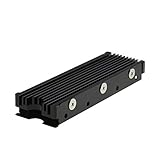
- 【Designed for M.2 SSD】-The heat sink is specially designed for M.2 2280mm SSD, which is very suitable for desktop computers/Playstation 5, etc.
- 【Double-sided cooling】- Aluminum alloy-Groove design, greatly increase the heat dissipation area, with 10°C - 30°C cooling effect (Varies depending on the environments), cool your M.2 SSD to a safe temp to avoid overheating and throttling, improving the performance of your computer.
- 【Easy to Install and Operate】 - With double-sided clip design, 6 adjustable height screws, suitable for M.2 SSD of various heights, stable installation, better protection of your M.2 SSD.
- 【Unique Nano Thermal Pad】- Advancing Gene thermal pad is made from Nano Silicon Grease Material, with good thermal conductivity ability. Soft enough and good ductility, compatible with uneven surfaces of the M.2 SSD. Low viscosity, with no damage to the SSD warranty label.
- 【Fine Workmanship】- Main body material: Aluminum alloy, silver plating (Helps eliminate static electricity), anodic oxidation surface treatment. Dimensions: 3 x 0.95 x 0.4in., net weight: 1oz., minimum installation height requirement: 12mm.
| Modeled integration | Figures reported by xMEMS | How to interpret them |
|---|---|---|
| E3.S enterprise SSD | 3 W heat-removal capability; more than 18% average temperature reduction; more than 25% lower thermal resistance | Thermal-modeling results published by xMEMS in its May 29, 2025 announcement; not independently verified. |
| Laptop M.2 SSD | 30–50% average power-overhead allowance; more than 20% temperature reduction; 30% lower thermal resistance; 30% lower temperature rise above ambient | Thermal-modeling results published by xMEMS in its May 29, 2025 announcement; not independently verified. |
The release also says E3.S drives routinely operate at 9.5 W TDP or higher, attributing that characterization to xMEMS. It cites an SSD-market forecast of 21.9% CAGR through 2028 and attributes it to IDC, but the announcement does not establish the original forecast’s publication date. Treat that figure as a forecast repeated by the vendor, not as a verified current IDC outlook.
Do these 3 things before closing this tab:
1Clear out junk files and repair common Windows errors2Scan for outdated or missing drivers - takes under a minute3Repair Windows errors before they cause bigger problemsWithout independent tests, the figures cannot establish how much a particular shipping SSD would improve, what its real-world power draw would be, or whether µCooling would outperform a specific heatsink or drive. Actual results would depend on the final implementation and operating conditions.
Rank #3

- High-Performance Cooling with Integrated Heatpipe: Advanced aluminum heatsink with built-in heatpipe ensures efficient heat dissipation, keeping your M.2 NVMe SSD cool even under heavy workloads.
- Maintains Maximum Read and Write Speed: Prevents thermal throttling by lowering SSD temperatures, allowing your drive to maintain top performance for longer periods.
- Compatible with Single and Double-Sided M.2 2280 Drives: Designed to fit both single-sided and double-sided M.2 2280 modules, offering flexible compatibility with a wide range of NVMe SSDs.
- Premium Black Aluminum Design: Sleek matte black finish delivers a clean, high-quality look that perfectly matches modern PC builds while providing excellent thermal conductivity.
- Easy Installation and Secure Fit: Simple mounting system allows quick, hassle-free setup on your M.2 slot for reliable cooling and long-term durability.
How the listed µCooling components compare
The current xMEMS product page lists two micro-blower models. The specifications below are the company’s current listed values, accessed October 4, 2026; they are component specifications, not SSD-level test results.
| Model | Dimensions | Airflow | Back pressure | Power |
|---|---|---|---|---|
| XMC-2400 | 7.42 × 9.48 × 1.13 mm | Up to 28 cc/s | Up to 1,300 Pa | Approximately 150 mW |
| XMC-4800 | 9.93 × 14.35 × 1.13 mm | Up to 48 cc/s | Up to 1,100 Pa | Approximately 240 mW |
These specifications should not be mixed with the figures in xMEMS’s August 2024 XMC-2400 announcement, which listed a different package size (9.26 × 7.6 × 1.08 mm), airflow up to 39 cc/s, back pressure of 1,000 Pa, mass under 150 mg and IP58. That release-era specification set is distinct from the current product-page listing and does not, by itself, explain the reason for the differences. The 2024 release also said customer sampling was planned for Q1 2025; that was a plan stated at the time, not proof of present SSD availability. Read the August 20, 2024 XMC-2400 announcement.
Rank #4

- 【Designed for desktop PC/PS5】- Perfectly fit for Samsung 860 EVO, 960 EVO, 970 EVO, 970 Pro, 980 Pro, PS5 etc. this M.2 SSD heatsink compatible with all single sided Type.
- 【Main body material】- Aluminum alloy, silver plating (helps eliminate static electricity), anodic oxidation surface treatment. Dimensions: 3 x 0.95 x 0.4inm.2 heatsink well fit for PS5 installation as well as PC M.2 Slot.
- 【Thermal Pads】- with good thermal conductivity ability. Low viscosity, with no damage to the M.2 SSD.
- 【High Performance】- With 10°C - 20°C cooling effect (varies depending on the environments), cool your M.2 2280 SSD to a safe temp to avoid overheating and throttling, improve your computer's performance.
- 【Easy to Install 】 - With double-sided clip design, are suitable for M.2 NVME SSD of various heights, stable installation, better protection of your M.2 SSD with good heat dissipation performance.
What this could mean for data centers and laptops
Enterprise E3.S SSDs
For data-center SSD designers, in-drive airflow could offer a way to manage NAND and controller heat in higher-power E3.S devices without relying exclusively on system-level airflow. Whether it helps a deployed server depends on the drive design, airflow path, power budget and the host’s thermal environment. xMEMS’s stated 3 W removal capability and temperature and resistance changes are modeled outcomes, not a field result.
Free tools Windows power users keep installed
One-click scans. No signup required.
Laptop NVMe M.2 SSDs
Laptop M.2 drives have limited space and share thermal constraints with other components. A thin active component could give SSD designers another option where passive heat spreading or airflow from the laptop is insufficient. The listed micro-blower power figures and modeled M.2 power-overhead allowance are relevant design inputs, but the sources do not establish power impact or battery-life effects in a shipping laptop.
Best Value

- BLAZING SPEED. COOL VICTORY: Consider this a cheat code; Our Samsung 990 PRO Gen 4 with Heatsink SSD helps you reach near max performance* with lightning-fast speeds and Heatsink for improved temperature control
- REACH THE NEXT LEVEL: Gen4 steps up with faster transfer speeds and high-performance bandwidth; With a more than 55% improvement in random performance compared to 980 PRO, it’s here for heavy computing and faster loading
- THE FASTEST SSD FROM THE WORLD'S #1 FLASH MEMORY BRAND**: The speed you need for any occasion; With read and write speeds up to 7450/6900 MB/s* you’ll reach near max performance of PCIe 4.0*** powering through for any use
- PLAY WITHOUT LIMITS: Give yourself some space with storage capacities from 1TB to 4TB; Sync all your saves and reign supreme in gaming, video editing, data analysis and more
- MADE w/ PS5 IN MIND: Ultra-slim Integrated Heatsink is designed to dissipate heat from your device to stabilize its temperature and prevent performance issues; It’s compatible with PlayStation 5 and PCI-SIG D8 standard desktops and laptops****
Is µCooling available in SSDs now?
The May 2025 announcement forecast a production start in Q1 2026. The current µCooling page offers evaluation and sample requests, but the reviewed company information does not verify that volume production began, identify a customer or partner, or name a shipping SSD model with the technology. Availability in a specific enterprise drive or laptop therefore remains unestablished by these sources.
For a current M.2 SSD that runs hot, a compatible passive heatsink is a separate, more conventional option—not µCooling. Check laptop clearance and the drive or system manufacturer’s compatibility guidance before fitting one, since laptop space and thermal hardware vary.
What SSD designers should verify before adopting it
For an OEM or storage integrator evaluating the concept, the practical question is not just maximum airflow: it is whether the complete drive can use that airflow effectively within its mechanical and electrical limits. The vendor’s public modeling does not answer every integration question, so prospective adopters would need implementation-specific validation.
- Confirm package, vent and channel geometry fit the planned E3.S or M.2 design.
- Measure temperatures and thermal throttling behavior on the completed drive under its intended workload and enclosure conditions.
- Account for component power and airflow-path pressure in the full system thermal and power budgets.
- Evaluate reliability and operating behavior in the intended environment; the SSD announcement does not publish independent qualification results.
- Ask xMEMS for current sample, evaluation and production status rather than treating the Q1 2026 forecast as confirmation of availability.
xMEMS VP of Marketing Mike Housholder framed the announcement as a way to add active thermal management without enlarging the drive or depending on system airflow. That is the company’s stated design proposition; its usefulness for any particular SSD remains a question for integration and validation.
Quick Recap
Product prices and availability are accurate as of the date/time indicated and are subject to change. Any price and availability information displayed on Amazon at the time of purchase will apply.

