
iTechGuides is reader-supported. When you buy through links on our site, we may earn an affiliate commission. As an Amazon Associate I earn from qualifying purchases. Learn more
bE-More combined an Arduino light-sensing demo, IoT telemetry and locally run AI analysis to show how a workplace lighting system might avoid unnecessary use. Project lead Giovanni Zanotti says his team shared the win at its school’s Project Day 2025; the project was a miniature office demonstration, not a measured office deployment.
What bE-More demonstrated
bE-More was presented as a semi-automatic system for monitoring workplace energy use and controlling lighting. Zanotti’s account says the team began the project in February 2025 for a school showcase called Project Day, where bE-More shared the win with another project, VIPRA. That outcome is reported by Zanotti; no independent school or organizer confirmation is established.
The physical build was a miniature office diorama rather than a live workplace installation. It included workspace LEDs, an indicator LED, a buzzer, two buttons for manual or autonomous control, and a photoresistor. The intended sustainability benefit was to reduce unnecessary lighting when natural light was sufficient, but the project sources do not report measured energy savings or emissions reductions.
What’s actually slowing this PC down?
Pick the symptom - the matching free tool is one click away.
How the system was put together
The design joined four layers: a desktop controller, an IoT platform, an Arduino edge device, and a local analysis service. The project’s descriptions outline the following roles:
#1 Best Overall
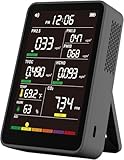
- 【16-In-1 Comprehensive Air Quality Tracking】: This all-in-one air quality meter simultaneously tests PM1.0, PM2.5, PM10, TVOC, HCHO, temperature and humidity, covering 7 core ambient indicators. It eliminates the need for extra single-function testers, cuts equipment costs, and delivers full-spectrum indoor air data for timely ventilation adjustments, protecting your family, pets and delicate plants from harmful airborne pollutants.
- 【Easy Single-Tap Operation with Adjustable Audio Prompt】: One button controls power on/off and ℃/℉ unit switching; double tap to turn off the built-in audio prompt. The simple setup fits elderly users perfectly, and the quiet sampling mode avoids sound distractions during night use in bedrooms, offices and vehicles.
- 【High-Precision Sensor System & HD Large Display】Equipped with a high-precision sensor array, the unit automatically samples and processes air data every 1.5 seconds, delivering continuous, real-time updates on your indoor air conditions. The clear, high-definition color screen not only enhances readability with color-coded air level readings, but also adds a modern, professional aesthetic to your workspace or living area.
- 【Up to 4-5h Run-Time & Universal Type-C Fast Charging】: A full charge supports 4-5 hours of continuous air sampling. The standard Type-C port works with common mobile charging cables, and the package includes a matching AC power adapter and Type-C fast charging cable for convenient power replenishment. You can easily use it across home, car and indoor spaces without frequent charging.
- 【Portable Multi‑Scenario Air Testing Device & Reliable After‑Sales Service】: Compact and lightweight for flexible placement and handheld use, ideal for checking air parameters in indoor rooms, vehicles, bedrooms, offices, campsites and more. Package includes 1 air quality monitor, 1 Type‑C charging cable, 1 AC power adapter and 1 user manual. We offer 12‑month full‑unit warranty for worry‑free long‑term daily air monitoring.
- Controller: A Java 23 desktop application with a WebView dashboard and management of the AI process lifecycle.
- IoT platform: ThingsBoard handled telemetry and dashboards. The Arduino communicated with it over MQTT; the article also describes a ThingsBoard PostgreSQL database queried by the analysis middleware.
- Edge device: An Arduino UNO R4 read the light sensor and applied deterministic lighting automation.
- Local analysis: A Python service connected project data to Ollama running Mistral:7b, with the analysis intended to surface insights and anomalies in the telemetry.
This division matters: the light-control decision was a rule running on the Arduino, while the AI layer analyzed data. The available descriptions do not establish that AI directly controlled the lights.
How the light-control rule worked
The photoresistor was connected to analog pin A3. In the repository’s documented AUTO behavior, a reading above 450 switches the demonstration’s lights off. The project sources do not specify the threshold’s units or sensor calibration, so 450 should be treated as a value for this particular prototype—not a universal brightness setting.
Rank #2

- Know your air – An Alexa air quality monitor that makes it easy to understand what’s in your indoor air.
- Track and measure – Our indoor air quality monitor keeps tabs on 5 key factors: particulate matter (PM 2.5), volatile organic compounds (VOCs), carbon monoxide (CO), humidity, and temperature.
- Stay informed – Get an indication of current indoor air quality from the color-coded LED, and detailed information and an easy-to-understand air quality score in the Alexa app.
- Real-time alerts - Get notifications on your phone or announcements on Echo devices when Alexa detects poor indoor air quality.
- Automate climate control - Enable Routines to turn on or off your compatible Alexa devices, such as air purifiers, dehumidifiers, and fans, when the indoor air quality sensors detect changes.
The two control buttons allowed the demonstrator to choose between manual and autonomous operation. A real installation would need carefully defined override behavior and tested sensor placement: readings depend on the sensor, its position, and surrounding light, none of which the sources quantify for a deployed office.
Windows Errors? Fix Them Before They Spread
Repair common Windows errors and clear accumulated junk for a smoother, more stable PC - no reinstall needed.Free scan · no reinstallOutdated Drivers Are Slowing You Down
One free scan finds every outdated or missing driver and matches the right update for your exact hardware.Free scan · exact hardware matchWhy run the AI locally—and what that does not guarantee
Zanotti describes privacy as a motivation for using local analysis. Running Ollama and Mistral:7b on a local machine can avoid sending the analysis prompt to a hosted model provider. That describes the intended inference path, not a guarantee that every component or deployment keeps all data on a private network.
Rank #3

- High Accuracy & Fast Refresh Data: With this smart sensor, the PM2.5 accuracy is ±15 µg/m³ while temperature and humidity accuracies are ±0.54°F and ±3%RH.The two-second correction data feature shows the latest changes in PM2.5, temperature, and humidity.Keep sensor clear for accurate detection.
- Multifunctional Air Quality Detector: The GoveeLife Air Quality Monitor conveniently measures 3 important indexes for indoor air quality, including PM2.5, temperature, and humidity.
- Switchable Display: Press the top button for the clock & PM2.5 display. Long press for 2 seconds to switch to bright screen mode & night mode. The LED indicator displays 4 levels of ambient air quality. 2.4G Wi-Fi is required to display the time.
- Connect with GoveeHome Appliances: Set your target air quality and link with your other GoveeHome smart appliances. GoveeLife air purifiers, humidifiers, and space heaters will turn on and off automatically when the indoor air quality changes.
- H5106 needs to be connected to a power source and supports GoveeLife devices: Smart Air Purifiers - H7126, H7120, H7124, H712C, H7122, H7123; Humidifiers - H7140; Fans - H7100, H7102
The article describes MQTT telemetry, HTTP dashboard delivery, and HTTPS as future work for the initial web server. Local model inference alone does not secure telemetry, dashboards, databases, backups, or other network traffic. The project materials do not establish a security review or prove that all data stayed local under every configuration.
What a reproduction would require
The project-specific setup notes identify Java JDK 23, ThingsBoard Community Edition configured locally, Ollama with Mistral, and the hardware sketch. These are the project’s stated prerequisites, not independently tested compatibility guidance.
Rank #4
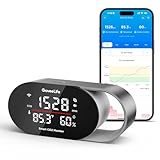
- Fast & Accurate: Equipped with the SCD4x CO₂ sensor (photoacoustic NDIR principle), it ensures accuracy of ±(40ppm + 5%), a 5s refresh rate, and built-in pressure compensation for any altitude. It helps prevent headaches and drowsiness, improving sleep and concentration.Please note: Calibrate in the app's settings outdoors if required.
- 4-in-1 Multi-Function Display: This CO₂ detector clearly shows four essential metrics—real-time CO₂ levels, temperature (°F/°C), humidity (%RH), and a built-in clock(need to connect to the APP).The ideal solution for bedrooms, nurseries, and offices: a combined CO₂ detector and GoveeLife thermometer hygrometer for complete, at-a-glance air quality information.
- Triple Alert System: When CO₂ levels, temperature, or humidity exceeds customizable thresholds, this air monitor triggers three types of warnings: a built-in buzzer, instant app notifications, and detailed email reports. Ensures no alert is missed and provides ultimate peace of mind—especially for families with children or elderly members.
- Customizable LED Display: The CO₂ meter features a programmable screen and tri-color light bar that automatically adjusts brightness based on your custom day/night schedule via the app, ensuring clear visibility by day and eliminating sleep-disrupting light pollution at night. Ideal for light-sensitive sleepers and nurseries.
- Data Tracking & Export: Track up to two years of historical data via interactive charts in the app, and export professional CSV reports for medical consultations or energy efficiency optimization. Enables data-driven improvements to your indoor environment.
- An Arduino UNO R4 matching the project’s code and wiring
- A photoresistor and the wiring needed to read it on an analog input
- Workspace LEDs, an indicator LED, two buttons, a buzzer, and basic prototyping components
- A computer for the Java controller, ThingsBoard, Python middleware, and local Ollama model
The project descriptions differ in how specifically they identify Wi-Fi functionality. Verify the exact UNO R4 variant against the sketch and intended network setup before buying a board. Zanotti names an ESP32 as a possible future direction, but the sources do not show that an ESP32 version was built or tested.
Quick wins for a faster PC:
Fix the driver behind crashes, sound loss and screen glitchesFind Drivers →Repair Windows errors before they cause bigger problemsFix Now →What the project proves—and what it does not
bE-More demonstrates an architecture for combining a simple sensor-based lighting rule, IoT telemetry, dashboards, and local AI analysis in a school project. Its energy-saving rationale is plausible as a design goal, but the published project descriptions provide no electricity readings, baseline comparison, operating duration, quantified savings, or carbon calculation. They therefore do not establish how much energy the prototype—or an office based on it—would save.
Best Value
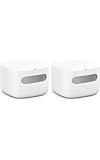
- The information below is per-pack only
- Know your air – An Alexa air quality monitor that makes it easy to understand what’s in your indoor air.
- Track and measure – Our indoor air quality monitor keeps tabs on 5 key factors: particulate matter (PM 2.5), volatile organic compounds (VOCs), carbon monoxide (CO), humidity, and temperature.
- Stay informed – Get an indication of current indoor air quality from the color-coded LED, and detailed information and an easy-to-understand air quality score in the Alexa app.
- Real-time alerts - Get notifications on your phone or announcements on Echo devices when Alexa detects poor indoor air quality.
The sources also do not establish field deployment, model accuracy, comparative performance, or independent contest verification. Those boundaries distinguish a useful demonstration from evidence that the system is ready for commercial use or has delivered a measured environmental result.
Future directions proposed by the author
Zanotti lists several ideas for further development: migrating the web server to HTTPS; improving prompts or using a newer or custom model; separating sensor and actuator roles across devices; exploring an ESP32 for a more deployment-oriented build; and adding an intermediary MQTT broker such as Mosquitto for bidirectional communication. These are proposed next steps, not features the sources establish as implemented.
Quick Recap
Sources
- Giovanni Zanotti’s account of bE-More on DEV Community, published September 24, 2026.
- GiZano’s bE-More GitHub repository, which documents the project architecture, hardware logic, and setup. Repository content may change.
Product prices and availability are accurate as of the date/time indicated and are subject to change. Any price and availability information displayed on Amazon at the time of purchase will apply.

