
iTechGuides is reader-supported. When you buy through links on our site, we may earn an affiliate commission. As an Amazon Associate I earn from qualifying purchases. Learn more
Yes, normally. A PCIe x1 sound card can usually be installed in a physically full-length PCIe x16 slot that is electrically wired for x4. The card will normally negotiate a PCIe x1 link; the slot’s x4 capability does not force the card to use four lanes. Compatibility still depends on the slot being enabled, physically accessible, and not disabled by motherboard lane-sharing rules.
What “x16 slot at x4” means
Three different measurements are often confused:
| Term | Meaning in this example |
|---|---|
| Physical slot size | The connector is full-length, approximately x16 in size. |
| Electrical lane configuration | The motherboard wires the slot for up to four PCIe lanes. |
| Negotiated link width | The installed sound card and motherboard establish the link they both support—normally x1 for an x1 card. |
A long connector does not prove that a slot is electrically x16. Motherboard specifications commonly identify full-length connectors that operate at x4 or x8. Gigabyte documents examples of this arrangement and its lane-sharing conditions in its GA-Z270X-Gaming K5 specifications.

Why the card normally works electrically
PCI Express devices negotiate link width and generation during initialization. An x1 card has one lane, so it normally uses one lane even when inserted into an x4-, x8-, or x16-capable connector. PCI-SIG describes PCIe devices as interoperating across generations at the highest common capability supported by both ends; see its compatibility FAQ and PCIe-generation compatibility explanation.
Quick wins for a faster PC:
Fix the driver behind crashes, sound loss and screen glitchesFind Drivers →Repair Windows errors before they cause bigger problemsFix Now →Scan for outdated or missing drivers - takes under a minuteDriver Scan →That means the card does not “run at x4” simply because the slot can provide four lanes. It remains an x1 device unless its own specifications state otherwise. PCIe generation compatibility is normal in standard implementations, but the motherboard firmware, card design, and driver still matter.
#1 Best Overall

- HIGH-RESOLUTION AUDIO - Delivers ultra-clear playback with 32-bit / 384 kHz and up to 120 dB SNR
- SURROUND SOUND - Supports discrete 7.1-channel analog output for immersive multi-channel audio on your PC
- VERSATILE CONNECTIVITY - Connects effortlessly to multi-channel PC speaker systems, SPDIF output and headset outputs, mic-in, as well as line-in sources
- ALL-NEW CREATIVE NEXUS APP - AutoEq customization that allows users to simulate the frequency response of various headphones for a tailored listening experience
- COMPACT LOW-PROFILE DESIGN - The card is 10.5 cm in length and comes with a half-height bracket to ensure compatibility with smaller cases and different build needs
Will an x1 sound card fit physically?
A short PCIe x1 card generally fits a longer PCIe x16 connector because the card’s edge connector aligns with the PCIe contacts. Before installing it, check:
- The connector is a genuine PCIe slot, not a legacy 32-bit PCI slot.
- The slot is open-ended or otherwise allows the x1 card’s connector to seat fully.
- The rear bracket matches the case and does not stop insertion.
- The graphics card, heatsinks, storage devices, or case structure do not block the slot.
- The installed card will not obstruct GPU airflow or bottom-of-case clearance.
Creative’s installation guidance explicitly lists PCI Express x1, x4, and x8 slots for its PCIe sound cards, while noting that x16 slots are commonly used for graphics cards. That guidance is useful for Creative models but is not a universal guarantee for every manufacturer; consult your card’s manual at Creative’s installation article or the equivalent manufacturer documentation.
Check motherboard lane sharing before using the slot
Lane sharing is the main practical qualification. A full-length x4 slot may share motherboard resources with:
Recommended Free Tools
Rank #2
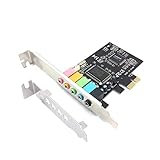
- 1) PCIe sound card, 5.1 stereo audio card
- 2) Easily convert the PC into a cinematic entertainment system by providing a 5.1 3D stereo surrounding sound
- 3) With low profile bracket for 2U case, your best choice of sound card for PC desktop
- 4) 16-bit multimedia digital signal editing decoder inside, Supports 32/64-bit audio processing, recording and playback
- The primary graphics slot.
- Another PCIe slot.
- M.2 sockets.
- SATA or SATA Express ports.
- The chipset uplink and other chipset-connected devices.
Depending on which connectors are populated, the board may reduce a slot’s width, disable a slot or storage connector, or alter the GPU’s link. Gigabyte’s GA-Z270X-Gaming K5 specifications and GA-Z270X-Gaming SOC specifications illustrate how x4-capable slots can share bandwidth with M.2 and other PCIe connections.
Sharing bandwidth usually does not stop a low-bandwidth sound card from functioning. A rule that disables the slot or changes its mode can, however, prevent detection. Find your manual’s tables headed “PCIe slot configuration,” “Expansion slots,” “Lane sharing,” “PCIEX16 bandwidth,” “When M.2 is populated,” or similar.
Could installing it reduce GPU performance?
There is no universal answer; it depends on which physical slot you use and how the motherboard routes its lanes.
Rank #3

- REFERENCE-GRADE HI-RES AUDIO – Powered by the ESS ES9039Q2M DAC with up to 130 dB SNR, supporting 32-bit / 384 kHz playback for exceptional clarity and detail, far beyond typical onboard audio
- POWER FOR DEMANDING HEADPHONES – Built-in high-performance headphone amplifier delivers up to 350mW @ 32Ω. Easily drives studio-grade headphones
- LOW-LATENCY PERFORMANCE – Supports DSD256 and ASIO 2.3 for high-resolution playback and low-latency audio, ideal for music, gaming, and PC audio workflows.
- PRECISION SOUND PERSONALISATION – 10-band parametric EQ + AutoEq in Creative Nexus add meaningful personalization and offers advanced audio tuning and control
- FLEXIBLE CONNECTIVITY – Coaxial output and optical input for seamless integration with desktop audio setups.
| Motherboard arrangement | Likely consequence |
|---|---|
| Secondary x16-length slot connected at x4 | The primary GPU often remains at x16, though the manual controls. |
| Second slot sharing CPU lanes with the GPU | The GPU may change from x16 to x8 when both slots are populated. |
| Chipset-connected x4 slot | The GPU may be unaffected, but chipset bandwidth and other connectors are shared. |
| Slot tied to M.2, SATA, or another PCIe connector | Another connector may be disabled or downgraded when the sound card is installed. |
Do not assume that a sound card will always leave GPU link width unchanged. Verify the exact board manual before using a slot that shares CPU graphics lanes.
BIOS settings: what to change and what not to change
Most x1 sound cards need no special BIOS configuration. Firmware labels vary, but relevant settings can include slot enablement, PCIe link speed, bifurcation, and onboard audio.
- Leave the slot’s link speed at Auto initially.
- Boot and check whether the operating system detects the card.
- Use a forced older generation such as Gen 2 only as a troubleshooting test, and only if the motherboard offers that setting.
- Do not enable bifurcation routinely. Bifurcation divides a wider slot into multiple independent links and is generally intended for configurations such as x4/x4, not for a single x1 sound card.
Settings such as Above 4G Decoding and Resizable BAR are generally graphics-related and are not routine fixes for sound-card detection.
Rank #4
Safe installation procedure
- Shut down the computer completely.
- Switch off the power supply, unplug the AC cable, and press the case power button briefly.
- Touch the case chassis or use appropriate anti-static precautions.
- Confirm that the target connector is PCIe and remove its rear expansion-slot cover.
- Insert the x1 card straight into the x16-length slot without forcing it.
- Secure the bracket with the case screw and check that the card is fully seated.
- Reconnect power and boot the system.
- Install the exact driver and control software for the sound-card model.
- In Windows, inspect Device Manager → Sound, video and game controllers and Device Manager → System devices.
- Select the card as the default playback and recording device, then test speakers, headphones, microphone, and optical output separately.
Most ordinary x1 sound cards draw power through the slot. Some high-end models require auxiliary power; for example, Creative’s AE-9 instructions require a PCIe 6-pin connector and warn against substituting an ATX 4-pin, P4, or EPS connector. Follow the exact card manual and see Creative’s AE-9 instructions.
If Windows does not detect the card
Check the installation and slot
- Power off, remove the card, and reseat it firmly.
- Make sure the bracket is not preventing full insertion.
- Try another PCIe slot if one is available.
- Check whether an M.2 drive or another card disables the target slot.
- Inspect the slot and card edge for dust or damage.
- Confirm that the card is PCIe, not a legacy PCI model.
Review firmware settings
- Load BIOS defaults if unusual PCIe settings were changed.
- Confirm that the slot is enabled.
- Leave link speed on Auto first.
- Test a lower generation only when the manual provides that option.
- Review the board’s lane-sharing and slot-disable rules.
Check drivers and Windows audio selection
- Install the driver for the exact model and operating system.
- Look for an unknown multimedia or audio device in Device Manager.
- Remove obsolete or conflicting drivers when appropriate.
- Check that Windows has not selected HDMI or DisplayPort audio from the graphics card.
- Disable onboard audio only as a diagnostic or preference choice, not as a universal requirement.
Creative’s troubleshooting guidance recommends checking system requirements, trying another slot, and testing another computer to separate a faulty card from a motherboard or resource problem: system-requirement guidance and detection troubleshooting.
Free tools Windows power users keep installed
One-click scans. No signup required.
Isolate the failed component
- Test the sound card in a known-compatible computer.
- Test another PCIe card in the target slot.
- If other cards also fail, investigate the slot, motherboard, or BIOS.
- If the sound card fails in multiple systems, suspect the card or its driver.
- If only this card fails in this slot, investigate firmware compatibility, resources, and link-speed settings.
Do you need to disable onboard audio?
No. Both the motherboard codec and add-in sound card can normally remain enabled, and Windows can expose both devices. Disable onboard audio if it causes a specific conflict, creates confusing duplicate outputs, or you want applications to use only the add-in card. Leaving it enabled provides a fallback and may preserve convenient front-panel audio. Creative presents disabling onboard audio as a troubleshooting option, not a requirement, in its support guidance.
Best Value

- ESS SABRE32 ES9018K2M DAC The speaker line-out is driven by the ES9018K2M with ESS's 32-bit Hyperstream architecture, delivering clean, low-distortion Hi-Res sound up to 24-bit / 96 kHz to your powered speakers, soundbar or amplifier — a real step up from onboard audio.
- Driver-Free, True Plug and Play Built on USB Audio Class 1.0, the ST113 is recognized instantly by Windows, macOS, Linux and Android. No driver CD, no software conflicts, no setup headaches — install it and it just works.
- Optical Isolation Ends the Noise The galvanically isolated optical TOSLINK output blocks the ground-loop hum, hiss and static that plague PC audio, so your external DAC or AV receiver receives a dead-silent digital signal. A coaxial RCA digital output is also included.
- 9-Pin Front-Panel Header for Headphones and Mic A 9-pin front-panel audio header extends headphone out and mic-in to the front of your PC case. Connect your case's front-panel audio cable and get easy, cable-free access for calls, voice chat, gaming and everyday listening.
- Five Ports for Complete Desktop Audio 3.5 mm speaker line-out (for powered speakers / amplifiers), 3.5 mm headphone out, SPDIF optical (TOSLINK) and coaxial (RCA) digital output, and a 3.5 mm microphone input.
Do not confuse PCIe with legacy PCI
A PCIe x1 sound card cannot be installed directly in a conventional 32-bit PCI slot. PCIe x1 uses a small, keyed connector and serial PCIe signaling; legacy PCI uses a different, longer connector and signaling standard. A passive mechanical adapter generally cannot convert one protocol to the other. Active bridge hardware would be required and may introduce driver and compatibility limitations.
When a riser or USB audio device is better
If the card is electrically suitable but blocked by a graphics card or case, a PCIe x1-to-x16 riser can relocate it. The riser must support the relevant PCIe generation and lane configuration, and poor-quality risers can cause detection failures, signal-integrity problems, electromagnetic interference, or instability. A riser changes placement; it does not turn the x1 card into an x4 device.
Choose USB audio or an external DAC instead when all suitable slots are blocked or disabled, the system is small-form-factor, driver support for the old card is uncertain, or portability and easy replacement matter more than internal expansion. Choose integrated audio when the motherboard codec meets your needs and installing the card would compromise GPU airflow, storage expansion, or operating-system support.
Quick decision checklist
- Use the x16-length x4 slot: the card is genuine PCIe, the slot remains enabled, clearance is adequate, and the manual shows no unacceptable GPU or storage trade-off.
- Prefer a normal x1 slot: it is available without blocking airflow and the full-length slot shares CPU lanes or disables an important connector.
- Prefer USB audio: no suitable PCIe slot remains, the case is compact, or reliable modern driver support is more important than internal installation.
For model-specific compatibility, ASUS also publishes device reports such as its PCIe sound-card compatibility report. Always prioritize the motherboard and sound-card manuals for your exact models.
Quick Recap
Product prices and availability are accurate as of the date/time indicated and are subject to change. Any price and availability information displayed on Amazon at the time of purchase will apply.

