
iTechGuides is reader-supported. When you buy through links on our site, we may earn an affiliate commission. As an Amazon Associate I earn from qualifying purchases. Learn more
A decision app can make options and preferences easier to see, but it cannot guarantee agreement. The strongest lesson supported by the available evidence is that a useful group decision flow must balance clarity with participation, privacy, and the friction of asking people to use another tool. The title’s first-person story, however, cannot be reconstructed from studies or another builder’s post: no verified build history or product details are available here.
Why group chats can leave a choice unresolved
Chat is good at exchanging messages, but a decision often requires more than collecting replies. A group needs to surface preferences, compare opinions, and settle on a shared choice. Those are separate stages; a conversation can have plenty of messages and still not make clear what the options are, who prefers what, or whether anyone has agreed.
A Reddit post about a thematically similar project describes unanswered questions, buried messages, and conflicting replies. It is an individual project description, not confirmed evidence from the author of this article’s title, so it illustrates the problem rather than establishing this app’s origin or results. Read the Reddit project post.
Free tools Windows power users keep installed
One-click scans. No signup required.
What a decision app can—and cannot—improve
A dedicated voting flow can organize choices and make preferences visible. That does not mean it automatically produces a better decision than a poll in the group’s existing chat. The practical question is whether the structure it adds is worth the extra step of opening, joining, and returning to a separate tool.
#1 Best Overall

- Read two questions—guess which one was answered
- Trick your friends or totally misread them
- A party game where intuition meets accusation
- 300+ double-sided cards full of savage prompts. First to 10 correct guesses wins
- For 3+ players ages 17+
| Question | What to look for |
|---|---|
| Does the group have to leave its normal chat? | A separate app may add friction; a chat-native flow keeps discussion and decision-making closer together. |
| Are options and votes easy to understand? | Members should be able to see what is being chosen and how preferences are represented. |
| What happens when preferences conflict or are missing? | A vote count alone may not expose unresolved objections or members who did not respond. |
| Can every member participate? | Joining steps, accessibility, and the group’s communication habits affect who takes part. |
| Who can see individual responses? | Visibility and privacy are distinct design choices, not automatic consequences of using a poll. |
| Will people return to finish? | Any added tool has to make its benefit clear enough to justify opening and revisiting it. |
These are useful product questions, not a validated scoring system. They help distinguish the convenience of a structured vote from the social and practical work of reaching a choice.
Keep the decision flow close to the group
A 2025 study of CHARM examined a Telegram chatbot embedded in the group’s existing conversation. Its authors reported lower perceived decision difficulty and fewer messages in their experiment, while also noting task limitations and areas for improvement. This is evidence that a chat-native workflow is worth exploring—not proof that standalone decision apps fail or that the same results will hold for every group or decision. Read the CHARM study.
Rank #2
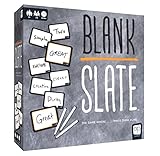
- The game where _______ minds think alike!
- Prepare yourself for Blank Slate, a game of addicting predictions! How well can you put your finger on what everyone's thinking?
- Pick a Word Cue card, write the word you think best completes the phrase, and try to match it to anther player's word without giving a single hint
- Easy to learn, quick to play, and fun for the whole family; just grab a slate, write a word, and get ready to make a match. Great for large groups or small gatherings!
- Includes: Scoreboard, 8 dry-erase slates, 250 doubled-sided word cue cards, rules
The design implication is straightforward: reduce needless transitions where possible. A dedicated app may still be useful if it makes a complex choice substantially clearer, but requiring a new destination is part of the product’s cost. Putting the vote in an existing chat is one way to lower that cost; it does not resolve questions such as privacy, competing preferences, or who gets heard.
Agreement, satisfaction, and participation are different outcomes
In a 2024 qualitative focus-group study, 14 participants from friend, family, and couple groups described a good group choice as one that maximizes overall satisfaction without leaving a member dissatisfied. That finding reflects a small study sample, not a population-wide statistic, but it highlights why simply selecting the most popular option may not feel like a good outcome to everyone. Participants also raised concerns about competing members and privacy, and wanted support suited to personality and group structure. Read the 2024 focus-group study.
Rank #3

- VIRAL TREND AT THE TABLE – Bring the familiar challenge to game night with prompts, reactions, and relatable moments that spark laughter and conversation; easy for new players to join and enjoy instantly.
- SIMPLE RULES, BIG ENERGY – Hold up five fingers, read a card aloud, and react by putting a finger up or down; intuitive mechanics create fast, engaging rounds that keep everyone involved start to finish.
- UNEXPECTED UP AND DOWN TWISTS – Special cards add surprising moments, funny penalties, and playful twists that encourage expressive reactions, storytelling, and memorable interactions among the group.
- FLEXIBLE FOR ANY GROUP SIZE – Works for pairs or full gatherings, making it great for college hangouts, casual meetups, living rooms, or party groups who want a quick, social, conversation driven experience.
- REPEATABLE FUN EVERY ROUND – Quick setup and varied prompts support multiple sessions, letting players explore new card mixes, create fresh moments, and build energy across back to back games.
Participation equity also does not guarantee consensus. A 1990 INFORMS experiment found that technology-supported groups had more equal participation than manually supported groups, but were less likely to reach consensus and took longer. The experiment is historical and its technology and task may not predict how a current consumer app performs; it is a reminder that making participation more even and reaching agreement are separate goals. Read the INFORMS study.
Be cautious about using AI to steer a group
A 2026 Google DeepMind report describes two group-deliberation studies with 879 participants, including a task involving $7,200 USD in real financial stakes. LLM facilitation did not significantly improve consensus, although participants preferred facilitated discussion. The authors also reported shifts of up to 5.5 percentage points in select charity-level allocations, while measures of participation equity did not improve. Preference for facilitation, consensus, allocation outcomes, and equitable participation are different measures; the results do not establish that AI can fairly settle everyday group choices. Read the 2026 study.
Rank #4
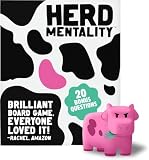
- Udderly hilarious board game for family and friends game nights. Fun for big groups of 4-20+ players
- Easy to learn, quick to play and endlessly repayable board game. This version comes with 20 extra questions
- Think the same to win the game. Flip over a question and guess what your family and friends are thinking
- If your answer is in the majority, you win cows. If you’re the odd one out, you’re stuck with the pink cow of doom
- One of the best board games for families, adults, teens and kids aged 10+. Perfect icebreaker game. Easy and fun for everyone! Perfect as a Thanksgiving or Christmas game
A separate 2022 ACL paper evaluated signals associated with people changing their minds in online group conversations. Its language-aware ranking performed best among the evaluated approaches for that prediction task. Predicting who may change their mind is not the same as fairly deciding what a group should choose, and the paper does not establish that an AI can do the latter. Read the ACL paper.
What can honestly be claimed about this app
The title presents a first-person account, but the available evidence does not identify the author, describe the app’s features, document its development, or report user testing, adoption, or outcomes. Studies and a separate builder’s post can inform the design questions; they cannot stand in for the author’s own lessons. Without that product history, it would be misleading to claim that this app solved group indecision or to prescribe its specific design.
Best Value

- FUN RANKING & GUESSING PARTY GAME: First to Worst challenges players to get into each other’s heads by ranking a variety of fun and polarizing priorities from best to worst and then guessing how others ordered them — perfect for laughs and lively discussions
- EASY TO LEARN & QUICK TO PLAY - Simple rules make it easy for anyone to jump in: one player secretly ranks five things, and the rest of the group works together to guess the exact order.
- GAME NIGHT FAVORITE FOR FRIENDS & FAMILY: Designed to bring people together across generations. Great for game nights, breakouts at parties, pregames, family get-togethers, birthdays, or anytime you want a fun group activity that sparks laughter and conversation.
- EXAMPLE CARDS: Players work together to get inside each other’s heads by guessing how one player ranked five topics from best to worst. Topics range from Pineapple on Pizza to Country Music and Cat Videos, with nearly 300 total topics
- GREAT GIFT FOR ANY OCCASION: A fun and unique gift idea for birthdays, Christmas, white elephant exchanges, Secret Santa, and holiday parties. Makes a great stocking stuffer and go-to gift for teens, adults, and family game lovers.
The evidence does support a narrower conclusion: structure can make preferences more legible, but any decision tool must account for participation, satisfaction, privacy, and adoption friction separately. Whether a standalone app is better than a chat poll depends on the group and the decision; the cited work does not establish a universal winner.
Quick Recap
Product prices and availability are accurate as of the date/time indicated and are subject to change. Any price and availability information displayed on Amazon at the time of purchase will apply.

