
Quick wins for a faster PC:
Scan for outdated or missing drivers - takes under a minuteDriver Scan →Clear out junk files and repair common Windows errorsFree Scan →iTechGuides is reader-supported. When you buy through links on our site, we may earn an affiliate commission. As an Amazon Associate I earn from qualifying purchases. Learn more
Astrobotic’s Peregrine lander lost fuel after a helium pressure-control valve failed to seal, allowing helium to over-pressurize and rupture the oxidizer tank. The leak left the spacecraft unable to support a soft lunar landing. Peregrine was redirected for controlled re-entry and broke up over the South Pacific on January 18, 2024. Four of NASA’s five instruments aboard nevertheless powered on and collected data during the flight.
What happened to Peregrine?
Peregrine launched on January 8, 2024, aboard United Launch Alliance’s first Vulcan rocket. After separating from the rocket, the spacecraft powered up and began commissioning its systems. A propulsion anomaly then triggered an uncontrolled loss of oxidizer, the propellant component needed by Peregrine’s engines.
On January 11, NASA said the propulsion failure had caused critical propellant loss and ruled out a soft landing. Astrobotic continued operating the spacecraft where possible, including stabilizing it and collecting data. On January 13, Astrobotic and NASA agreed to end the mission rather than risk creating debris in cislunar space. Peregrine re-entered Earth’s atmosphere over the South Pacific at approximately 4:04 p.m. EST on January 18, 2024.
Recommended Free Tools
Why did Peregrine lose fuel?
A valve let helium into the oxidizer tank
Astrobotic’s post-mission review board identified failure of pressure-control valve PCV2 as the most likely initiating cause. The valve was meant to control helium used to pressurize the propulsion system. The review concluded that PCV2 lost its ability to seal, likely because vibration loosened threaded components inside the valve.
#1 Best Overall

- HOBBY MODEL KIT – Unassembled model packed in an envelope with easy to follow instructions. Ideal for ages 14 and up
- NO GLUE OR SOLDER NEEDED – Parts can be easily clipped from the metal sheets. Tweezers are the recommended tool for bending and twisting the connection tabs
- APOLLO LUNAR MODULE – 2 Sheet Model with a moderate difficulty level. Once assembled, dimensions are 2.34 x 2.34 x 2.15 inches.
- FROM STEEL SHEETS TO 3D – Pop out the pieces and connect using tabs and holes. Includes illustrated instructions
- HIGHLY DETAILED ETCHED MODEL – Display your 3D model once completed - collect and build them all
When the valve was actuated during propulsion-system activation, helium flowed into the oxidizer tank without proper control. The tank pressure rose beyond its operating limit and the tank ruptured. Oxidizer then continued leaking for the rest of the mission. NASA’s Office of Inspector General later summarized the failure chain as a helium pressurization valve that failed to close, over-pressurizing and rupturing the tank.
Why couldn’t Peregrine land on the Moon?
A lunar landing requires a working propulsion system that can provide controlled thrust and braking. After the tank rupture, Peregrine could not pressurize its propulsion system to the level needed for the landing sequence. The leak also depleted propellant that the spacecraft needed for maneuvering.
Rank #2
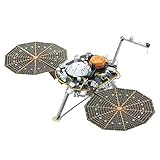
- Metal Earth- Insight Mars Lander - 3D Model Metal kit - Age 14 plus
- It starts as 2 x 10 cm metal sheets
- Use the easy to follow illustrated instructions
- Pop out the pieces, bend the tabs and connect them at the attachment points
- Assembled Size: 15cm x 5.5cm x 6.25cm, 5.9 x 2.2 x 2.5 inches, Scale 1:40
Astrobotic had to use attitude-control thrusters far more than expected to keep Peregrine oriented toward the Sun and its solar arrays. As propellant dwindled, the spacecraft could no longer preserve the planned sequence for reaching and landing on the Moon. Astrobotic’s January 12 update placed Peregrine about 238,000 miles from Earth, at lunar distance, but estimated that propellant would run out before the planned 15-day arrival point. Being near the Moon was not enough: the spacecraft no longer had the propulsion capability to make a controlled landing.
How the mission changed course
| Date | Mission event |
|---|---|
| January 8, 2024 | Peregrine launched on Vulcan. During propulsion activation, PCV2 was actuated; telemetry later showed uncontrolled helium flow, oxidizer-tank overpressure, rupture, and a continuing leak. |
| January 11, 2024 | NASA reported critical propellant loss and said a soft lunar landing was no longer possible. |
| January 12, 2024 | Astrobotic reported the spacecraft was at lunar distance and estimated it would run out of propellant before its planned arrival. |
| January 13, 2024 | Astrobotic, in consultation with NASA, decided to end the mission to avoid a possible cislunar debris event. |
| January 18, 2024 | Peregrine made a controlled re-entry over the South Pacific at approximately 4:04 p.m. EST. |
| January 19, 2024 | NASA announced the mission’s conclusion and summarized the payload results. |
Did NASA get any science from Peregrine?
Yes. NASA reported that four of the five agency payloads powered on and gathered data, even though the lander never reached the lunar surface.
Rank #3

- Features a detailed Eagle lunar lander replica with lunar surface, crater, footprints, and U.S. flag for a realistic space experience.
- This modular set includes a descent stage with gold-colored landing pads, panels, opening camera, laser hatches, and movable ladder.
- The ascent stage boasts a detailed interior with room for 2 astronaut minifigures, finished with an Apollo 11 Lunar Lander nameplate.
- This collector building set includes 2 astronaut minifigures with N.A.S.A decoration and golden helmets.
- This building model makes a great centerpiece for home or office, providing a challenging and rewarding building experience for adults.
- Linear Energy Transfer Spectrometer (LETS): measured radiation in the spacecraft’s environment.
- Neutron Spectrometer System (NSS): measured another part of the interplanetary radiation environment. NASA said NSS and LETS provided complementary measurements relevant to future human missions and spacecraft electronics.
- Near-Infrared Volatile Spectrometer System (NIRVSS): powered on and collected in-flight data.
- Peregrine Ion-Trap Mass Spectrometer (PITMS): powered on and collected in-flight data.
- Laser Retroreflector Array (LRA): was passive and depended on lunar-surface operations for its planned experiment, so it could not perform that experiment during the flight.
NASA described preliminary data as including measurements of natural radiation and chemical compounds around the spacecraft. The instruments’ operation in space also gave NASA a chance to assess payload performance and data-collection processes before later missions.
What did the failed landing mean for NASA’s CLPS program?
Peregrine was the first flight by a commercial vendor under NASA’s Commercial Lunar Payload Services (CLPS) initiative. Its primary objective—a soft lunar landing and delivery of payloads—was not achieved. It did, however, return engineering telemetry about the propulsion failure and partial science results from four NASA instruments.
Rank #4

- "One small step for man, one giant leap for mankind." Words spoken by Neil Armstrong, the first human to walk on the moon. Those moments of the 21st of July 1969 will resonate, entertain and inspire generations to come.
- "The Eagle has landed." Then the moment of watching Neil Armstrong taking his first steps on the moon after leaving the Lunar Module, will make you wax nostalgia everytime you look at this model on one of the most pivotal moments in history, witnessed by millions on live television.
- Airfix is the oldest UK manufacturer of scale model plastic kits and has been producing kits for the mass market since 1952. Airfix produce a wide range of kits aimed at all types of scale modelers with subjects such as; military aircraft, ships, space, cars, dioramas and military vehicles.
- All paints, glue and brushes are included to complete the kit. Additional paints may be required to complete models to a higher specification. Painting and Assembly required.
- Large Gift Sets are perfect one-stop-shop gifts for your modeler friends or to build yourself once you have mastered the basics.
NASA’s Inspector General has described CLPS as accepting the risks of flying lower-cost, non-critical payloads on early missions in exchange for opportunities to learn and improve later deliveries. Peregrine illustrated both sides of that approach: a serious hardware failure prevented the landing, while the flight still provided operational and instrument data. The spacecraft’s controlled re-entry also reflected a deliberate effort to avoid leaving a potential debris hazard in cislunar space.
How long did Peregrine operate?
NASA reported that the spacecraft spent 10 days and 13 hours in space. Astrobotic reported that it operated for 10 days and 14 hours and traveled more than 535,000 miles. The figures use different descriptions—NASA’s time in space and Astrobotic’s operating duration—so they are best kept attributed to their respective organizations.
Quick Recap
Best Value

- HOBBY MODEL KIT – Unassembled model packed in an envelope with easy to follow instructions. Ideal for ages 14 and up.
- NO GLUE OR SOLDER NEEDED – Parts can be easily clipped from the metal sheets. Tweezers are the recommended tool for bending and twisting the connection tabs.
- PREMIUM SERIES ARTEMIS MOON ROCKET - 3.50 Sheet Model with a Challenging difficulty level. Once assembled, dimensions are 3.30 L x 2.88 W x 7.40 H inches. 115 Pieces. 1:522 Scale.
- FROM STEEL SHEETS TO 3D – Pop out the pieces and connect using tabs and holes. Includes illustrated instructions
- HIGHLY DETAILED ETCHED MODEL – Display your 3D model once completed - collect and build them all.
Product prices and availability are accurate as of the date/time indicated and are subject to change. Any price and availability information displayed on Amazon at the time of purchase will apply.

