
iTechGuides is reader-supported. When you buy through links on our site, we may earn an affiliate commission. As an Amazon Associate I earn from qualifying purchases. Learn more
For a TV near the router, use 6 GHz if both the router and streaming device support Wi-Fi 6E or Wi-Fi 7, 6 GHz is available in your region, and the signal is strong. Otherwise, try 5 GHz first. If the TV is farther away or separated by walls, choose the band that gives it the most stable connection—often 2.4 GHz or 5 GHz. You do not need 6 GHz just because you stream in 4K.
How the three bands compare for 4K streaming
These are general tendencies, not speed guarantees. The router and streaming device must both support a band, and distance, walls, interference, channel width, and device specifications all affect performance.
| Band | When to try it | Trade-off |
|---|---|---|
| 2.4 GHz | The TV is far from the router, behind obstacles, or needs broad compatibility. | It generally reaches farther and passes through walls better, but is often slower and more congested. Microsoft explains the range and speed trade-offs. |
| 5 GHz | The TV is reasonably close and supports 5 GHz; a sensible starting point for streaming. | It generally offers faster throughput than 2.4 GHz, but has shorter range and weaker obstacle penetration. Microsoft’s Wi-Fi guide identifies it as better suited to movie streaming. |
| 6 GHz | The TV is close, the connection is strong, and both router and device support Wi-Fi 6E or Wi-Fi 7. | It can offer high performance with less congestion, but has the weakest reach through walls, requires compatible equipment, and may not be available under local rules. See Apple’s Wi-Fi 6E guidance and ASUS’s band comparison. |
Does 4K require 6 GHz?
No. Netflix recommends an internet speed of 15 Mbps or higher for UHD/4K playback; that is Netflix’s service recommendation, not a Wi-Fi-band requirement. Netflix lists its recommended internet connection speeds. A stable connection at the TV that meets your streaming service’s requirement can be sufficient on any supported band.
If playback already works reliably, changing bands may not visibly improve the picture. That is a practical inference from the service speed recommendation and the bands’ trade-offs, not a guaranteed result for every home.
#1 Best Overall

- OneMesh Compatible Router - Form a seamless WiFi when work with TP-Link OneMesh WiFi Extenders
- Next-Gen Wi-Fi 6 Technology – The Archer AX10 leverages advanced Wi-Fi 6 features like OFDMA and 1024-QAM to deliver improved efficiency across your entire network. Perfect for high-bandwidth activities like streaming, gaming, and smart home connectivity.
- Next-gen Dual Band router - 300 Mbps on 2. 4 GHz (802. 11n) plus 1201 Mbps on 5 GHz (802. 11ax)
- Connect more devices than ever before - Wi-Fi 6 technology simultaneously communicates more data to more devices using OFDMA and MU-MIMO while reducing lag dramatically
- Powerful Dual-Core 900MHz Processor – Handles multiple data streams simultaneously for reliable performance across your devices. Ensures smooth streaming, online gaming, and video conferencing without buffering or lag.
Choose the band where the TV actually sits
A band that is fast beside the router can perform poorly at the TV. Check the connection at the device’s location, where walls and distance have their full effect.
- Check which bands the TV or streaming device supports, and whether the router supports them too. For 6 GHz, both ends need compatible hardware; Apple’s compatibility guidance describes its supported devices and router requirement.
- If the router uses one network name (SSID) across bands, the device may select a band automatically. Apple recommends one network name across bands for compatibility on supported Apple devices; on Windows, band selection can also be automatic. See Apple’s guidance and Microsoft’s guide.
- If the router offers separate network names, connect the TV to each supported band in turn and compare connection stability or speed at the TV. Microsoft recommends measuring Wi-Fi performance in different parts of the home; its wireless network report guide covers measurement.
- Keep the band that performs reliably at the TV. If 6 GHz struggles through walls or over distance, compare 5 GHz and 2.4 GHz rather than assuming the highest frequency is best.
When 6 GHz is—and is not—worth considering
6 GHz can be useful for a nearby compatible TV when other bands are busy, but it is not a universal upgrade for every room. Devices and features vary by region, and local regulations affect available 6 GHz channels. Apple notes regional availability differences; ASUS describes regional channel allocation and factors that affect performance.
Rank #2

- DUAL-BAND WIFI 6 ROUTER: Wi-Fi 6(802.11ax) technology achieves faster speeds, greater capacity and reduced network congestion compared to the previous gen. All WiFi routers require a separate modem. Dual-Band WiFi routers do not support the 6 GHz band.
- AX1800: Enjoy smoother and more stable streaming, gaming, downloading with 1.8 Gbps total bandwidth (up to 1200 Mbps on 5 GHz and up to 574 Mbps on 2.4 GHz). Performance varies by conditions, distance to devices, and obstacles such as walls.
- CONNECT MORE DEVICES: Wi-Fi 6 technology communicates more data to more devices simultaneously using revolutionary OFDMA technology
- EXTENSIVE COVERAGE: Achieve the strong, reliable WiFi coverage with Archer AX1800 as it focuses signal strength to your devices far away using Beamforming technology, 4 high-gain antennas and an advanced front-end module (FEM) chipset
- OUR CYBERSECURITY COMMITMENT: TP-Link is a signatory of the U.S. Cybersecurity and Infrastructure Security Agency’s (CISA) Secure-by-Design pledge. This device is designed, built, and maintained, with advanced security as a core requirement.
A 2021 CableLabs and Intel field trial, announced by the Wireless Broadband Alliance, reported 1.7 TCP Gbps downlink and 1.2 TCP Gbps uplink near an access point using 160 MHz Wi-Fi 6E channels. It took place in one 3,600-square-foot, two-story home with a basement, using an ASUS access point; these results describe that setup, not typical speeds or a promised improvement for another home. The Wireless Broadband Alliance’s trial announcement includes the conditions and results.
The Tool Desk
Outbyte Driver Updater FREEScan for outdated or missing drivers - takes under a minuteDriver Scan →Outbyte PC Repair FREEClear out junk files and repair common Windows errorsFree Scan →Quick Recap
Best Value
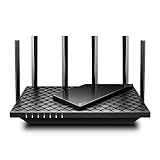
- 𝐆𝐢𝐠𝐚𝐛𝐢𝐭 𝐖𝐢𝐅𝐢 𝐟𝐨𝐫 𝟖𝐊 𝐒𝐭𝐫𝐞𝐚𝐦𝐢𝐧𝐠 – Up to 5400 Mbps WiFi for faster browsing, streaming, gaming and downloading, all at the same time. Performance varies by conditions, distance to devices, & obstacles such as walls.
- 𝐅𝐮𝐥𝐥 𝐅𝐞𝐚𝐭𝐮𝐫𝐞𝐝 𝐖𝐢𝐅𝐢 𝟔 𝐑𝐨𝐮𝐭𝐞𝐫 – Equipped with 4T4R and HE160 technologies on the 5 GHz band to enable max 4.8 Gbps ultra-fast connections.Power:12 V 2.5 A
- 𝐂𝐨𝐧𝐧𝐞𝐜𝐭 𝐌𝐨𝐫𝐞 𝐃𝐞𝐯𝐢𝐜𝐞𝐬 – Supports MU-MIMO and OFDMA to reduce congestion and 4X the average throughput
- 𝐄𝐱𝐭𝐞𝐧𝐬𝐢𝐯𝐞 𝐂𝐨𝐯𝐞𝐫𝐚𝐠𝐞 - Covers up to 2,000 sq. ft. High-Power FEM, 6× Antennas, Beamforming, and 4T4R structures combine to adapt WiFi coverage to perfectly fit your home and concentrate signal strength towards your devices.
- 𝐌𝐨𝐫𝐞 𝐕𝐞𝐧𝐭𝐬, 𝐋𝐞𝐬𝐬 𝐇𝐞𝐚𝐭 – Improved vented areas help unleash the full power of the router
Rank #4

- NIGHTHAWK WIFI 6 ROUTER FOR YOUR WHOLE HOME: Delivers fast, reliable WiFi across every room of your apartment or small home for streaming, gaming, video calls, and smart home devices, all running at the same time without slowing each other down.
- WORKS WITH YOUR EXISTING INTERNET SERVICE: Pairs with your existing modem or gateway via ethernet. Compatible with most cable, fiber, DSL, and satellite providers. Some gateways and modem router combos may require bridge mode. No coax needed.
- SET UP AND MANAGE YOUR NETWORK WITH THE NIGHTHAWK APP: Download the free Nighthawk app on iOS or Android for guided setup. Manage WiFi, run speed tests, pause devices, and set up guest networks from anywhere. Active internet required.
- READY FOR THE DEVICES YOU ALREADY OWN: Your phones, laptops, and TVs work right out of the box. WiFi 6 delivers speeds up to 1.8 Gbps across 2.4 GHz and 5 GHz bands. Backward compatible with WiFi 5 and earlier.
- COVERAGE IN EVERY ROOM: Covers up to 1,500 sq. ft. for up to 20 connected devices. Walls, floors, and interference can reduce range. Larger or multi-story homes may benefit from a NETGEAR Orbi mesh WiFi system.
Rank #3

- Next-Gen Gigabit Wi-Fi 6 Speeds: 2402 Mbps on 5 GHz and 574 Mbps on 2.4 GHz bands ensure smoother streaming and faster downloads; support VPN server and VPN client¹
- A More Responsive Experience: Enjoy smooth gaming, video streaming, and live feeds simultaneously. OFDMA makes your Wi-Fi stronger by allowing multiple clients to share one band at the same time, cutting latency and jitter.²
- Expanded Wi-Fi Coverage: 4 high-gain external antennas and Beamforming technology combine to extend strong, reliable, Wi-Fi throughout your home.
- Improved Battery Life: Target Wake Time helps your devices to communicate efficiently while consuming less power.
- Improved Cooling Design: No heat ups, no throttles. A larger heat sink and redefined case design cools the WiFi 6 system and enables your network to stay at top speeds in more versatile environments.
What to try if the stream still buffers
- Test the connection at the TV rather than beside the router, and compare supported bands there.
- Check that the streaming service’s recommended internet speed is met consistently; a Wi-Fi band cannot compensate for an inadequate internet connection.
- Consider router placement before buying equipment. If measurements show a weak signal at the TV because of distance or obstacles, repositioning the router or adding coverage may help. A 6 GHz-capable router alone is not a reason to upgrade for 4K.
Product prices and availability are accurate as of the date/time indicated and are subject to change. Any price and availability information displayed on Amazon at the time of purchase will apply.

