
What’s actually slowing this PC down?
Pick the symptom - the matching free tool is one click away.
iTechGuides is reader-supported. When you buy through links on our site, we may earn an affiliate commission. As an Amazon Associate I earn from qualifying purchases. Learn more
Before buying shares in a regional bank, review several quarters of its FDIC Call Reports and compare its loans, credit losses, deposits, funding, liquidity, capital, securities exposure and earnings with those of similar banks. No single ratio can establish that a bank is safe or a stock is a good buy: the figures need to be read together and in the context of the bank’s size, business model and markets.
Start with the bank’s filings and a suitable peer group
FDIC-insured banks and savings associations file Call Reports each quarter. Those reports give regulators and the public information about an institution’s condition, performance and risk profile. Begin with the bank’s latest reports, then review several prior quarters to see whether balances, concentrations and trends are changing. The FDIC Bank Financial Reports page is a starting point for reports and related information.


- Confirm the bank’s legal identity, charter, size, business mix and geographic footprint. Make sure you are examining the right institution rather than a similarly named company or only its holding company.
- Choose peers with reasonably similar size, loan mix, markets and business models. A bank concentrated in commercial real estate is not a like-for-like comparison with one focused on residential mortgages or consumer lending.
- Use the FDIC data downloads and comparison resources to find institution data, peer comparisons and branch deposit information.
- Record the same measures for each bank and compare both levels and direction over multiple quarters. A ratio can look different because of business mix or a one-quarter change, so investigate the underlying balances and disclosures before drawing a conclusion.
Review the loan book and the cost of credit
Loan growth can support earnings, but the type and concentration of lending matter. Look at balances by loan category and consider whether growth has made the bank more dependent on a sector, borrower type or geographic market. The FDIC’s Risk Review discusses credit exposures across commercial real estate and other lending categories, providing context for risks that can affect lenders.
What to track
- Loan balances and mix by category, including changes in concentrated portfolios.
- Past-due and nonaccrual loans, which help show where borrowers are falling behind or not making payments as agreed.
- Charge-offs and recoveries, to see realized credit losses and collections over time.
- The allowance for credit losses and provisions for credit losses. Consider whether the allowance and the bank’s capital appear proportionate to the risks and changes in its portfolio, rather than treating either figure alone as a definitive measure.
Read these measures together. For example, rapid growth in a concentrated loan category deserves closer examination when past-due loans or charge-offs are also rising. The FDIC’s account of the financial crisis says Call Report indicators such as concentrations, rapid asset growth, volatile funding and lower capital helped identify risk, but those indicators are prompts for further diligence—not predictions that a particular bank will fail.
Assess deposits, funding and liquidity
Deposits are a key source of bank funding, but their stability depends on more than the total balance. Track deposit liabilities and their composition over time. Where reported, examine uninsured deposits and reliance on alternative or wholesale funding, then consider those potential funding pressures alongside cash, securities and other available liquidity sources.
The OCC’s Problem Bank Supervision handbook cautions that “Deposit volatility can be a red flag of an emerging problem bank.” It identifies depositor type and relationship duration as relevant considerations. Changes in rates, reputation and geography can also affect how readily funds move, but public filings cannot reliably predict how customers will behave in a future stress event.
Rank #2
The FDIC’s annual Summary of Deposits survey measures branch deposits as of June 30. It can help show a bank’s branch-market position, but it is not a complete measure of deposit stability. Use it for market context, not as a substitute for reviewing deposit composition and funding trends in the bank’s filings.
Free tools Windows power users keep installed
One-click scans. No signup required.
Check capital alongside securities and interest-rate exposure
Review regulatory capital ratios and their direction over multiple reporting periods. Capital is a buffer against losses, but its adequacy depends on the risks a bank takes and the possible effects of credit, market and other risks. Interpret capital together with loan concentrations, asset quality, funding and liquidity rather than treating a single ratio as a pass-or-fail test.
Also examine securities holdings and any reported unrealized losses. Interest-rate changes can affect securities values, liquidity and funding needs, so a bank’s capital figures alone may not convey how much pressure those exposures could create. The FDIC’s risk coverage is useful context for the way interest rates can affect bank margins, securities values, liquidity and funding at the same time.
Test whether earnings look durable
Follow net interest income and net interest margin, noninterest revenue and expense, provisions for credit losses, and returns on assets and equity where reported. Ask what is driving the trend: a stronger core business, a change in funding costs, unusually favorable credit costs, or nonrecurring items can produce very different implications for future earnings.
Rank #4
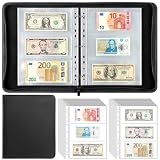
- Premium Leather Construction: The Uncle Paul money binder is crafted from high-quality artificial leather, offering durability and a sophisticated, professional look for your currency collection.
- Ample Storage Capacity: Comes with 40 sheets Currency Pages(240 pockets) to neatly organize and store a large number of paper money bills, banknotes, and coupons, keeping them safe and easily accessible.
- Double-Sided Design: Each page features a double-sided insert with 3 rows and 6 pockets, maximizing storage space and allowing for efficient categorization and display of your paper money collection.
- Secure Zipper Closure: The currency holder album is equipped with a reliable zipper closure, ensuring that your valuable currency collection remains protected from dust, moisture, and accidental spills.
- Sturdy and Well-Structured: Its robust build and well-thought-out design provide excellent support for the pages, preventing sagging or bending, and ensuring your collection stays in pristine condition over time.
Industry averages provide a reference point, not a target-bank result. In its Q1 2026 profile, the FDIC reported 1.26% return on assets and $80.5 billion in net income for FDIC-insured institutions as an industry aggregate. Those figures describe the industry for that quarter; they do not establish the profitability or outlook of any particular regional bank. The FDIC Quarterly Banking Profile for Q1 2026 provides the underlying aggregate context.
Similarly, the FDIC’s Q4 2025 statement reported full-year 2025 industry return on assets of 1.20% and net income of $295.6 billion, while noting that unrealized losses remained elevated. It also reported 60 banks on its problem-bank list at year-end 2025, or 1.4% of all banks, within the 1-to-2% range the agency described as typical in non-crisis periods. These are industry-level and supervisory statistics, not a public risk rating for the bank you are considering.
Best Value

- 【PRODUCT SPECIFICATIONS】- 20 double-sided sheets, 40 pockets. Pocket size: 197×103mm/7.7×4.0in, page size: 210×110mm/8.2×4.3in, cover size: 214×125mm/8.4×4.9in.
- 【QUALITY & CAPACITY】- Superior textured artificial leather is aesthetic and durable. Safe acid-free PVC inner pages provide effective protection. Double-sided design, larger capacity to meet daily needs.
- 【WIDE ADAPTABILITY】- Perfect for banknotes, trading cards, stamps, tickets, bills, documents, invoices, etc. smaller than 19.4×10.3cm/7.6×4.0in.
- 【BONUS DESIGN】- Banknote collecting album can be completely flattened at 180°, and the highly transparent inner pages are easy to assemble and display banknotes.
- 【UNIQUE GIFT】- It is an excellent gift for friends, family members and partners who love to collect. A great companion for collection and display.
Use CAMELS as a checklist, not a public rating
The OCC’s CAMELS framework organizes bank supervision around six areas. It can help an investor avoid focusing too narrowly on earnings or capital, but public financial data do not give investors a substitute for the confidential supervisory assessment. The OCC’s 2026 CAMELS bulletin describes proposed revisions; it is useful here for the names of the six existing components, not as evidence that the proposal has become final.
| CAMELS area | Public-data questions to consider |
|---|---|
| Capital adequacy | How have regulatory capital measures changed, and do they make sense alongside the bank’s concentrations and potential losses? |
| Asset quality | What are the loan mix, concentrations, past-due and nonaccrual balances, charge-offs, recoveries and allowance trends? |
| Management | Public figures can raise questions about outcomes and risk trends, but they do not reveal every management practice, governance issue or supervisory finding. |
| Earnings | Are net interest income, margin, noninterest revenue and expense, provisions and returns changing in a way that appears supportable? |
| Liquidity | How are deposit composition and volatility, wholesale funding, cash, securities and other liquidity sources changing together? |
| Sensitivity to market risk | How could interest-rate movements affect margins, securities values, funding costs and liquidity? |
Compare banks across the whole risk picture
When weighing two banks, compare similar periods and use the same measures for both. A compact comparison sheet can include:
- Business model, size, geography and peer group.
- Loan portfolio mix and concentrations; past-due and nonaccrual balances; charge-off trends; allowance and provisions.
- Capital levels and direction, considered against portfolio and market risks.
- Deposit composition and volatility, uninsured deposits where disclosed, liquidity and wholesale funding.
- Securities exposure and interest-rate sensitivity.
- Profitability, net interest margin, funding costs and the sources of earnings.
A concerning movement in one area is a reason to investigate related areas, not an automatic buy or sell signal. Public filings are valuable for recurring comparisons, but they cannot reveal every supervisory concern, management weakness or institution-specific risk practice, and investors should not imply access to a confidential CAMELS rating.
Do these 3 things before closing this tab:
1Scan for outdated or missing drivers - takes under a minute2Repair Windows errors before they cause bigger problems3Fix the driver behind crashes, sound loss and screen glitchesQuick Recap
Product prices and availability are accurate as of the date/time indicated and are subject to change. Any price and availability information displayed on Amazon at the time of purchase will apply.

