
The Tool Desk
Outbyte PC Repair FREERepair Windows errors before they cause bigger problemsFix Now →Outbyte Driver Updater FREEFix the driver behind crashes, sound loss and screen glitchesFind Drivers →iTechGuides is reader-supported. When you buy through links on our site, we may earn an affiliate commission. As an Amazon Associate I earn from qualifying purchases. Learn more
Russian cyber operations accompanied the invasion of Ukraine, combining destructive attacks, espionage, attempts to gain access to networks and influence activity. They caused disruption, but Ukraine’s digital systems did not collapse: rapid defensive adaptation, distributed infrastructure and cooperation helped the country sustain essential operations. For other organizations, the clearest defensive priorities are universal multifactor authentication (MFA), fast patching, restricted privileges, monitoring, tested isolated backups and a rehearsed recovery plan.
What did Russian hackers do during the first year of the invasion?
Microsoft’s April 2022 account described at least six Russian advanced persistent threat (APT) actors conducting destructive attacks, espionage or both. The cyber campaign was part of a broader hybrid war: some operations took place alongside conventional military activity, while others sought access, intelligence or influence.

Microsoft’s contemporaneous tally, summarized by Axios, counted 237 operations by six Russia-aligned nation-state actors against Ukraine. That is a count of operations Microsoft observed, not a census of every incident or actor. The reported toolkit included wiper malware designed to destroy data, phishing and credential theft, network intrusion, espionage, denial-of-service attacks and influence operations.
Do these 3 things before closing this tab:
1Repair Windows errors before they cause bigger problems2Scan for outdated or missing drivers - takes under a minute3Clear out junk files and repair common Windows errorsTargets included government and military systems, critical civilian infrastructure, media and organizations supporting Ukraine. The range matters: cyber risk was not confined to military networks, and an intrusion intended for intelligence gathering could have different immediate effects from a destructive wiper attack.
#1 Best Overall

- POWERFUL SECURITY KEY: The YubiKey 5 is a versatile physical passkey that protects your digital life from phishing attacks. It ensures only you can access your accounts.
- WORKS WITH 1000+ ACCOUNTS: Compatible with popular accounts like Google, Microsoft, and Apple. A single YubiKey 5 secures 100+ of your favorite accounts, including email, password managers, and more.
- FAST & CONVENIENT LOGIN: Plug in your YubiKey 5 via USB and tap it to authenticate. No batteries, no internet connection, and no extra fees required.
- MOST SECURE PASSKEY: Supports FIDO2/WebAuthn, FIDO U2F, Yubico OTP, OATH-TOTP/HOTP, Smart card (PIV), and OpenPGP. That means it’s versatile, working almost anywhere you need it.
- BUILT TO LAST: Made from tough, waterproof, and crush-resistant materials. Manufactured in Sweden and programmed in the USA with the highest security standards.
Did Russian cyberattacks reach beyond Ukraine?
Yes. Microsoft reported that Russian actors pursued network intrusions against 128 organizations in 42 countries outside Ukraine. In that report, the United States was the leading target, and Poland was a priority because it coordinated logistical support for Ukraine. These figures describe Microsoft’s observations in 2022, not a complete count of all activity worldwide.
Was the war a “cyberwar,” and why didn’t Ukraine’s digital systems collapse?
Cyber operations were a significant part of the war, but “cyberwar” can misleadingly suggest that digital attacks replaced conventional warfare or disabled the country’s essential systems. The first-year evidence instead shows a persistent campaign that included serious destructive effects and espionage, alongside Ukrainian defenses that adapted under pressure.
Rank #2
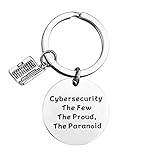
- Programmer Gift - Cybersecurity The Few The Proud, The Paranoid. Get this to have the best information security workers present. Computer programmer, computer coder, and anyone in IT tech!
- Material: Stainless Steel, it is lead free and nickel free, hypo allergenic, it doesn’t rust, change colour or tarnish.
- Measurement: 30mm(1.18"). TIPS:manual measuring permissible error.
- If you are a cybersecurity engineer and you love to work with computer science this will be a great gift for you to wear. People who like programming, hackers and hacking will like this fantastic IT security keychain.
- Velvet bag- Only the most elegant velvet jewelry pouches are used to package and ship our bangle. If you have any quality problems, please feel free to contact us and we will give you a proper solution until you satisfied.
Microsoft reported that Ukraine moved government digital operations and data into public-cloud facilities across Europe after on-premises systems became vulnerable to conventional strikes and wiper malware. Moving services away from threatened local infrastructure helped distribute risk. Microsoft also credited rapid threat-intelligence sharing, endpoint protection and cooperation among Ukrainian officials, technology companies and allied governments. NATO’s review of the conflict likewise emphasizes civil-military cooperation and private-sector assistance.
What’s actually slowing this PC down?
Pick the symptom - the matching free tool is one click away.
The result was resilience, not immunity: attacks caused disruption, but distributed infrastructure and coordinated defense helped Ukraine sustain civil and military operations rather than experience a general collapse of state capacity.
How certain is attribution to Russian actors?
Attribution is strongest when a joint advisory names a specific actor and campaign. For example, a multinational advisory issued by CISA, the FBI, the NSA and partner agencies on August 31, 2023, attributed the Infamous Chisel malware campaign against the Ukrainian military to Sandworm, a Russian actor.
That specific attribution should not be stretched to every incident. Cyber campaigns can involve overlapping tools, proxies or incomplete visibility, so confidence depends on the evidence available for each case. A named attribution for one operation is not proof that every attack with similar features had the same operator.
Rank #4

- KEYCHAIN WITH CHARM: Our circle keychains have just the right balance of fun and function, and hold your key collection together with style. Made from aluminum.
- PROFESSIONALLY PRINTED: Thousands of vivid prints to choose from
- IDENTIFY YOUR KEYS: Easily find your lost keys with our unique novelty prints
- GIFTABLE: A perfect addition to any gift set
- IDEAL FOR YOURSELF & A UNIQUE GIFT: Surprise your husband, brother, dad, grandpa, son, uncle or friend, or order one just for you! Our men's pajamas make a unique and thoughtful gift for Christmas, Father's Day, Mother's Day and birthdays, or just because!
How can an organization reduce the risk of Russian cyberattacks?
The controls below address common routes into an organization and the ability to contain and recover from an intrusion. A joint CISA, FBI and NSA advisory published January 11, 2022, urged organizations to require MFA for all users, without exception. Microsoft’s 2023 recommendations also emphasize endpoint and identity protection.
- Require MFA for every user. Apply it to all accounts, especially email, remote access and administrative accounts. For important accounts, a FIDO2/WebAuthn security key provides a phishing-resistant option. MFA reduces the value of a stolen password; it does not remove the need to monitor accounts for suspicious activity.
- Patch internet-facing systems promptly. Prioritize known exploited vulnerabilities, particularly remote-code-execution and denial-of-service flaws on exposed equipment. Maintain an inventory of externally reachable systems so the team can identify what needs attention.
- Limit privileges and exposure. Give users and services only the access they need. Restrict administrative pathways, segment critical networks and remove unnecessary internet exposure. These steps can make it harder for an attacker who gains one foothold to move broadly through the environment.
- Monitor endpoints and identities. Deploy antimalware, endpoint detection and response (EDR), and identity-protection capabilities. Centralized logs support investigation; ensure the organization can review them as part of its response process.
- Make recovery dependable. Keep frequent backups isolated from normal network connections, test restoration and document configurations for critical IT and operational-technology equipment. Maintain an incident-response plan so people know how to contain an incident and restore services.
- Plan for continuity and distribution. Identify critical services and consider geographic and provider redundancy, along with offline or otherwise independent recovery paths. The goal is to avoid having one damaged site, provider or network connection become a single point of failure.
How should teams compare security controls and providers?
Assess controls against operational needs rather than assuming that a product or vendor is endorsed by Microsoft, CISA or NATO. Compare the capabilities that determine whether a control prevents access, reveals an intrusion and supports recovery.
- MFA: Does it resist phishing, and can it cover all users and important accounts?
- Endpoint and identity protection: Which endpoints and identities are covered, and how useful are the alerts for investigation?
- Vulnerability management: How quickly are updates available, and can the organization identify exposed systems that need them?
- Network controls: Can teams segment critical systems and restrict administrative pathways?
- Logging and response: Are logs sufficiently detailed for investigation, and what incident-support model is available?
- Backup and continuity: Can backups be isolated and restoration tested? Does the service support geographic redundancy and interoperability with the organization’s recovery arrangements?
What should readers take away from the first-year record?
The evidence from 2022 and the attribution example published in 2023 show a campaign with destructive, espionage and access-seeking activity—not a harmless threat, and not a cyber operation that brought Ukraine’s government to a general standstill. Ukraine’s experience highlights both sides of the problem: attackers can target civilian as well as military organizations, while distributed systems, fast information-sharing and tested defenses can limit the damage and help services continue.
Quick Recap
Product prices and availability are accurate as of the date/time indicated and are subject to change. Any price and availability information displayed on Amazon at the time of purchase will apply.

