
Quick wins for a faster PC:
Clear out junk files and repair common Windows errorsFree Scan →Scan for outdated or missing drivers - takes under a minuteDriver Scan →Repair Windows errors before they cause bigger problemsFix Now →iTechGuides is reader-supported. When you buy through links on our site, we may earn an affiliate commission. As an Amazon Associate I earn from qualifying purchases. Learn more
A desktop PC is a set of parts that work together: the processor handles instructions, RAM holds data in active use, storage keeps files and programs, and the motherboard connects the system. A power supply, cooling and a case support those core parts. Many gaming and graphics-heavy computers also need a discrete graphics card, but a suitable processor’s integrated graphics can be enough for everyday tasks.
What components are essential to build a PC?
A typical desktop build includes a CPU, motherboard, RAM, storage, power supply (PSU), case and cooling. A discrete GPU is optional for some systems, while a monitor, keyboard, mouse and operating system are needed to use the completed computer but are not internal components.
Each part has a distinct role. RAM is not long-term storage, and a GPU is not required in every desktop. The exact combination depends on what you plan to do and what the other parts support.
Recommended Free Tools
What does each PC component do?
CPU: executes instructions
The central processing unit (CPU), or processor, executes program instructions and coordinates general computation. Cores and threads let a processor work on multiple tasks or streams of work, but core count or peak clock speed by itself does not predict how fast a computer will feel. Consider the programs you use, the processor platform, motherboard support and cooling together. Intel’s PC-building guide describes the CPU as fitting directly onto the motherboard.
#1 Best Overall

- Comprehensive 420-Piece Screw Kit – This kit includes 420 pieces of computer screws, pc screws, and laptop screws in sizes M2, M2.5, M3 and M5, offering a complete solution for laptop, desktop, and motherboard repairs. Perfect for SSD, HDD, and hard drive replacements. Whether you're fixing a laptop or upgrading a PC case, this kit ensures you have the right motherboard screws for the job.
- Universal Compatibility for Versatile Use – The screw assortment includes laptop screws, pc screws, and computer screws, compatible with popular brands like Lenovo, Dell, HP, Acer, and Asus. It is ideal for repairs of motherboards, hard drives, and SSDs. Whether working on a PC case or replacing motherboard screws, this kit covers all your repair needs.
- High-Quality Alloy Steel Construction – Made from durable alloy steel, this set of computer screws, pc screws, laptop screws, and motherboard screws offers excellent resistance to corrosion and wear. Ideal for long-term use, these screws ensure stable PC case construction and reliable motherboard installations, making them a perfect choice for all repair professionals.
- Ideal for PC Case, Fan, and Motherboard Repairs – This versatile kit includes everything you need for PC assembly, including pc screws, pc case screws, laptop screws, and motherboard screws. It’s perfect for fan installation, power supply mounting, and motherboard repairs, providing an all-in-one solution for computer and laptop upgrades.
- Neatly Organized with Easy Access – The 420-piece assortment of computer screws, pc case screws, and laptop screws comes in a clearly labeled storage box. The organized compartments make it easy to find the right motherboard screws or pc screws for your repair, reducing search time and ensuring efficient and hassle-free repairs for laptops, desktops, and PC cases.
Motherboard: connects the system
The motherboard is the main circuit board: it provides connections for the processor, memory, storage, graphics and other devices, and connects the system to power from the PSU. Intel puts it simply: “The motherboard is the main circuit board and is connected to everything.” It also establishes important compatibility limits, including CPU support, RAM type, expansion slots, storage connections, ports and physical size. The chipset influences available features such as PCIe lanes, USB and storage connections. Check the specific board’s processor support list and manual; a matching socket name alone does not guarantee that a processor is supported.
RAM: holds data in active use
Random-access memory (RAM) is short-term working space for data the CPU and applications need quickly. It does not retain your files when the computer is off. The motherboard and processor determine supported memory generation, capacity and speed, while the board manual specifies slot layout and recommended module placement.
Memory recommendations depend on workload. Intel’s current gaming guide calls 16 GB a minimum for modern gaming; Dell’s 2026 beginner guide calls 16 GB a solid starting point for most modern builds and notes that lighter tasks may work with 8 GB. These are attributed recommendations, not universal requirements. Choose capacity for your applications and multitasking needs.
Do these 3 things before closing this tab:
1Fix the driver behind crashes, sound loss and screen glitches2Clear out junk files and repair common Windows errors3Scan for outdated or missing drivers - takes under a minuteRank #2

- Revolutionary Design: Get ready for a groundbreaking experience with the world's first-ever building set computer case! Unleash your creativity and build your dream gaming computer case with this exceptional set. Through a dynamic collaboration, this unique computer model combines innovation and excitement, offering a thrilling project for tech enthusiasts.
- In-Depth Hardware Assembly: Crafted for enthusiasts, this set allows you to assemble a graphics card, power supply unit, dual SSD hard drive docking station, motherboard, and two DDR RAM modules. Each component is meticulously designed for seamless integration, providing you with the true essence of a real PC case – with the added satisfaction of disassembly and reassembly.
- Elevate Your Space: Craft a captivating PC desktop computer case display with our innovative building kit, measuring 21.7cm in height, 8.6cm in length, and 21cm in width. Transform your home or office decor with an exclusive lighting design that delivers mesmerizing effects, setting your space apart from the ordinary.
- Creative Kit, Ideal Gifting: This building block kit, born from the visionary design of creative experts, makes an ideal gift for birthdays, anniversaries, weddings, or housewarmings. Perfect for all age groups, this Idea Building Blocks Set captures the joy of creativity and the excitement of assembling an iconic piece, whether for yourself or a special someone.
- Perfect Block Fit: Experience the magic of optimal block alignment with our precision-engineered Building Bricks. Each block is meticulously designed for a snug yet secure fit, ensuring your creation stands the test of time. The assembly guide features crystal-clear, step-by-step instructions for an effortless construction process.
GPU: processes graphics
A graphics processing unit (GPU) produces visual output. Many processors include integrated graphics, which can handle everyday computing on an appropriate system. A discrete graphics card is a separate component, typically installed in a PCIe x16 slot, and is valuable for graphics-heavy games, video editing, rendering and similar workloads.
When comparing graphics cards, look for benchmarks in the actual games or applications you plan to run, at your target resolution. Also check the card’s power requirements, connectors and physical dimensions. There is no workload-independent “best GPU.”
Storage: keeps files and applications
Storage holds the operating system, applications and files even when the PC is turned off. SSDs and hard disk drives (HDDs) are different storage types; an SSD is a common choice in modern builds, and Dell describes NVMe SSDs as a standard option for many of them. That is guide-level advice, not a quantified performance guarantee.
Rank #3

- Computer Standoffs Spacer Screws Assortment Kit,especially suitable for professional computer installation,fixing and maintenance, is an ideal product for computer assembly enthusiasts.
- 【Product Features】It is made of high-quality carbon steel,steel with black zinc plated, which makes them have good corrosion resistance and oxidation resistance and can be used for a long time.The computer screw adopts deep-cut design, with smooth edge, easy to twist, high hardness and strength, and not easy to slip and break.
- 【Wide Application】Suitable for PC Case,ATX Case,PC chassis fans, SSD,CD-ROM,hard disk, graphics card and motherboard.
- 【Easy to Use 】A total of 400 PCS computer screws kits,10 different sizes,enough replacement to suit your needs.The are placed in a transparent plastic box, each size of computer screws are sorted separately which is easy to transport and distinguish.
- 【Package Include 】:Thumb screws,standoffs screws,Chassis fans screws,Main board washers,main board fixed screws,CD-ROM set screws,Hard drive screws,Chassis screws,Standoffs screws,SSD screws.
Do not treat M.2 and NVMe as interchangeable terms. M.2 describes a physical form factor; NVMe is a storage protocol. Check the motherboard’s manual for supported M.2 slots and interfaces, including whether a drive uses NVMe or SATA, before buying.
PSU: supplies power
The power supply unit converts and delivers power to the components. Its capacity and connectors must suit the selected CPU, GPU, drives and other hardware, with room for the intended configuration. Intel calls PSU selection a critical step. Dell suggests estimating system draw and adding roughly 20–30% headroom; treat that as Dell’s recommendation, not a universal electrical standard. Check component specifications rather than choosing by wattage alone.
Cooling and case: manage heat and fit
Heatsinks, fans or liquid-cooling assemblies carry heat away from components. The case houses and protects the hardware, provides mounting points and influences airflow. A common airflow arrangement in a typical ATX system is front-to-back, but actual airflow depends on the case, fan placement and cooler. Follow the case and cooler makers’ instructions for the specific build.
Rank #4
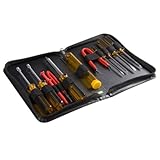
- ALL-IN-ONE SOLUTION: This 11-piece computer tool kit provides you with everything you’ll need to repair and maintain today’s computers.
- SECURE DESIGN: Designed to be used in offices or by computer services people, the computer tool set features a high quality vinyl case and is zippered to keep everything in one place.
- VERSATILE FUNCTIONALITY: This PC repair tool kit is perfect for computer technicians, off-site technicians and hobbyists looking for a basic tool kit to perform PC repairs and maintenance from home.
- MAXIMUM PORTABILITY: This PC tool kit is perfect for technicians who need a kit of common repair tools in a small, portable package.
Check both physical fit and cooling support: motherboard form factor, GPU length, cooler height, radiator support, fan positions and available drive bays. A component fitting into a slot or case does not by itself establish electrical or protocol compatibility.
Peripherals and operating system: make the PC usable
A complete setup also needs a display and input devices such as a keyboard and mouse. The operating system is installed on storage after assembly. These are essential to using the computer, though they are separate from the internal component list.
How do you check component compatibility?
Plan the parts as a system, not as independent purchases. A compatibility check should cover platform support as well as physical dimensions.
Best Value

- Disclaimer: Maximum Speed requires overclocking/PC BIOS adjustments. Maximum speed and performance depend on system components, including motherboard and CPU
- Hand-sorted memory chips ensure high performance with generous overclocking headroom
- VENGEANCE LPX is optimized for wide compatibility with the latest Intel and AMD DDR4 motherboards
- A low-profile height of just 34mm ensures that VENGEANCE LPX even fits in most small-form-factor builds
- A solid aluminum heatspreader efficiently dissipates heat from each module so that they consistently run at high clock speeds
- Processor and motherboard: Confirm the CPU socket, supported processor generation, chipset and any firmware requirements against the motherboard’s current support list.
- Memory: Verify DDR generation, capacity, supported speeds, number of modules and which slots to populate in the board manual.
- Storage: Match drive capacity and type to the motherboard’s supported M.2, NVMe or SATA connections.
- Graphics: Decide whether integrated graphics meet the workload or a discrete card is needed. Check application or game benchmarks, power connectors and card dimensions.
- Power and cooling: Confirm PSU capacity and connectors for the selected parts, plus cooler capability and case airflow.
- Physical fit and expansion: Match motherboard form factor to the case and check GPU length, cooler height, radiator support, drive bays and available slots.
- Workload and budget: Prioritize the parts that matter for office use, gaming, content creation, rendering or mixed use instead of buying the highest tier in every category.
For board-specific details, consult Intel’s motherboard buying guide alongside the manual and support documentation for the exact parts. Intel’s examples focus on Intel platforms; AMD processors and boards also exist, and compatibility must be checked model by model.
What is a sensible order for assembling a desktop?
The assembly sequence depends on the case and hardware, so follow the manuals for the specific components. Dell’s 2026 beginner guide outlines a practical sequence: install the CPU, cooler, RAM and storage; mount the motherboard; install the PSU and remaining drives; add a discrete GPU if used; connect cables; check the BIOS; then install the operating system.
- Prepare and check: Compare the parts list with the motherboard manual, identify the correct RAM slots and M.2 connections, and review the case and cooler instructions.
- Install accessible components: Many builders install the CPU, cooler, RAM and M.2 storage on the motherboard before mounting it, but the exact order can vary.
- Mount and connect: Secure the motherboard and PSU in the case, then connect the required power and front-panel cables according to their manuals.
- Install remaining hardware: Fit drives and, if needed, the discrete GPU; verify that cables and components do not obstruct fans or other parts.
- Check startup and install software: Confirm that the system reaches BIOS or firmware setup, then install the operating system.
A Phillips screwdriver is sufficient for most installations, according to Dell. An anti-static wrist strap and a parts tray are optional aids. Follow the motherboard and component manuals rather than relying on a generic sequence.
Windows Errors? Fix Them Before They Spread
Repair common Windows errors and clear accumulated junk for a smoother, more stable PC - no reinstall needed.Free scan · no reinstallCrashes, No Sound, or Screen Glitches?
Random freezes, missing sound and display glitches usually trace back to one bad driver. Find and replace yours safely.Free scan · under a minuteWhich parts matter most for different uses?
There is no single ideal parts list for every desktop. The workload determines where performance and budget matter most.
- Everyday computing: A suitable CPU with integrated graphics may be enough; choose RAM and storage for the applications and multitasking you expect.
- Gaming: A discrete GPU is often important, and the value of a particular card depends on the games and target resolution. Intel’s 16 GB RAM recommendation applies specifically to modern gaming.
- Editing, rendering and other graphics-heavy work: Compare performance in the software you use, including its CPU and GPU demands, rather than choosing by component labels alone.
- Mixed use or future upgrades: Check expansion slots, power connectors, PSU capacity and case clearances along with today’s performance needs.
Prices, availability and exact component support change. Before purchasing, check the current specifications from each component maker and the motherboard’s support documentation.
Quick Recap
Product prices and availability are accurate as of the date/time indicated and are subject to change. Any price and availability information displayed on Amazon at the time of purchase will apply.

