
PC Slower Than It Used to Be?
A free scan shows the junk files, broken settings and background clutter dragging Windows down - then fixes them in one click.Free scan · Windows 10 & 11Crashes, No Sound, or Screen Glitches?
Random freezes, missing sound and display glitches usually trace back to one bad driver. Find and replace yours safely.Free scan · under a minuteiTechGuides is reader-supported. When you buy through links on our site, we may earn an affiliate commission. As an Amazon Associate I earn from qualifying purchases. Learn more
Yes: the October 6, 2026 NASA Astronomy Picture of the Day shows a complete northern auroral oval, captured in ultraviolet by the Ultraviolet Imager (UVI) aboard the SMILE spacecraft. The ring ripples as Earth’s magnetosphere is disturbed by the solar wind; the points of light beside it are distant stars that appear to drift because the spacecraft’s camera view changes as it orbits.
What the SMILE video actually shows
NASA’s October 6, 2026 Astronomy Picture of the Day features a time-lapse of the northern auroral oval, the broad ring of auroral activity surrounding a magnetic pole. It is not a natural-color view: SMILE’s UVI recorded ultraviolet light, which makes auroral emissions visible across the oval, including on the sunlit side of Earth.
The sequence is a short presentation of a longer observation, not a one-minute event. ESA identifies the footage as covering 00:00–00:58 UT on July 24, 2026, during SMILE’s in-space commissioning, about two weeks after UVI was switched on. NASA describes the underlying observation as covering about an hour. The ring’s uneven, rippling appearance marks changing auroral activity, rather than a fixed outline.
Why a complete oval is hard to see from the ground
An observer on Earth sees only the part of the auroral ring that is above the local horizon and within view. The oval encircles a magnetic pole, so its full extent is too large to appear as one circle from a ground-based viewpoint. Ordinary visible-light cameras also cannot capture aurora on the dayside in the same way they capture the night-side display.
#1 Best Overall

- SV305C is a color entry-Level telescope camera; which has good performance in planetary photography; lunar photography; and is very suitable for EAA
- SV305C astrophotography camera uses IMX662 sensor; 1/2.8” back-illuminated sensor; 2.9um pixel size can accommodate 38ke full well charge; can effectively avoid overexposure
- IMX662 sensor has low readout noise; no glow; NIR is improved; especially in the red spectral band; the light sensitivity has been greatly improved
- SV305C svbony camera has set the planetary high-speed mode and sky space long exposure mode in the sharpcap software; which can be quickly set with one key according to the actual shooting; and can be saved for the convenience of one-key setting next time
- SV305C built-in 128MB DDRIII image buffer; when the USB interface is not busy or interrupted; the memory will cache the image and transfer it to the computer; so that the frame will not be lost or damaged
UVI uses ultraviolet wavelengths because auroras emit strongly in UV. ESA explains that the instrument can separate the faint ultraviolet dayglow of Earth’s upper atmosphere from auroral emission, allowing it to image activity around the complete ring, including the sunlit portion. That is why this view differs from a conventional aurora photograph.
What makes the ring ripple
ESA identifies the changing feature in the July 24 footage as a substorm: a brief disturbance in Earth’s magnetosphere. The solar wind—a stream of charged particles from the Sun—interacts with the magnetic environment around Earth. During a substorm, solar-wind particles compress magnetic field lines and energetic particles are directed toward the polar regions, where they produce auroral light.
Rank #2

- 1080P 30fps Lunar & Planetary Imaging: FIBONAX Nova200 is a beginner-friendly telescope camera with a 2MP CMOS sensor supporting 19201080 video up to 30fps. Capture the Moon, Jupiter, Saturn and bright terrestrial targets, or enjoy real-time telescope views on your computer
- UVC Plug and Play + ASCOM Upgrade Path: Connect by USB for standard UVC live viewing on compatible Windows, macOS and Linux systems. Windows users can also install the optional FIBONAX ASCOM driver for more astronomy-focused imaging workflows with compatible software
- Removable UV IR Cut Filter Included: Unlike a fixed-filter electronic eyepiece, Nova200 includes a removable UV IR cut filter to reduce unwanted ultraviolet and infrared light for more natural lunar and planetary color. Remove or replace the filter when your imaging setup requires greater flexibility
- Standard 1.25 Inch Electronic Telescope Eyepiece: Insert Nova200 directly into many standard 1.25 inch telescope focusers in place of a traditional eyepiece. The M28.5x0.6 thread also supports compatible 1.25 inch astronomy filters and accessories
- Lightweight CNC Aluminum Camera Body: The compact 110g aluminum housing keeps the telescope setup lightweight while providing a durable metal body and effective heat dissipation for longer observation and video capture sessions
The oval is therefore a useful visual indicator of activity in a system that cannot be understood from images alone. Its shape changes as the magnetosphere responds to solar-wind conditions.
Why the points of light seem to move
The small points beside Earth are distant stars, not fast-moving objects in the foreground. They appear to shift across the frame because SMILE’s viewing angle changes as the spacecraft travels in orbit. The motion belongs to the camera’s changing perspective, not to the stars racing around Earth.
Rank #3

- SV405CC deep sky camera; cooled color astronomy camera; the deep space shooting targets are mainly nebulae; galaxies; star clusters; multiple stars; etc
- SV405CC is designed with imx294 color cmos sensor; the imx294 sensor adopts the 4/3 format and provides the necessary number of pixels for true 4k output at 120 frames per second
- USB 3.0 high-speed interface; the bandwidth of up to 5gb allows the camera to run at 19 frames per second in raw8 mode and 16 frames per second in raw16 mode at full resolution of 11.7 million pixels
- This UV/IR Cut off filter blocks undesirable ultraviolet and infrared rays that may interfere with obtaining the high contrast and high quality images possible with a digital sensor
- True optical quality glass substrate and coatings achieves greater detail;less chromatic aberration;more natural colors and finer color gradation
What SMILE is designed to measure
SMILE stands for Solar wind Magnetosphere Ionosphere Link Explorer. It is a joint European Space Agency and Chinese Academy of Sciences mission intended to study how the solar wind affects Earth’s magnetosphere and how that response connects to auroras. Its four science instruments combine remote imaging with measurements made near the spacecraft:
| Instrument | What it does | Measurement type |
|---|---|---|
| Soft X-ray Imager (SXI) | Images soft X-rays from interactions around Earth’s magnetosphere | Remote sensing |
| Ultraviolet Imager (UVI) | Images auroral emission in ultraviolet light | Remote sensing |
| Magnetometer (MAG) | Measures magnetic fields near the spacecraft | In situ |
| Light Ion Analyser (LIA) | Measures ions and plasma near the spacecraft | In situ |
Images from SXI and UVI provide large-scale context; MAG and LIA record local magnetic-field and particle conditions. Together, those observations are intended to help scientists relate solar-wind and magnetosheath conditions to changes in the magnetosphere and the aurora.
Rank #4

- THE BEST WAY TO GET STARTED WITH ASTROIMAGING: Capture amazing images of the Moon, Jupiter, Saturn, Mars, and more with this easy-to-use, plug-and-play planetary camera.
- 10.7 MP COLOR IMAGING SENSOR: Enjoy sharp, detailed images thanks to the sensor’s ON Semiconductor technology which dramatically reduces image noise. Small pixels provide sub arc-second planetary detail with most telescopes
- INCLUDES SOPHISTICATED CAMERA CONTROL AND STACKING SOFTWARE: View and capture live video on your computer, stack the sharpest frames for the best image, and manually adjust all the image settings.
- MACHINED ALUMINUM 1.25” BARREL: This standard size barrel makes this camera compatible with most any telescope that accepts 1.25” eyepieces and also allows you to use your eyepiece filters with the camera.
- ADVANCED FEATURES: Integrated IR-cut optical window, selectable region of interest sub-framing, 2x2 binning, progressive scan, integrated C-threads for direct connection to a telescope.
How long UVI can observe—and what the clip does not show
The approximately 58-second displayed sequence should not be confused with UVI’s observing capacity. ESA says UVI can observe aurora continuously for up to 45 hours at a time, and can take as many as one image every 60 seconds. ESA gives image resolution as 30–90 km depending on orbit. Those are instrument capabilities, not measurements of the duration or resolution of this particular APOD clip.
SMILE’s commissioning status in September 2026
ESA reported that SMILE reached its target science orbit on June 20, 2026, and was cleared to begin science operations on September 23. In its September 30 update, ESA said SXI had taken first images but still detected excess stray light when pointed toward Earth. ESA expected onboard setting and software changes to reduce the unwanted light to a minimum in mid-October, potentially allowing a first useful image of the magnetopause or northern polar cusp. That was an expectation reported on September 30, not confirmation that such an image was subsequently obtained.
Best Value
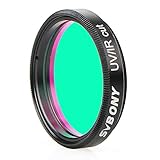
- This UV/IR Cut off filter blocks undesirable ultraviolet and infrared rays that may interfere with obtaining the high contrast and quality images possible with a digital sensor
- It serves as a permanent lens protector;digital imaging with DSLR cameras;CCD cameras;and modified WebCams;or telescope
- True optical quality glass substrate and coatings achieves greater detail;less chromatic aberration;more natural colors and finer color gradation
- Combine with any standard 1.25” filter threads for 1.25" eyepieces and other accessories to deliver the sharpest images possible;reducing ghost images caused by IR radiation
- Comes with a plastic box to keep it safe and clean when not in use;It's a great birthday christmas gift
The July auroral footage was recorded during commissioning, before the September science-operations clearance. The fact that this UV sequence shows the oval does not mean that every instrument or observation mode had already reached its intended science performance.
Quick Recap
Product prices and availability are accurate as of the date/time indicated and are subject to change. Any price and availability information displayed on Amazon at the time of purchase will apply.

