
What’s actually slowing this PC down?
Pick the symptom - the matching free tool is one click away.
iTechGuides is reader-supported. When you buy through links on our site, we may earn an affiliate commission. As an Amazon Associate I earn from qualifying purchases. Learn more
GPM J1839−10 is a repeating cosmic radio source whose pulses arrive about every 21 minutes. Astronomers found archival detections dating back to at least 1988, giving the 2023 discovery study a roughly 35-year historical baseline. Its underlying physical identity remains unknown; the records do not show that it has emitted continuously or establish whether it is still active today.
What astronomers observed
The 2023 study by Hurley-Walker and colleagues classified GPM J1839−10 as a long-period radio transient. Its reported period is about 21 minutes, but the signal is not a steady radio tone: individual pulses last from 30 to 300 seconds. Their brightness varies by two orders of magnitude, and the pulses show quasi-periodic structure within them. The University of Manchester record for the Nature study gives the abstract and publication details.
Why the signal is described as lasting 35 years
After detecting the source, the researchers searched archived radio observations and found earlier detections reaching back to at least 1988. That historical record is the basis for the roughly 35-year framing when the study appeared online on 19 July 2023 and in the 20 July 2023 issue of Nature. “Since at least 1988” means that observations show activity at times across that span; it does not mean astronomers monitored it continuously or that it has been confirmed active through 2026.
Do these 3 things before closing this tab:
1Fix the driver behind crashes, sound loss and screen glitches2Repair Windows errors before they cause bigger problems3Scan for outdated or missing drivers - takes under a minuteWhy a 21-minute period is puzzling
One familiar explanation for repeating astronomical radio pulses is a pulsar: a rotating neutron star whose magnetic axis is misaligned with its rotation axis. As it spins, its radio beam sweeps past Earth, much like a lighthouse beam passing an observer. GPM J1839−10’s unusually slow, roughly 21-minute period makes it difficult to reconcile with expectations for ordinary radio pulsars. Victoria M. Kaspi’s Nature News & Views discussion describes this puzzle and the proposed alternatives.
#1 Best Overall

- 【Space Exploration Fun】 Build a detailed radio telescope and satellite communication base, ideal for space lovers and aspiring engineers.
- 【STEM Learning Tool】 This building set encourages STEM skills, enhancing creativity, problem-solving, and critical thinking in kids and adults alike.
- 【Perfect Holiday Gift】 A fantastic Christmas gift for kids (8+), teens, and adults who enjoy space-themed toys, puzzles, and architectural models.
- 【Realistic Design】 With intricate details, this model captures the essence of a space communication base, making it an impressive display piece once completed.
- 【Educational and Entertaining】 Not only fun to build, but also a great way to spark an interest in space exploration and science for all ages.
What could be producing the pulses?
Researchers have considered both neutron-star and white-dwarf interpretations. These are candidate explanations, not confirmed identifications.
| Candidate | Why it is considered | What remains difficult |
|---|---|---|
| Neutron star | A rotating neutron star can produce pulsed radio emission when its magnetic geometry directs a beam toward Earth. | The very long period is hard to reconcile with standard radio-pulsar expectations, and the model does not readily explain the observed bright coherent pulses. |
| Highly magnetic white dwarf | A highly magnetic, rotating white dwarf is another proposed kind of compact object that could be associated with long-period radio emission. | The proposal has unresolved theoretical challenges and does not readily account for the bright coherent pulses either. |
A 2024 population study examined rotating-dipole scenarios for isolated neutron stars and white dwarfs. It found substantial difficulties for both candidate classes in explaining long-period radio pulsars and their emission; it did not establish that either class is ruled out or identify GPM J1839−10. The University of Hertfordshire record for the study provides its abstract and DOI.
Rank #2

- HOBBY MODEL KIT – Unassembled model packed in an envelope with easy to follow instructions. Ideal for ages 14 and up.
- NO GLUE OR SOLDER NEEDED – Parts can be easily clipped from the metal sheets. Tweezers are the recommended tool for bending and twisting the connection tabs.
- JAMES WEBB SPACE TELESCOPE - 2.75 Sheet Model with a moderate difficulty level. Assembled Size: 4.13 L x 2.75 W x 2.75 H inches. 1:221 Scale. 62 Pieces
- FROM STEEL SHEETS TO 3D – Pop out the pieces and connect using tabs and holes. Includes illustrated instructions.
- HIGHLY DETAILED ETCHED MODEL – Display your 3D model once completed - collect and build them all.
Has astronomers’ 21-minute signal been explained?
No. The observed repetition pattern and long historical record are established, but the source’s physical nature is not. Calling it a neutron star, a white dwarf, or a particular kind of pulsar would go beyond what the cited studies demonstrate. The available studies also do not establish its present-day emission status.
Quick wins for a faster PC:
Clear out junk files and repair common Windows errorsFree Scan →Scan for outdated or missing drivers - takes under a minuteDriver Scan →Repair Windows errors before they cause bigger problemsFix Now →Quick Recap
Rank #4
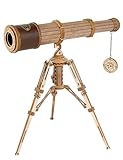
- 【Retro Flavor Toy】Designed as antique pirate telescope with a skull-pattern lens cover. Lightwight toys and ideal gifts for Adult. Unique 3D puzzles.
- 【3X Magnification】Visual range: 150m. Push and pull the 3 tubes slowly to focus on objects in different ditance.(20x29mm lens)
- 【Dual Play Mood】The 3d puzzle can be used on its tropid indoor or taken off. A handheld portable spyglass in camping/outdoors will add so much fun.
- 【Easy to Assemble】Simple building kit for beginners. This 3D wooden puzzle comes with a pictorial manual book and all accessories. No glue or extra tools are required. Pre-cut parts fit well easily.
- 【Unique Gifts】Vintage collection for antique lovers or 3D puzzles DIYers. Meaningful science kit toys for adult to learn about optics and space. Ideal to gift on any occasion like birthday or celebrations, Christmas, etc.
Rank #3

- HOBBY MODEL KIT – Unassembled model packed in an envelope with easy to follow instructions. Ideal for ages 14 and up.
- NO GLUE OR SOLDER NEEDED – Parts can be easily clipped from the metal sheets. Tweezers are the recommended tool for bending and twisting the connection tabs.
- HUBBLE TELESCOPE – 1 Sheet Model with a moderate difficulty level. Assembled Size: 3.00 x 2.00 x 2.50 inches.
- FROM STEEL SHEETS TO 3D – Pop out the pieces and connect using tabs and holes. Includes illustrated instructions.
- HIGHLY DETAILED ETCHED MODEL – Display your 3D model once completed - collect and build them all.
Product prices and availability are accurate as of the date/time indicated and are subject to change. Any price and availability information displayed on Amazon at the time of purchase will apply.

