
Recommended Free Tools
iTechGuides is reader-supported. When you buy through links on our site, we may earn an affiliate commission. As an Amazon Associate I earn from qualifying purchases. Learn more
JPEG stands for Joint Photographic Experts Group. The name belongs to a standards committee, and it is also the everyday label for the image coding method that committee produced: a way of compressing photographs so they take up less storage. The most common form of JPEG compression is lossy, meaning a smaller file costs some of the original image information. The JFIF format is what lets JPEG-coded images be saved and exchanged as ordinary files, which is why you see the .jpg and .jpeg extensions.
Where the name comes from
The Joint Photographic Experts Group is a working group that develops digital still-image coding standards. It operates within ISO/IEC, the joint standards body of the International Organization for Standardization and the International Electrotechnical Commission, and it collaborates with the International Telecommunication Union (ITU).



That collaboration explains the word “Joint.” The JPEG Committee states in its official explanation of the name that “Joint” does not refer to the joint efforts of ISO and IEC, but to the additional collaboration with the ITU. Readers who assume the name describes a two-body partnership between ISO and IEC are working from a misreading.
JPEG as a coding standard
In everyday use, “JPEG” usually means the photographic image coding standard rather than the committee. Its formal designation is ITU-T T.81 | ISO/IEC 10918-1. According to the ITU’s summary record of that standard (ITU-T T.873, version 3, dated 13 September 2023), the standard specifies a codestream format and a decoding process, and it is designed primarily for continuous-tone photographic content, such as the smooth tonal gradations found in camera photographs.
#1 Best Overall
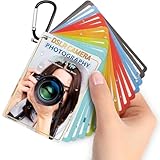
- Quick reference cards for Sony Canon Nikon Leica Fuji Ricoh digital SLR camera settings: This 30-page photography guide is designed for digital SLR camera users, providing basic techniques and 15 double-sided color quick reference tables. Suitable for any camera model, simplifying complex concepts and helping you master techniques for portrait, landscape, or street photography.
- An easy-to-use photography books:covering exposure, aperture settings, shooting modes, histogram interpretation, composition and lighting, and other commonly used photography techniques, so that you can access all the necessary information anytime, whether you are shooting fireworks, sunrise, family portraits, or group photos.
- PORTABLE TRAVEL DESIGN: Featuring a 4x3 inch pocket size with a sturdy metal clip and camera lanyard, these photographer accessories attach to your bag easily, giving you instant access to camera stuff during street or family photography sessions
- PHOTOGRAPHY TOOL CHEAT: This 30-page photography techniques guide covers histograms, composition, and lighting, acting as photography books for beginners that fit in your hand to provide you with immediate on-site learning support while shooting
- PRACTICAL PHOTOGRAPHER GIFTS: An ideal choice for photography gifts for men, women, and moms, these photographer must haves serve as film camera accessories for your sunrise or fireworks shoots, fitting seamlessly into any camera equipment kit
Put simply, the standard describes how image data is represented so that a compliant decoder can reconstruct the picture. It is a set of rules for the compressed data, not a single program or a single file type. For exact encoding parameters, the standard text itself is the authority; the ITU summary is a high-level description.
What “lossy” means in practice
Common JPEG compression is lossy. It discards some visual information to reduce file size, and the W3C’s JPEG JFIF explainer (its page metadata was last updated in January 2003) describes the compression amount as adjustable, so the user can trade file size against visual quality. A higher-compression setting produces a smaller file with more visible artifacts; a lower-compression setting preserves more detail with a larger file.
Rank #2
Two cautions follow. First, “lossy” does not mean every JPEG looks degraded. At mild compression settings, the difference from the original is often hard to see, and whether it matters depends on the image and how it will be viewed. Second, the trade-off is set by the encoder and its quality setting, so two JPEG files of the same picture can differ considerably in size and fidelity.
Free tools Windows power users keep installed
One-click scans. No signup required.
JPEG coding versus JFIF files
The coding standard and the file format are related but separate things, and mixing them up causes most of the confusion around the term.
Rank #3
- JPEG coding is the compression method and codestream defined by T.81 | ISO/IEC 10918-1. It describes how pixel data is encoded and decoded.
- JFIF (JPEG File Interchange Format) is the file format for exchanging images coded with JPEG. ITU-T T.871, approved on 14 May 2011, formalized it. The specification it builds on, JFIF version 1.02, circulated widely from 1992.
So when you open a .jpg file, you are typically opening a JPEG-coded image wrapped in an interchange format that the JFIF specification defines. The file extension tells software what to expect, but the coding method and the wrapper are different layers of the same file.
Independent reader supportYour contribution helps us test, update, and keep practical guides available for everyone.Related names that are not the same thing
“JPEG” appears in the names of other standards, and these should not be treated as interchangeable with the basic JPEG standard.
Rank #4
- JPEG 2000, JPEG XL, and JPEG AI are separate image standards in the wider JPEG portfolio. This article does not compare their features; if your decision depends on one of them, check each standard’s own documentation for the capability you need.
- JPEG Systems is a system-level suite. The JPEG Committee’s overview describes it as covering formats, transport, metadata, and added functionality beyond coded image data. Those extensions are not part of the basic coding standard, so a capability described for JPEG Systems should not be assumed for a plain JPEG file.
No source reviewed for this article supports a general ranking of these formats. Which one suits a task depends on the required image quality, file size, compatibility with your software and devices, and whether you need lossless coding.
Do these 3 things before closing this tab:
1Scan for outdated or missing drivers - takes under a minute2Repair Windows errors before they cause bigger problems3Fix the driver behind crashes, sound loss and screen glitchesQuick Recap
Sources
- JPEG Committee, “About JPEG,” for the committee’s identity, its ISO/IEC and ITU collaboration, and the meaning of “Joint.”
- ITU, ITU-T T.873 (version 3), September 2023, for the summary description of T.81 | ISO/IEC 10918-1.
- ITU, ITU-T T.871, May 2011, for the JFIF file format specification.
- W3C, “JPEG JFIF,” for the concise description of lossy compression and adjustable quality.
- JPEG Committee, “Overview of JPEG Systems,” for the scope of the system-level suite.
Product prices and availability are accurate as of the date/time indicated and are subject to change. Any price and availability information displayed on Amazon at the time of purchase will apply.

