
iTechGuides is reader-supported. When you buy through links on our site, we may earn an affiliate commission. As an Amazon Associate I earn from qualifying purchases. Learn more
An eGPU is a desktop graphics card mounted in an external enclosure and connected to a laptop over a Thunderbolt or eGPU-capable USB4 link. It is worth considering when your exact laptop is confirmed compatible, you will use it docked at a desk, and the full cost of the setup is justified by the games or creative work you run. A laptop with a USB-C port does not qualify on that basis alone.
What an eGPU setup actually consists of
A working eGPU is several separate purchases, and the total is often larger than the enclosure’s price tag suggests. A typical setup includes:
- The enclosure, a box with a PCIe slot for the graphics card, a Thunderbolt or USB4 connection to the laptop, and sometimes extra ports. HP describes the enclosure as the piece that carries the GPU and may supply power.
- A desktop graphics card, bought separately in most cases. The card must physically fit the enclosure and draw no more power than the enclosure can supply.
- A power supply, which some enclosures include and others do not.
- A cable between the laptop and enclosure, which some products include and others leave to you. It must support the link your host and enclosure use.
- An external monitor, which is optional but matters for performance (covered below).
Because the card lives outside the laptop, the enclosure stays on your desk. Detached from it, the laptop only has its own built-in graphics.
Recommended Free Tools
Does your laptop support an eGPU?
Compatibility is the first and most common point of failure. Do not infer it from the brand, the processor, or the shape of the port. Work through these checks in order:
#1 Best Overall

- 【Up Link & Down Link】Up link: Oculink 4i(PCIE4.0x4), Down Link: PCIEx16(PCIE4.0x4). Only Support Oculink.
- 【Power Supply】This DEG1 supports ATX and SFX standard power supplies, which provides flexible power supply solutions for mini chassis.
- 【Oculink Interfaces】Please kindly note the OCulink interface does not support hot plugging, and the machine needs to be turned off first.
- 【Follow-start Function】The follow-start function is only compatible with MINISFORUM Mini PCs, it requires the use of original wires.
- Note: The GPU is not included.
- Identify the exact model. On Windows 11, open Settings, then System, then About to see the device name. Use the full model number to look up the manufacturer’s specifications page.
- Check the port type in the specifications. Look for the Thunderbolt lightning-bolt symbol next to the port, or for the port listed as Thunderbolt or USB4 in the I/O specifications. Intel advises checking the port icon or the laptop’s I/O specifications for this reason.
- Confirm eGPU support explicitly. The manufacturer should state that the laptop supports external graphics or eGPU connection. A Thunderbolt-capable port without that statement may still be unsupported for eGPU use.
- Confirm operating system and firmware. Intel’s current Thunderbolt overview states that Thunderbolt 5 on PCs is supported with Windows 11 version 23H2 or later and with Linux kernel 6.7 or later. Check the laptop maker’s BIOS and firmware requirements as well.
- Match the enclosure’s host list. Each enclosure publishes the hosts it supports. Your laptop must appear on that list, or be covered by a stated host class such as Thunderbolt 4 or eGPU-capable USB4.
- Check the card fit and power. Compare card length, width, slot type, power connectors, and power draw against the enclosure’s specifications before buying the card.
USB-C, Thunderbolt and USB4 are not the same thing
USB-C describes a connector shape. Thunderbolt is a capability set that can run over that shape, and USB4 is a separate standard that can also use it. A USB-C port on a laptop may carry only charging and basic USB data. Plugable states plainly that USB-C-only hosts are unsupported for its TBT5-AI enclosure. USB4 can support eGPUs, but support depends on the implementation and on the product. Sonnet’s Windows 11 setup guide, for example, says that USB4 hosts need a Microsoft USB4 Host Router for its Breakaway Box setup.
What Thunderbolt 5 changes, and what it does not
Thunderbolt 5 raises the interface ceiling. Intel’s FAQ states: “Thunderbolt™ 5 technology doubles minimum bandwidth requirements from 40 Gbps to 80 Gbps compared to Thunderbolt™ 4 technology.” Intel also lists up to 80 Gbps bidirectional bandwidth, or up to 120 Gbps in one-way Bandwidth Boost mode, and up to 240 W of charging capability. These are interface specifications. They are not measured eGPU frame-rate gains, and they do not guarantee that a given laptop will charge at 240 W.
Rank #2
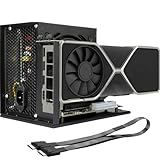
- Package Include: OCuLink SFF-8612 Female to PCIe x16 Enclosure Dock, and SFF-8611 Male to Male Cable 50cm/19.7inch (Note: The GPU and Power Supply are not included)
- Advantage of the dock: Our enclosue detachable design on both ends for improved portability and easy storage. PCB board with 10μ gold-plated contacts ensure superior conductivity and reduce oxidation/rust-related resistance that may cause system crashes or BSOD. Multi-status LED indicators provide clear visual feedback for real-time device monitoring. Transfer Speed: PCIe 4.0 x4 (64Gbps )
- SFF-8611 Male to Male Cable: Ultra-thin & flexible design (0.5mm thickness) with premium aesthetics, eliminating port damage risks from rigid traditional OCuLink cables. Flat cable architecture with full-coverage shielding and advanced EMI materials to minimize interference and performance degradation
- Compatible Graphics Cards: Compatible with graphics cards of various sizes like RTX 4090, AMD RX 7900 XTX etc., no need to worry about graphics card length restrictions. 🔺Compatible Power Supply: Compatible with standard ATX power supply ONLY, dual screw mounting (top & bottom) for PSU stability
- Note: The OCulink interface does not support hot plugging, and the computer needs to be turned off to unplug the cable.
The higher ceiling only helps when both ends of the link support Thunderbolt 5. A Thunderbolt 5 enclosure connected to a Thunderbolt 4 laptop will run at the Thunderbolt 4 level. Thunderbolt 5 also does not turn an external link into an internal desktop PCIe slot. The card still sits behind a cable, so the reduction in bandwidth compared with a desktop motherboard remains.
How much performance you give up
An eGPU sends data over a cable and interface with less bandwidth than a desktop graphics card has when it sits directly in a motherboard slot. There is no single, independently verified percentage that applies across laptops, cards, games and display paths. Treat any percentage you see as specific to the test setup that produced it.
Rank #3
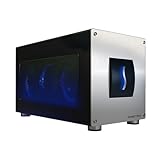
- Astounding Performance: Unlock near-desktop GPU power with your Thunderbolt 5 Windows 11 laptop. Breakaway Box 850 T5 delivers 80 Gbps of bi-directional bandwidth, ensuring blazing-fast performance for GPU-accelerated workflows. Accelerates Thunderbolt 4 and Most USB4 Windows 11 Computers, too. Intel Thunderbolt Certified.
- Supports Triple Wide GPU Cards NVIDIA GeForce RX50, 40, and 30 Series; AMD Radeon RX 9000, 7000, and 6000 Series.
- 850W power supply supports the power requirements of today’s and tomorrow’s power-hungry GPU cards. And large built-in, variable-speed, temperature-controlled fan quietly and effectively cools whatever card you install.
- Editing, rendering, color grading, animation, and visual effects run significantly faster with GPU acceleration. And Supercharge AI-driven applications with massively increased processing power and efficiency.
- Built-in Thunderbolt 5 Dock for Additional Connectivity Includes one Thunderbolt 5 peripheral port, three 10 Gbps USB Type A ports, plus a 5 Gigabit Ethernet (RJ45) port for super-fast wired network connectivity.
The workload decides how much the link matters
XMG’s manufacturer guidance says the Thunderbolt bandwidth limit matters most in gaming at lower resolutions and high frame rates. At higher resolutions and heavier graphics settings, fewer CPU-to-GPU exchanges happen each second, and the link is less of a constraint. These are vendor statements about its own setup, not a guarantee for every title. Expect the difference to vary by game and by settings.
Connect the monitor to the eGPU
HP recommends connecting the external monitor directly to the eGPU’s own video output for optimal performance. If the display is attached to the laptop instead, rendered frames must travel back over the link to the laptop’s screen, which adds work to the connection. If you already own a monitor, use the eGPU’s output, and keep the laptop’s built-in display for other tasks.
Rank #4

- USB4 V2 (TBT5 compatible) and OCuLink Dual Mode: Dual-link interfaces support transfer speeds up to 80Gbps (TB5) and 64Gbps (OCuLink). A dedicated hardware switch allows for instant switching between all-in-one docking mode and pure GPU performance mode.
- Integrated M.2 NVMe Storage: A built-in M.2 2280 slot allows direct storage of AI models and project files on the dock. Maintains synchronized workspace and GPU performance when switching between different host devices.
- Universal Power and Graphics Card Compatibility: Supports standard ATX and SFX power supplies and is compatible with a variety of desktop graphics cards. Modular design ensures easy upgrades to power and computing power.
- Enhanced Signal Stability: Built-in re-drive signal booster stabilizes PCIe data transfer. Minimizes latency and connection interruptions during high-bandwidth tasks such as LLM inference or 8K rendering.
- Single-Cable Desktop Workflow: A single TB5 cable handles data transfer, display, and laptop charging. It features automatic power-on and can synchronize with the host computer, providing a seamless plug-and-play desktop experience.
Is an eGPU worth it for your laptop?
An eGPU makes sense when most of the following are true:
- Your laptop is confirmed by its manufacturer to support eGPU use.
- You keep the laptop at a desk and connect it to the enclosure most of the time.
- You play supported games or run creative or compute software that benefits from a desktop-class GPU.
- You already own, or are willing to buy, a monitor that can connect to the eGPU.
- The full setup cost, including any missing power supply, cable and monitor, is acceptable compared with the alternatives.
It is less compelling when the laptop has no confirmed support, when you need graphics performance away from the desk, or when the enclosure, card and accessories approach the cost of a laptop or desktop built for the same work. That last comparison is editorial reasoning based on the extra components and compatibility limits, not on a sourced market price. For many readers, a laptop bought with a stronger built-in GPU, or a desktop, will be simpler.
Best Value

- Compatibility: Compatible with most NVIDIA/AMD graphics cards up to ≤205mm (≤8.07”) in length, ≤150mm (≤5.91”) in height, and ≤55mm (≤2.17”) in width. Support Windows 10/11, Linux
- This complete kit includes everything you need:a GPU Enclosure Box ,240W external power supply, Thunderbolt 4 cable, 8-pin PCIe power cable, and a custom carrying case. Simply connect one cable to your device and instantly boost your graphics power for editing, rendering, or gaming
- Application: Compatible with NUC/laptop/handheld game console with Thunderbolt 4/3 USB4 interface. Note that The Type-C port is not applicable if it does not support Thunderbolt 3/4 or USB4 protocols. And package does not contain the graphics card
- Multiple Interfaces: Features one Thunderbolt port with PD 85W charging, one Thunderbolt port with PD 15W charging, and one DP port.Supports PCIe 3.0 x16 data transfer mode
- Compact & Durable Design:Featuring a lightweight yet robust anodized aluminum shell, this enclosure combines portability with premium protection. Complete with a custom carrying case, it delivers desktop-grade graphics performance wherever you go
Compare the enclosures before buying
The three products below illustrate how much requirements differ between vendors. Each figure comes from that vendor’s own documentation; none is an independent test. Where a source does not state a value, the table says so.
| Item | Razer Core X V2 (product page) | Plugable TBT5-AI (product documentation) | Sonnet Breakaway Box (Windows 11 setup guide) |
|---|---|---|---|
| Host connection required | Thunderbolt 4 or 5, or eGPU-capable USB4 | Thunderbolt 5, Thunderbolt 4, or eGPU-capable USB4; USB-C-only hosts unsupported | Thunderbolt 5, Thunderbolt 4, or certain USB4 hosts; USB4 hosts need a Microsoft USB4 Host Router |
| Operating system | Not stated in the product material reviewed | Windows 11 | Current 64-bit Windows 11 |
| Supported graphics cards | Desktop NVIDIA and AMD cards | Not stated in the summarized documentation | AMD RX 6000 series and newer; NVIDIA RTX 30 series and newer |
| Graphics card included | No; sold separately | Not stated in the summarized documentation | Not stated in the summarized guide |
| Power supply | Standard ATX power supply; sold separately | Included 850 W PSU, supplying up to 600 W to the GPU | Not stated in the summarized guide |
| Host memory guidance | Not stated | Minimum 16 GB RAM; 32 GB or more recommended | Not stated |
The practical lesson is that a low enclosure price means little until you know which hosts, cards and power supplies it accepts. Razer’s page includes its own performance claims; those reflect Razer’s testing, not independent measurement.
Count the total cost, not the enclosure price
- Enclosure, including whether it includes a power supply and cable.
- Graphics card, chosen to fit the enclosure and its power limit.
- Power supply and cable, if they are not in the box.
- Monitor, if you do not already own one that can connect to the eGPU.
- Prices, taken from current retailer listings on the day you buy, since enclosure and card prices change frequently.
Common problems and what to check
- The enclosure is not detected. Confirm the laptop port is Thunderbolt or eGPU-capable USB4, not a USB-C-only port. Recheck the enclosure’s host list and the laptop’s firmware.
- The link runs slower than expected. Confirm that both host and enclosure support the same Thunderbolt generation. A Thunderbolt 5 enclosure on a Thunderbolt 4 host runs at Thunderbolt 4 level.
- The card does not fit or does not power. Compare card dimensions, slot type and power connectors with the enclosure specification, and confirm the power supply can meet the card’s draw.
- Games are limited by the connection. Connect the monitor to the eGPU’s output rather than the laptop screen, and test at higher resolutions or detail settings where the link matters less, as XMG’s guidance describes.
Bottom line on the decision
An eGPU is a reasonable upgrade for a laptop owner who has confirmed compatibility, works at a desk, and needs desktop-class graphics for supported software. Start by checking the laptop’s manufacturer documentation and the enclosure’s host list. If either one fails to name your exact laptop or a supported host class, the setup is not worth buying, regardless of how well the card would perform.
Quick wins for a faster PC:
Clear out junk files and repair common Windows errorsFree Scan →Scan for outdated or missing drivers - takes under a minuteDriver Scan →Quick Recap
Product prices and availability are accurate as of the date/time indicated and are subject to change. Any price and availability information displayed on Amazon at the time of purchase will apply.

