
Quick wins for a faster PC:
Scan for outdated or missing drivers - takes under a minuteDriver Scan →Clear out junk files and repair common Windows errorsFree Scan →iTechGuides is reader-supported. When you buy through links on our site, we may earn an affiliate commission. As an Amazon Associate I earn from qualifying purchases. Learn more
A stereo home theater is a home audio setup that plays sound through two channels—left and right—usually using a pair of speakers to create a soundstage in front of the listener. It can play TV, movie, game, and music audio, but it does not have separate physical center, rear, or height channels like a multichannel surround system.
What does “stereo home theater” mean?
“Stereo” describes the audio layout: one left channel and one right channel. In a typical setup, a pair of speakers sits in front of the listening position and reproduces those channels. Dolby puts the distinction simply: “Stereo sound systems use only two audio sources – left and right – while surround sound systems use several speakers to play audio from all directions.”
In other words, “home theater” describes using the system at home for entertainment; it does not necessarily mean the system has surround speakers. A two-speaker arrangement can provide a front soundstage for a television or movie without placing discrete sound channels around or above the listener. Dolby’s explanation of stereo and surround sound and Denon’s guide to starting a home theater system describe the relevant layouts.
What do 2.0, 2.1, and 5.1 mean?
The numbers describe the audio configuration, not necessarily the number of separate speaker cabinets. The first number counts main channels; the number after the decimal indicates a subwoofer element in these common system labels.
#1 Best Overall

- An all-in-one home theater package - The YHT-4970U comes with a Dolby Atmos AV Receiver (Yamaha RX300A), a 5.1 speaker package (two front channel speakers, a center channel speaker, two surround channel speakers, and a powered subwoofer), plus a subwoofer cable and speaker wire all in one box.
- Step into lifelike sonic worlds - Dolby Atmos and DTS Virtual:X for deeply dimensional, lifelike sound that draws you into every moment of your favorite entertainment, plus crystal-clear dialogue so you can hear every word.
- Stunning visual realism - Supports ultra-high definition 4K/120 and 8K/60 video, high-performance HDMI switching, advanced Dolby Vision and HDR10+ dynamic range technologies, HDMI eARC/ARC and next-gen gaming features like ALLM and VRR.
- Room Correction - Experience perfect sound in any room. An included setup microphone measures your room’s acoustics and speaker characteristics, allowing the receiver to automatically optimize sound performance.
- Easy streaming with Bluetooth Multipoint - Stream all your favorite music, podcasts and audiobooks wirelessly. Built-in Bluetooth Multipoint lets you pair two source devices and instantly switch between them.
| Label | What it indicates | What it does not indicate |
|---|---|---|
| 2.0 | Two main channels: left and right, with no subwoofer in the system notation used by Denon and Bose. | It does not include a separate subwoofer channel. |
| 2.1 | Two main channels, left and right, plus a subwoofer. | The “.1” does not mean there are rear or center surround speakers. |
| 5.1 | Five main channels plus a low-frequency effects/subwoofer channel, as described in Dolby’s multichannel-surround explanation. | It is not a two-channel stereo layout. |
These definitions are set out by Denon, Bose, and Dolby. Adding a subwoofer to left and right speakers can extend bass in a stereo setup, but it does not by itself add surround channels.
How is stereo different from surround sound?
Stereo sends audio through left and right channels, generally from speakers in front of the listener. Surround systems add speaker positions—such as a front center and side or rear channels—to place sound around the listening area; some layouts also include height positions. The practical distinction is whether you want a front soundstage or distinct effects from around and above the seating position.
Rank #2

- Your purchase includes: 1 AV receiver, 5 speakers, 1 Sub-Woofer and Speaker wire.Waterproof : No
- Dimensions: AV Receiver – 17” W x 6” H x 12” D | Four Speakers (each) – 4” W x 6” H x 4” D | Center speaker – 10” W x 4” H x 4” D | Subwoofer – 11” W x 11” H x 13” D
- Technical specs: HDMI – 4 | Standby Power Consumption – ≤ 0.2 W | Frequency Response – 28Hz/25kHz
- Bluetooth for streaming all your favorite music and podcasts. No wireless functionality
- Easy setup with Yamaha YPAO room optimization and flexible speaker placement options, including virtual cinema front
Processing can also change how material is rendered. For example, Dolby Pro Logic II can process stereo material into left, right, center, left-surround, and right-surround channels. That is surround processing of stereo material, not native two-channel stereo output. See Dolby Pro Logic II and Dolby’s surround-sound overview.
The Tool Desk
Outbyte Driver Updater FREEFix the driver behind crashes, sound loss and screen glitchesFind Drivers →Outbyte PC Repair FREERepair Windows errors before they cause bigger problemsFix Now →- Choose stereo when a straightforward pair of speakers and sound from the front suit your room and listening priorities.
- Consider surround when you want additional physical speaker positions for directional effects around the listener.
- Decide separately on bass: a 2.0 system has no subwoofer in its notation; a 2.1 system adds one.
Room size and primary use are among the factors Bose says to consider when choosing a home theater audio setup. Bose’s setup guide discusses those considerations.
Rank #3
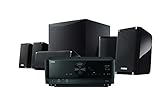
- 5.1-channel 80-Watt powerful surround sound system
- 4K60, 4K120AB and 8K60B HDMI 2.1 with HDCP 2.3 and eARC (4 in/1 out)
- Dolby Vision, Hybrid Log-Gamma and BT.2020
- Supports enhanced media and gaming - ALLM, VRR
- YPAO automatic room calibration
Can a stereo system play surround or Dolby Atmos content?
Yes. Dolby says Atmos content is compatible with conventional stereo playback as well as 5.1- and 7.1-channel systems. Compatibility means the content can be played; it does not mean a stereo pair reproduces separate surround or overhead speaker channels. With two channels, the system remains a left/right presentation rather than a set of discrete speakers around and above the listener. See Dolby’s information on Dolby Atmos for the home and Dolby’s description of multichannel layouts.
Independent reader supportYour contribution helps us test, update, and keep practical guides available for everyone.What do you need to set up stereo home theater?
The direct physical fit is a stereo speaker pair: one left speaker and one right speaker, connected to a suitable audio source and amplification. Stereo does not inherently require an AV receiver; the important point is that the system can reproduce the two channels. If you want stronger bass, consider whether your setup supports adding a subwoofer, making it a 2.1 arrangement.
Rank #4
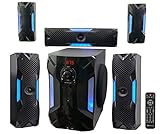
- POWERFUL 5.1 SURROUND SOUND: Delivers 1000W peak power with five satellite speakers and an 8" subwoofer for rich, immersive audio in your home theater setup.
- MULTIPLE INPUT OPTIONS: Connect via Bluetooth, USB, SD, RCA, or optical input-ideal for TVs, smartphones, DVD players, and more.
- BUILT-IN KARAOKE FEATURES: Includes 2 mic inputs with echo control, a 5-band EQ, and FM radio for karaoke parties and audio customization.
- LED LIGHT MODES + REMOTE: Features an LED display and subwoofer/satellite LED lights with modes like blink-to-beat and spectrum analyzer, all controllable via the included remote.
- READY TO SET UP: Includes all speaker cables (up to 30 ft), mounting kits, signal and antenna cables, and a setup manual for fast and easy installation.
For placement, Denon recommends starting with at least two speakers, setting the left and right speakers equidistant from the center listening position, avoiding placement directly against a wall, and keeping the speakers at a safe distance from the ears. These are manufacturer recommendations, not a guarantee that one placement will suit every room. Consult Denon’s home theater setup guidance.
Recommended Free Tools
Quick Recap
Best Value

- High-quality sound with maximum output of 30W:15W+15W, high-performance silk tweeter for high frequencies and precise imaging, balanced braided carbon fiber woofer for powerful and transient bass. Simple and elegant compact design, simple and easy operation to enjoy music from CD and smartphone. You can choose your favorite sound quality, pop/jazz/rock/classic/flat, if you like more bass, choose "Bass" mode, if you like soft sound, choose "Jazz" mode.
- [Multifunction] 1. Listen to CD: CD/CD-R/CD-RW/MP3 2. Listen to Radio: 87.5MHz to 108MHz 3. Connect Bluetooth: Connect your device (phone, computer, etc.) with the CD player (Bluetooth headphones are not supported) 4. Listen to MP3s via USB (up to 32GB): MP3/WMA 5. AUX IN: Connect the device (phone, computer, etc.) to the CD player ( make sure your device has 3.5mm jack) 6. Listen with headphone(3.5mm)
- ■ [Repeat] Play one track repeatedly/Play shuffle/Play all tracks repeatedly. ■ [Resume Play] After pausing disc playback, start playback from the point where it was last played. Ideal for children learning languages Kindergarten and listening to music in the company. Equipped with two stereo speakers, loud and high quality
- Very convenient to open the CD tray by pressing the button. The LED on the front makes it easy to see the CD number. The remote control can be operated from a remote location and includes all necessary functions
- It consists of 3 parts, 1 main unit + 2 speakers, which are easily connected with cables. Product size: main unit 6.3*8.5*7 inch/16*21.5*18cm / speaker(single) 5.2*7.2*6.3 inch/13.3 *18.4 x*16cm. Product weight: 8.5 pounds/3.9kg
Product prices and availability are accurate as of the date/time indicated and are subject to change. Any price and availability information displayed on Amazon at the time of purchase will apply.

