
Do these 3 things before closing this tab:
1Repair Windows errors before they cause bigger problems2Fix the driver behind crashes, sound loss and screen glitches3Clear out junk files and repair common Windows errorsiTechGuides is reader-supported. When you buy through links on our site, we may earn an affiliate commission. As an Amazon Associate I earn from qualifying purchases. Learn more
A digital signal controller (DSC) is an embedded chip that combines microcontroller-style control with digital signal processor (DSP) computation. It is designed for applications that need both real-time control—such as responding to inputs and driving peripherals—and fast, predictable calculations for signal or control algorithms.
How a digital signal controller works
A DSC brings together capabilities commonly associated with a microcontroller (MCU) and a DSP in one device. The MCU side handles tasks such as reading inputs, managing peripherals, and reacting to interrupts. The DSP side accelerates mathematical operations used in signal processing and control algorithms.
For example, Microchip describes its dsPIC DSCs as combining DSP performance with MCU simplicity. Its dsPIC material cites multiply-accumulate operations, accumulators, deterministic interrupt response, and fast DMA as features found in those families. These are examples, not requirements for every chip called a DSC. NXP likewise describes DSCs as devices whose core can perform both MCU and DSP functions, with platform peripherals that may include PWM, ADC, DAC, timers, and crossbar logic. Microchip dsPIC DSC Developer Help; NXP Digital Signal Controllers
What’s actually slowing this PC down?
Pick the symptom - the matching free tool is one click away.
What are digital signal controllers used for?
DSCs are especially useful when a device must repeatedly measure, calculate, and act within a controlled time. Motor control and digital power conversion are central examples: a controller can sample electrical signals, compute a response, and adjust outputs such as PWM signals.
#1 Best Overall
![Arduino UNO R4 WiFi [ABX00087] - Renesas RA4M1 + ESP32-S3, Wi-Fi, Bluetooth, USB-C, CAN, 12-bit DAC, OP AMP, Qwiic Connector, 12x8 LED Matrix for Advanced IoT & Embedded Projects](https://m.media-amazon.com/images/I/416S910MpBL._SL160_.jpg)
- Dual-Core Processing with Renesas RA4M1 and ESP32-S3: The Arduino UNO R4 WiFi combines the Renesas RA4M1 microcontroller (ARM Cortex-M4) and the ESP32-S3 Wi-Fi/Bluetooth chip, delivering powerful dual-core processing capabilities. This combination offers flexibility for a wide range of projects, from high-speed communications and wireless control to real-time data processing and edge AI applications.
- Comprehensive Wireless Connectivity: Equipped with Wi-Fi and Bluetooth 5.0, the UNO R4 WiFi ensures robust wireless communication for IoT projects, remote sensors, smart devices, and wireless control applications. Whether connecting to the cloud, other devices, or local networks, the board offers stable and high-speed wireless connectivity for seamless operation.
- Modern USB-C, CAN, & Qwiic Connector: The USB-C port enables efficient power delivery and fast programming, improving ease of use compared to traditional USB connections. The Controller Area Network (CAN) support allows for reliable, real-time communication in industrial, automotive, or robotic systems. Additionally, the Qwiic Connector makes it easy to add I2C sensors and peripherals, simplifying the connection process and reducing the need for complex wiring.
- High-Precision 12-bit DAC & OP-AMP: For projects that require high-quality analog output, the 12-bit DAC (Digital-to-Analog Converter) and integrated operational amplifier (OP-AMP) provide precise analog signal generation and amplification. This feature is ideal for audio projects, sensor interfacing, or applications where analog signal control and processing are necessary.
- Integrated 12x8 LED Matrix: The UNO R4 WiFi includes a built-in 12x8 LED Matrix, enabling users to display dynamic visuals, messages, or real-time data on the board itself. This makes it perfect for projects that require immediate visual feedback, such as status indicators, event displays, or interactive user interfaces.
Other applications listed by manufacturers include advanced sensing, touch, embedded security, and functional safety. These are application areas, not a guarantee that every DSC supports every feature or meets a particular safety requirement. A dated Texas Instruments C24x applications page also illustrates digital-control uses such as motor drives, uninterruptible power supplies, power conversion, robotics, automation, HVAC, appliance compressors, and automotive systems; it should not be read as a guide to current part availability. TI C24x DSP applications
How does a DSC differ from an MCU or DSP?
A practical selection heuristic is to start with the work the device must do. An MCU is often chosen for general embedded control, a DSP for intensive signal-processing computation, and a DSC when a design benefits from both control peripherals and DSP-style arithmetic in one chip. These are not rigid technical boundaries: product categories overlap, and manufacturers do not use the labels identically.
Rank #2

- 【ADS1115 16 Bit Analog-to-Digital-Converter】 High accuracy, programmable gain amplifier (PGA), four differential input channels, and internal oscillator for a variety of measurement and control applications.
- 【Programmable Gain Amplifier (PGA)】The gain of the input signal can be adjusted in steps of 1/2, 1/4, 1/8 or 1/16. This makes it suitable for applications with different input signals.
- 【Low Current Consumption】The ADS1115 is designed to consume very little power. In Continuous Mode, it draws a mere 150µA, and in Single-Shot Mode, it intelligently enters Auto Shut-Down, ensuring minimal power usage when not actively converting analog signals.
- 【Wide Supply Rrange】The voltage reference of these 16 bit ADC 4 channel module ranging from 2.0V to 5.5V, compatible with Raspberry Pi and other common microcontrollers.
- 【ADS1115 Pre-Soldered】Solderless! Pins are already attached. Ready to plug in and go.
| Device category | Typical emphasis | When it may fit |
|---|---|---|
| MCU | General embedded control and peripheral management | The application primarily reads inputs, manages devices, and executes control logic. |
| DSP | Signal-processing computation | The application is dominated by intensive signal-processing operations. |
| DSC | Embedded control combined with DSP-oriented computation | The application needs control peripherals and timely signal or control calculations in one device. |
How to choose a DSC for a real application
“DSC” is a category label, not a standardized specification. Compare individual families and parts against the system’s timing, computation, interface, and operating requirements rather than assuming every DSC has the same architecture or capabilities.
- Timing: Determine the control-loop period and the worst-case interrupt and processing latency the application can tolerate.
- Algorithm: Identify the required DSP operations and numeric format, then check whether the device supports them efficiently.
- Peripherals: Check ADC sampling rate, PWM resolution, timers, comparators, and how peripherals connect to one another.
- Device constraints: Compare CPU width and performance, memory, power, package, and operating conditions for the exact part.
- Assurance needs: Verify security or safety capabilities and any relevant evidence for the specific device; a category name alone does not establish compliance.
- Development support: Check compiler and debugger support, examples, software tools, evaluation hardware, and the practicality of migrating from an existing design.
Specifications must be kept tied to the family that publishes them. For example, Microchip describes its dsPIC33A family as having a 200 MHz 32-bit CPU and a double-precision FPU. Those are dsPIC33A family claims, not general DSC specifications. Microchip dsPIC33A
Rank #3
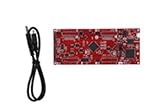
- DEVELOPMENT PLATFORM: Texas Instruments C2000 MCU F280025C LaunchPad development kit for rapid prototyping and evaluation
- CONNECTIVITY: Features USB connection cable for programming, debugging, and power supply
- PROCESSOR: Built around the F280025C microcontroller, ideal for real-time control applications and digital signal processing
- DESIGN FEATURES: Red PCB board with comprehensive development capabilities and expansion headers for additional functionality
- COMPATIBILITY: Supports TI's development ecosystem with Code Composer Studio and other programming tools
What a DSC development board can demonstrate
A development board is a platform for evaluating or developing with compatible controller hardware; it is not itself a finished controller product. Microchip identifies a Digital Power Development Board as a measurement platform that works with compatible dsPIC33 Digital Power Plug-In Modules. Check the exact module compatibility and kit contents before choosing a board. Microchip Digital Power Development Board
Quick Recap
Best Value

- Real-time signal processing for ultimate control
- Complete audio customization for application specific installations
- Easy-to-use Graphical User Interface (GUI)
- All eight output channels have a fully adjustable 10-band parametric EQ
- Optional Bluetooth dongle (for streaming and app control) and wired remote available
Rank #4

- Microcontroller development board can be used as modules, can be used as appliance control
- 5V - 12 V control signal of the TTL
- Control DC or AC signals can control the 220V AC Load
- There is a normally open and open normally closed contact
- Useful to control a motor, a led strip, or any other module. How to use it: Just connect a digital output of your board to your relay module, and you can control a power-demanding appliance with the digital signal
Product prices and availability are accurate as of the date/time indicated and are subject to change. Any price and availability information displayed on Amazon at the time of purchase will apply.

