
The Tool Desk
Outbyte PC Repair FREEClear out junk files and repair common Windows errorsFree Scan →Outbyte Driver Updater FREEFix the driver behind crashes, sound loss and screen glitchesFind Drivers →iTechGuides is reader-supported. When you buy through links on our site, we may earn an affiliate commission. As an Amazon Associate I earn from qualifying purchases. Learn more
A data center in orbit is computing infrastructure on a satellite or another orbital platform that processes, stores, or relays data. The term can describe an existing, mission-specific computing payload as well as proposed shared computing facilities or constellations. Those are not equivalent: onboard computing has been demonstrated in space, while large commercial orbital data centers remain proposals or early roadmaps in the sources available as of October 7, 2026.
What counts as a data center in orbit?
It is a spectrum, not necessarily a building in space. At the smaller end, a satellite or hosted payload runs computing hardware to process information gathered by a spacecraft. At the larger end, proposals envision orbital platforms or networks offering computing capacity to multiple users.
An orbital system may combine computing and storage with a spacecraft structure, power generation, communications, thermal control, and protections against radiation. A published patent, for example, describes solar arrays, computing hardware, wireless links, pumped coolant, and heat-radiating structures. It also discusses modular arrangements and possible dawn-dusk sun-synchronous or geostationary orbits. These are disclosed design ideas, not evidence that such a system is operating. WIPO patent publication WO2026055239A1
Onboard computing is different from an orbital cloud
NASA’s Spaceborne Computer-2 experiment on the International Space Station demonstrates computing in space, but it is not proof of a standalone commercial cloud facility in orbit. A mission-specific processor, a hosted satellite payload, and a multi-node commercial constellation differ in scale, workload, ownership, and readiness. NASA’s Spaceborne Computer-2 overview
#1 Best Overall

- HOBBY MODEL KIT – Unassembled model packed in an envelope with easy to follow instructions. Ideal for ages 14 and up.
- NO GLUE OR SOLDER NEEDED – Parts can be easily clipped from the metal sheets. Tweezers are the recommended tool for bending and twisting the connection tabs.
- VOYAGER – 1.5 Sheet Model with a moderate difficulty level. Assembled Size: 1.38 x 1.77 x 6.70 inches.
- FROM STEEL SHEETS TO 3D – Pop out the pieces and connect using tabs and holes. Includes illustrated instructions.
- HIGHLY DETAILED ETCHED MODEL – Display your 3D model once completed - collect and build them all.
Why process data in orbit?
The most direct use is to analyze data near where a satellite or spacecraft collects it. Sensors can produce more raw information than can conveniently be sent to Earth at once. Filtering, compression, or analysis onboard may reduce the amount that needs to be downlinked and help deliver useful results sooner. NASA describes onboard processing and AI-enabled edge computing as ways to analyze data faster; OrbitsEdge has also described a proposed micro-data-center role processing satellite data close to collection. NASA on space computing OrbitsEdge news archive
Other concepts target general-purpose or AI computing, with orbital solar power and networked nodes. Orbital’s website lists a 2027 pathfinder and a 2028 prototype node as roadmap milestones. These are company-stated plans, not deployed commercial capacity, and may change. Orbital
Rank #2

- Model Kit
- May Require Paints and Glues to Assemble
- Accurate Scale Model
- Detailed Instructions Provided
- Decals/Transfers Included
What makes an orbital data center difficult to build?
Power depends on orbit and system design
Solar energy is not automatically continuous just because a spacecraft is in space. Generation depends on the orbit’s sunlight and eclipse profile, array size, energy storage, and how the system manages its load. A design must match available power to the computing workload.
What’s actually slowing this PC down?
Pick the symptom - the matching free tool is one click away.
Heat must be radiated away
Vacuum does not cool electronics through convection as air does. Heat has to be conducted away from components and ultimately radiated into space. The patent’s example uses pumped coolant and radiator structures; those are design features, not proof of a working facility.
Rank #3

- HOBBY MODEL KIT – Unassembled model packed in an envelope with easy to follow instructions. Ideal for ages 14 and up
- NO GLUE OR SOLDER NEEDED – Parts can be easily clipped from the metal sheets. Tweezers are the recommended tool for bending and twisting the connection tabs
- APOLLO CSM – 3.5 Sheet Model with a challenging difficulty level. Assembled Size: 5.07 L x 2.28 W x 3.45 H inches.
- FROM STEEL SHEETS TO 3D – Pop out the pieces and connect using tabs and holes. Includes illustrated instructions
- HIGHLY DETAILED ETCHED MODEL – Display your 3D model once completed - collect and build them all
Radiation can disrupt or damage electronics
Space radiation can cause component damage or computing errors. NASA describes the need for onboard systems to mitigate or recover from errors, making reliability part of the computing architecture rather than an optional add-on. NASA on space computing
Communications remain essential
Even if processing happens in orbit, information must travel among the computing platform, other spacecraft, and users on Earth. The benefit of local processing depends on link capacity and availability, latency, and how much onboard processing reduces or transforms the data that must be transmitted.
Rank #4

- HOBBY MODEL KIT – Unassembled model packed in an envelope with easy to follow instructions. Ideal for ages 14 and up.
- NO GLUE OR SOLDER NEEDED – Parts can be easily clipped from the metal sheets. Tweezers are the recommended tool for bending and twisting the connection tabs.
- JAMES WEBB SPACE TELESCOPE - 2.75 Sheet Model with a moderate difficulty level. Assembled Size: 4.13 L x 2.75 W x 2.75 H inches. 1:221 Scale. 62 Pieces
- FROM STEEL SHEETS TO 3D – Pop out the pieces and connect using tabs and holes. Includes illustrated instructions.
- HIGHLY DETAILED ETCHED MODEL – Display your 3D model once completed - collect and build them all.
Launch, replacement, and environmental impact matter
Hardware must be launched, protected, and eventually replaced or upgraded. A large system has to justify those costs and impacts over its full life. The ASCEND feasibility study identifies architecture and launch as challenges and examines whether space-based data centers could reduce environmental impact; its expected benefits are targets to test, not established results. Thales Alenia Space’s ASCEND project interview
What do the proposed scale and environmental figures mean?
Figures associated with orbital data-center concepts describe different kinds of evidence. The patent threshold is a disclosed design specification; ASCEND’s values are planning assumptions or targets in a feasibility discussion. None is a measurement of a deployed orbital data center.
Best Value
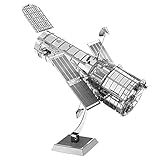
- HOBBY MODEL KIT – Unassembled model packed in an envelope with easy to follow instructions. Ideal for ages 14 and up.
- NO GLUE OR SOLDER NEEDED – Parts can be easily clipped from the metal sheets. Tweezers are the recommended tool for bending and twisting the connection tabs.
- HUBBLE TELESCOPE – 1 Sheet Model with a moderate difficulty level. Assembled Size: 3.00 x 2.00 x 2.50 inches.
- FROM STEEL SHEETS TO 3D – Pop out the pieces and connect using tabs and holes. Includes illustrated instructions.
- HIGHLY DETAILED ETCHED MODEL – Display your 3D model once completed - collect and build them all.
- Patent example: WO2026055239A1 describes computing hardware with aggregate peak power of at least 2 kW. This is a design threshold in the patent publication, not an operating measurement. WIPO patent publication WO2026055239A1
- ASCEND architecture under consideration: Thales Alenia Space describes a proposed 10 MW space data center and approximately 35,000 m² of solar-array surface. These are planning figures, not deployed specifications. Thales Alenia Space’s ASCEND project interview
- ASCEND project target: The study describes a 10 TWh capacity and a target of reducing the energy requirements of Earth-based data centers by 10%. These are stated aims, not achieved savings. Thales Alenia Space’s ASCEND project interview
- Project-cited terrestrial estimate: Thales Alenia Space cites an estimated European terrestrial data-center footprint of 20 million tonnes of CO₂ equivalent per year through 2030. This is an estimate cited in the project interview, not an orbital-facility result. Thales Alenia Space’s ASCEND project interview
These figures do not establish that orbital facilities are cheaper or lower-carbon over their lifecycle. Launch, manufacturing, replacement, power systems, and operations all affect that comparison.
How to judge an orbital data-center claim
When evaluating a project, identify what has actually been built or tested, and distinguish a mission-specific processor from shared commercial compute. Then check the system-level details that determine whether the concept can deliver its intended service:
Quick Recap
- Is it a hosted payload, one satellite, or a networked constellation?
- What orbit and sunlight or eclipse conditions does it rely on?
- What computing load, power-generation capacity, and heat-rejection approach are specified?
- How does it handle radiation-related faults?
- What communications capacity, latency, and downlink dependence does the workload require?
- How will the hardware be launched, maintained, replaced, and assessed across its lifecycle?
- Are claimed environmental benefits measured outcomes, feasibility-study targets, or company projections?
Product prices and availability are accurate as of the date/time indicated and are subject to change. Any price and availability information displayed on Amazon at the time of purchase will apply.

