
PC Slower Than It Used to Be?
A free scan shows the junk files, broken settings and background clutter dragging Windows down - then fixes them in one click.Free scan · Windows 10 & 11Crashes, No Sound, or Screen Glitches?
Random freezes, missing sound and display glitches usually trace back to one bad driver. Find and replace yours safely.Free scan · under a minuteiTechGuides is reader-supported. When you buy through links on our site, we may earn an affiliate commission. As an Amazon Associate I earn from qualifying purchases. Learn more
A contactless IC card is a card with an embedded integrated circuit that communicates wirelessly with a reader at close range, without being inserted into a slot or touching exposed electrical contacts. The term describes how the card communicates—not one universal application, data set, security design, or compatibility guarantee.
What does “contactless IC card” mean?
“IC” means integrated circuit. In a contactless IC card, the chip exchanges information with a compatible reader through a wireless interface when the card is brought into the reader’s operating field. Contactless payment cards and public-transport fare media are examples, but not every contactless IC card is used for payment or transit.
The Secure Technology Alliance describes ISO/IEC 14443 proximity-card communication as generally occurring at less than 10 cm (4 inches). That is broad category context, not a guaranteed range for every card, reader, or setting. Secure Technology Alliance: About Smart Cards FAQ
How does a contactless card work?
A reader initiates communication as the card enters its operating range. The reader and card then detect and select the card, initialize communication, and exchange data using procedures defined by the applicable card system and standards. Because the connection is wireless at close range, the card does not need to make direct electrical contact with the reader.
#1 Best Overall

- It not only supports Mifare cards and Class A and B cards conforming to the ISO 14443 standard, but also supports NFC and FeliCa contactless technology.
- This is a USB hot-pluggable device that complies with the CCID standard and is ideal for applications such as personal identity security authentication and online micropayments.
- This is a USB full-speed device (12 Mbps), which reads NFC tags at 106 kbps、212 Kbps and 242 Kbps, allowing faster read and write speeds and higher efficiency
- To increase the safety factor, you can choose to configure an ISO7816-3 compliant SAM card slot in the ACR122.
- Widely used in areas such as access control, electronic payment, bus e-ticketing, highway toll collection systems, network verification, logistics, and supply chain management.
For ISO/IEC 14443 proximity objects, the standard divides these tasks across parts. Part 3 covers polling, initial frames and timing, initialization, selection, and anticollision—the process that helps handle multiple objects in the reader’s field. Part 4 defines a half-duplex block transmission protocol and activation and deactivation sequences. These parts specify communication behavior, not a universal application or security model.
What does ISO/IEC 14443 cover?
ISO/IEC 14443 defines a family of contactless proximity objects, including Type A and Type B. Its parts describe how compatible readers and cards establish and conduct communication; they do not mean that all cards using a contactless interface store the same information or work with every reader.
Rank #2

- 1. Quick sensing and fast reading, stable identification 2. Durable PVC material, bend-resistant and long service life 3. Wide compatibility with access control and attendance systems 4. Cost-effective 10-piece pack for commercial and personal use
- Part 3: Initial detection, frames and timing, initialization, selection, and anticollision. The ISO catalog record is for Edition 4, published in July 2018; the catalog lists an amendment and a draft successor under development. ISO: ISO/IEC 14443-3:2018
- Part 4: The half-duplex block transmission protocol and activation/deactivation sequence. IEC lists ISO/IEC 14443-4:2018 as published. IEC: ISO/IEC 14443-4:2018
These catalog entries describe the cited editions; standards status can change, so consult the official catalog for current status.
Quick wins for a faster PC:
Clear out junk files and repair common Windows errorsFree Scan →Scan for outdated or missing drivers - takes under a minuteDriver Scan →Is a contactless IC card the same as NFC?
No. The terms overlap in context, but they are not interchangeable labels for every implementation. “Contactless IC card” refers to a card containing an integrated circuit that uses a contactless interface. NFC refers to a related technology used by consumer mobile devices as well as in contactless applications. Whether a particular phone, card, and reader interoperate depends on the system’s specifications and compatibility.
Rank #3
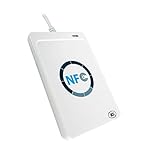
- This product does not come with any software. You need applications provided by third parties.
- Built-in antenna for contactless tag access, with card reading distance of up to 50 mm (depending on tag type)
- Supports ISO 14443 Type A and B cards, MIFARE, FeliCa, and all 4 types of NFC (ISO/IEC 18092) tags
For public transport, ISO/IEC TS 24192-1:2021 addresses communication between contactless readers and fare media and discusses interoperability with consumer NFC mobile devices. It describes transit-specific interoperability requirements, not a guarantee that every NFC phone works with every fare system. ISO: ISO/IEC TS 24192-1:2021
How is a proximity card different from a vicinity card?
ISO/IEC 14443 covers proximity objects; ISO/IEC 15693 is a related but distinct series for vicinity cards. IEC describes ISO/IEC 15693-2 as covering a 13.56 MHz reader-generated field and applications such as access to goods or services and tracking nearby objects. Do not assume the two categories have the same operating range or reader compatibility; those details depend on the card and implementation. IEC: ISO/IEC 15693-2:2006
Rank #4

- NFC RFID Mini RF IC Card Inductive Reading / Writing Card Swipe Module 13.56MHz 3.3V
What are contactless IC cards used for?
Supported examples include contactless payment and public-transport fare media. Transit systems may define additional requirements for the readers and fare media they use, including interoperability with consumer NFC mobile devices. A card’s actual purpose, stored data, security behavior, and compatibility are determined by its specific system, not by the phrase “contactless IC card” alone.
What’s actually slowing this PC down?
Pick the symptom - the matching free tool is one click away.
Quick Recap
Best Value

- [STANDARD CREDIT CARD SIZED] - Size 3 3/8" x 2 1/8" (85mm*54mm) Standard Credit Card Size (CR80 30 Mil) - Printable PVC on double Side - No Adhesive - No Pre-Punched Slots - Great for ID Badges
- [STANDARD 125KHZ IC CARD]- Read only, TK4100 chip, Reader Distance : 5-12mm,compatible with the RFID 125Khz Card Reader
- [APPLICATION] - Each card already print with ABA Code and Wiegand Code,It can be use on Access Control, Time Attendance, Hotel key card, loyalty card, and so on
- [DURABLE] - Anti-scratch, more resistant with overlay and protective film. PVC Material. Waterproof.
- [HIGH-QUALITY IDCARD PRINTING CONSUMABLES] -All Cards Arrive Sealed in Shrink Wrap, Print Your Logo on the card, Great Cards for Printing
Product prices and availability are accurate as of the date/time indicated and are subject to change. Any price and availability information displayed on Amazon at the time of purchase will apply.

