
Quick wins for a faster PC:
Repair Windows errors before they cause bigger problemsFix Now →Scan for outdated or missing drivers - takes under a minuteDriver Scan →iTechGuides is reader-supported. When you buy through links on our site, we may earn an affiliate commission. As an Amazon Associate I earn from qualifying purchases. Learn more
A 3D nanoprinting pen is a laboratory probe that uses a microscopic, electrolyte-filled hydrogel tip and electrochemical reactions to build structures at nanometre scales. It is not a handheld plastic-extruding craft pen: the reported setup requires an electrode and precision positioning equipment.
What is a 3D nanoprinting pen?
The term refers to a research-scale electrochemical nanofabrication method. A hydrogel tip carries electrolyte to a tiny contact area on an electrode. When the tip is positioned and brought into contact under controlled conditions, the reaction can deposit material in a designed pattern.
The Royal Society of Chemistry’s 2014 summary describes a demonstration by Seongpil Hwang of Korea University and colleagues. Their work was published as “Hydrogel Pen for Electrochemical Reaction and Its Applications for 3D Printing” in Nanoscale in 2015 (DOI: 10.1039/C4NR06041E).
How does the nanoscale printing pen work?
- Electrolyte is held at the tip. The probe has a microscopic pyramid-shaped hydrogel tip, with electrolyte at its sharp apex.
- The probe is positioned against an electrode. A nanopositioning system controls the tip’s placement and contact with an ultramicroelectrode.
- Contact localizes the reaction. The small contact region limits where reactants can travel and where the electrochemical reaction occurs.
- Material is deposited. In the reported demonstration, the reaction deposited platinum structures on a gold electrode; some structures were smaller than 100 nm, according to the RSC summary.
A related Korean patent record describes a sharp pyramid containing hydrogel, water and electrolyte, and mentions possible use with an electrochemical scanning microscope to map chemical reactivity. The English patent page is machine translated. Patent descriptions do not establish that a device is commercially available or independently validate its performance.
#1 Best Overall
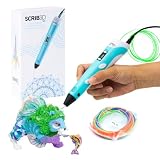
- [A GIFT FOR THE WHOLE FAMILY] Create, Draw, Doodle, and Build in 3D with this affordable yet high grade 3D pen. The new SCRIB3D P1 3D Pen helps improve spatial thinking, creativity and artistic skills. Great for quality family time and as a practical tool for making handmade gifts or decorations, or for everyday fixes around the home. The P1 Pen features a stepless speed function designed for optimal speed control no matter the task - whether slower intricate projects or faster infill work.
- [READY-TO-USE KIT] Includes 3 colors (30 feet) of PLA plastic to keep you Doodling for ages, as well as a power adapter, step-by-step manual, and a free stencil guide. Just plug in, heat it up and enjoy the fun of creating three-dimensional masterpieces. PLA is a versatile, easy-to-use printing plastic that is great for both first time and advanced users.
- [BEGINNER FRIENDLY] Plug the adapter into the back of the pen and choose your filament. The red light will turn on indicating warm up, this will take about 2-3 mins. Double click the forward button to start and feed the filament through the back of the pen. Once the filament has reached the nozzle of the pen, click forward to stop. Press and hold the forward button or double click for a continous flow. Once you have completed your design, press and hold the reverse button to retract filament.
- [MULTI-FUNCTIONAL] The SCRIB3D P1 Pen is temperature adjustable to accommodate multiple types of filament: PLA (160-210℃, 320-410°F) or ABS (210-235℃, 410-455°F). Unlike other 3D printing pens, the P1 has an easy-to-use stepless speed slider, designed for optimal speed adjustment. Perfect for any task, from slow & intricate projects to faster infill work.
- [SAFE & RISK FREE PURCHASE] The P1's ceramic nozzle and premium motor ensure safety and high performance without clogging. Equipped with 2 minute auto sleep function after 3D doodling stops, anti clogging features, and intititve controls ensure a seamless Doodling experience. 1 year guarantee and responsive customer service. Buy with 100% confidence. If there are any quality issues or you need getting started tips, please feel free to contact us and we'll be happy to help.
How it differs from other nanoprinting methods
“Nanoprinting” covers distinct methods, and their performance figures are specific to their materials and equipment. The hydrogel pen uses electrochemistry to deposit metal; other research approaches deliver or cure materials differently.
| Method | Material and mechanism | Reported capability | Trade-off or distinction |
|---|---|---|---|
| Hydrogel electrochemical pen | Electrochemical deposition; the cited demonstration deposited platinum on gold. | Some platinum structures were under 100 nm, according to the RSC’s 2014 summary. | Requires an electrolyte-bearing probe, electrode and controlled positioning; it is not a consumer filament printer. |
| AFM-guided polymer nanoprinting | Microfluidic delivery paired with atomic force microscopy (AFM) spatial control and rapid surface-initiated polymerization. | The 2022 Nature Communications study reports about 2 nm precision in individual z-layers and minimum line widths as small as 450 nm. | The authors describe it as slower than optical-based methods; it can work with polymers that do not require photoactive groups. It is a separate system from the hydrogel pen. |
| Metalens-array two-photon lithography | Parallel optical printing using a metalens array. | A February 16, 2026 UNC Charlotte release reports more than 120,000 laser focal points, speeds above 120 million voxels per second and features down to 113 nm. | These figures describe an optical platform, not the hydrogel pen. The release emphasizes parallel throughput. |
| Nanotube fountain pen | A metal-filled carbon nanotube acts as an injector, with a nanotube network serving as a metal mass reservoir. | The 2015 paper describes writing metallic nanostructures; the source summary does not state a comparable feature-size figure. | This is a distinct injector-and-reservoir approach, not hydrogel-based electrochemical deposition. |
For an overview of the AFM polymer method, see the 2022 Nature Communications paper. UNC Charlotte’s 2026 release on the metalens-array platform gives the optical system’s reported figures. The separate 2015 nanotube fountain pen paper describes the carbon-nanotube injector method.
Rank #2

- Turn your ordinary drawings into 3D works of art
- Stepless speed slider lets you regulate flow for optimal control of material while you're drawing
- New: ultrasonic sealed nozzle is nearly clog-proof and provides market leading durability
- The Super 3D Printing Pen is great for kids, artists and engineers of all ages
- Kit includes 3 colors of PLA plastic filament A/C adapter and slim, ergonomic touch pen with 1 year limited warranty
What the reported results do—and do not—show
The sub-100 nm figure belongs to the platinum structures in the RSC’s account of the hydrogel-pen research. It should not be treated as a universal resolution rating for every material, design or setup. Likewise, the polymer study’s z-layer precision and line width, and UNC Charlotte’s optical-platform speed and feature size, describe their respective systems rather than the hydrogel pen.
Recommended Free Tools
These are research methods, not interchangeable consumer printers. Their choice involves the material being formed, the deposition or curing mechanism, feature dimensions, throughput, ability to build layered or overhanging geometries, and the instruments and materials required. The cited polymer work emphasizes controlled layer-by-layer construction and fine z control while acknowledging slower speed than optical methods; the UNC Charlotte release emphasizes parallel optical throughput.
Rank #3
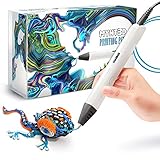
- Watch imagination come to life with the Professional 3D Pen
- Adjustable feed lets you regulate speed & flow for optimal control of material while you're drawing
- Temperature is adjustable in 1 degree increments from 140 to 230 C, for optimal fine-tuning
- Large, OLED display lets you monitor temperature of material to help you achieve a wide variety of effects
- Kit includes 3 colors of PLA plastic filament, A/C adapter and slim, ergonomic pen with 1 year limited warranty
Is a 3D nanoprinting pen available to buy?
The sources describing the hydrogel pen establish a research device and laboratory demonstration, not a currently available consumer product or a verified off-the-shelf complete system. They do not establish current pricing or compatible replacement tips. A standard handheld 3D printing pen, which extrudes plastic filament, is not an equivalent substitute.
For readers evaluating nanofabrication, the relevant equipment is specialized: the reported approach depends on a hydrogel probe, electrochemical setup and precise nanopositioning. The cited sources do not identify a specific purchasable system or accessory for this method.
Quick Recap
Rank #4

- [GREAT FOR GIFT-GIVING] Create, Draw, Doodle, Sketch, and Build like a Pro in 3D with our new SCRIB3D Advanced Pen. It features variable speed control, a large LCD screen to help monitor heat and ensure you have the correct settings, as well as a range of other engineering enhancements to ensure a smooth and accurate Doodling experience. Our most advanced 3D Printing Pen - designed for making accurate and creative 3d models and structures. The only limit is your imagination.
- [DESIGNED WITH COMFORT] Sleek and ergonomic design with curvature intended to fit your hand for the most comfortable 3D drawing experience on the market. The Advanced pen's "soft touch" surface is designed for optimal Doodling comfort. Features LCD display with buttons for loading / unloading and adjusting the temperature and speed, as well as 8 different speed options so you can regulate speed & flow for optimal control of line thickness while creating.
- [READY-TO-USE KIT] Includes 5 colors (15 meters ~50 feet) of PLA plastic, power adapter, step-by-step manual, and a free stencil guide. Just plug it in, heat it up and enjoy the unlimited fun of creating a three-dimensional masterpiece like a Pro. PLA is a versatile, easy-to-use printing plastic that is great for both first time and advanced users.
- [BEGINNER FRIENDLY] Plug the adapter into the back of the pen and choose your filament. The red light will turn on indicating warm up, this will take about 2-3 mins. Double click the forward button to start the pen and feed the filament through the back of the pen. Once the filament has reached the nozzle of the pen, click forward to stop the pen. Press the forward button once to start: click once to stop. Once you have completed your design, hold the reverse button to retract filament.
- [SAFE & RISK FREE PURCHASE] Built in safety features, anti clogging features, and intititve controls ensure a seamless Doodling experience. 1 year guarantee and responsive customer service. Buy with 100% confidence. If there are any quality issues or you need getting started tips, please feel free to contact us and we'll be happy to help.
Product prices and availability are accurate as of the date/time indicated and are subject to change. Any price and availability information displayed on Amazon at the time of purchase will apply.
Do these 3 things before closing this tab:
1Clear out junk files and repair common Windows errors2Scan for outdated or missing drivers - takes under a minute3Repair Windows errors before they cause bigger problems
