
Do these 3 things before closing this tab:
1Fix the driver behind crashes, sound loss and screen glitches2Repair Windows errors before they cause bigger problems3Scan for outdated or missing drivers - takes under a minuteiTechGuides is reader-supported. When you buy through links on our site, we may earn an affiliate commission. As an Amazon Associate I earn from qualifying purchases. Learn more
A builder of a Chinese-first voice mock-interview service found that the features that mattered most were not the ones a demo would show: an interviewer that asks follow-up questions, prompts tied to the candidate’s own background, feedback built on the actual transcript, a consistent interview structure, and several interviewer perspectives. The lessons come from a first-person account by MakeInterview, published on DEV Community on October 1, 2026. They describe design decisions and the author’s judgment, not measured results, so this article separates what the author reports from what remains unproven.
Why voice practice is harder to build than it looks
Most interview preparation still happens on paper or in silence. People read lists of common questions, write out model answers, or rehearse alone in their heads. What many candidates want is different: practice being asked a question out loud and answering in the moment, with no time to polish a sentence. MakeInterview frames the problem this way, and the design choices in the account follow from it. A voice agent that only reads questions in sequence does not capture the pressure of a live conversation, so the author treated conversation mechanics as the core product rather than an add-on.

Lesson 1: Let the interviewer follow up
The first version of the tool moved on as soon as the candidate finished an answer. The author describes the result as a monologue: a series of isolated questions and replies with no link between them. The fix was to let the interviewer ask one or two follow-up questions before moving to the next topic.
Outdated Drivers Are Slowing You Down
One free scan finds every outdated or missing driver and matches the right update for your exact hardware.Free scan · exact hardware matchPC Slower Than It Used to Be?
A free scan shows the junk files, broken settings and background clutter dragging Windows down - then fixes them in one click.Free scan · Windows 10 & 11The author reports that this made the transcript read more like a real conversation. The practical lesson is that a practice session is only as useful as its follow-up logic. If a candidate says “we improved the onboarding flow” and the interviewer never asks what they changed, measured, or would do differently, the candidate has not rehearsed the question that a real hiring manager is most likely to ask next.
#1 Best Overall
The author’s own summary of the principle is direct: “The interviewer has to follow up.”
Lesson 2: Ground every question in the candidate’s materials
The tool parses a resume and a target job description, and each generated question must attach to a specific entity found in those materials, such as a named project, a role, a tool, or a responsibility. If parsing does not produce a usable anchor, the interviewer asks a clarifying question instead of inventing a plausible project or experience.
This matters for two reasons. Generic questions train generic answers, which hiring panels recognize quickly. More seriously, a practice tool that invents candidate history teaches the user to describe experiences they do not have, or to be surprised when a real interviewer asks about something the tool made up. The article presents the no-invention rule as a design principle. It does not report how accurately the parsing works, so readers should treat the rule as a stated goal rather than a verified feature.
Quick wins for a faster PC:
Scan for outdated or missing drivers - takes under a minuteDriver Scan →Repair Windows errors before they cause bigger problemsFix Now →Fix the driver behind crashes, sound loss and screen glitchesFind Drivers →Rank #2
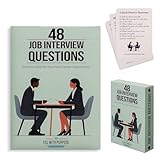
- Essential Phrases: Carefully selected flashcards feature common questions and advice to enhance your preparation and answers.
- Targeted Content: Curated by a career pathways and ESL instructor to help advanced language learners, as well as recent graduates and job seekers.
- Strategic Practice: Organized into 4 categories of relationship, knowledge, character, and leadership, allowing you to delve deep into each question and refine your responses.
- Insightful Guidance: The 8 tip cards such as the STAR method, along with what to ask the interviewer and more thoughtful ideas.
- Hiring Managers: Compact and portable, it provides a convenient resource to identify and draw out meaningful and honest responses.
The author’s phrasing for this idea is “Ground the questions in your resume and the JD,” which is a useful checklist item for any practice tool you evaluate.
Lesson 3: Show the words, not just a score
An early version gave each answer a score out of 100. The author replaced it with a verbatim transcript of the candidate’s answer displayed beside a model answer. The reasoning is that a number hides the cause. A candidate who sees their own sentences can notice filler words, repeated hedges such as “I think maybe,” and answers that wander before reaching a point.
This is the author’s product judgment. The account does not compare the two formats or measure whether candidates who read transcripts improved faster. It does, however, point to a feedback standard that is easy to check: can you see exactly what you said?
Lesson 4: Keep the interview structured
The article states that structured interviews are supported by research and cites Schmidt and Hunter’s 1998 meta-analysis together with a 2022 update by Sackett and colleagues. The account does not reproduce the methods or findings of either study, and it does not provide a validity figure. Readers who want the evidence should consult the original publications directly rather than relying on a summary of them.
Free tools Windows power users keep installed
One-click scans. No signup required.
Within the tool, structure means that sessions follow a consistent sequence rather than a random set of questions, so that one practice session can be compared with the next. Whether that sequence matches a particular employer’s process is a separate question that the article does not address.
Lesson 5: Practice with different interviewers
The author built five interviewer personas: an HR screener, a direct manager, a technical expert, a department head, and an executive. Each persona applies a different kind of pressure. An HR screener checks motivation and basic fit; a technical expert probes depth; an executive tends to ask about judgment and trade-offs.
The account presents these personas as a way to rehearse different pressures. It does not report a controlled comparison, a benefit measured against a control group, or evidence that a given persona prepares candidates for a given employer. Its value, as described, is breadth of practice.
Independent reader supportYour contribution helps us test, update, and keep practical guides available for everyone.What the account does and does not establish
The article is one builder’s report. It is useful for understanding design decisions, but several claims cannot be checked from it:
- It does not measure learning outcomes, interview performance, or user satisfaction.
- It does not evaluate how accurately resumes and job descriptions are parsed.
- It does not compare the tool with other practice products.
- It does not confirm current product availability, pricing, or any partner or affiliate arrangement beyond what appears on the author’s own pages.
The author’s own closing point is the one most worth carrying into any voice-agent project: “If you are building a voice agent for a high-stakes conversation, the interruption and follow-up loop is the part I would spend the most time on.”
A checklist for judging any AI interview practice tool
The article’s design choices suggest five questions to ask before you spend time on a practice tool. They are criteria drawn from the account, not a ranking of products.
- Does the interviewer follow up? Look for sessions where a vague answer prompts a second question about specifics, not only a move to the next item.
- Are the questions based on your material? Check whether the tool asks about your actual resume and the actual job description, and whether it asks for clarification when it cannot find a clear anchor.
- Can you see your own words? A transcript of your answer beside a model answer is more actionable than a single score.
- Is the session structure consistent? A repeatable format lets you track progress across sessions.
- Can you practice different interviewers? Practicing with a screener, a manager, and a technical reviewer covers different kinds of pressure.
If a tool meets only some of these, it may still help. The question is which gap matters most for the interview you are preparing for.
The article is published under the name MakeInterview on DEV Community and dated October 1, 2026. Check the author’s own page for the current state of the product, since the account describes a tool at one point in its development.
Quick Recap
Product prices and availability are accurate as of the date/time indicated and are subject to change. Any price and availability information displayed on Amazon at the time of purchase will apply.

