
Recommended Free Tools
iTechGuides is reader-supported. When you buy through links on our site, we may earn an affiliate commission. As an Amazon Associate I earn from qualifying purchases. Learn more
A student live-broadcast team can start with a camera or phone, a stable tripod and compatible mount, a microphone suited to the speaker, a computer or supported mobile device running streaming software, dependable internet, and the right cables and power supplies. Add headphones for audio checks. An audio mixer or interface becomes useful when you have multiple microphones or other sources; a switcher and extra monitoring become necessary when you produce multiple camera angles, graphics, or commentary.
The best kit is determined by the show, venue, existing school equipment, crew size, and budget—not by a universal shopping list. Build the signal path first, test every connection before the event, and buy only what solves the next production problem.
Define the broadcast before buying equipment
A one-presenter announcement, a school assembly, a panel discussion, and a sports stream place different demands on cameras, microphones, switching, and crew. Write down the intended format before comparing products.
| Show format | Typical coverage | Audio needs | Production needs |
|---|---|---|---|
| One-presenter announcement | One locked-off camera or phone shot | One lavalier, headset, or camera-mounted microphone | Direct stream with basic monitoring |
| Assembly or panel | Wide room shot plus optional close-up | Several microphones, or microphones plus playback audio | Mixer or interface; optional switching and graphics |
| Sports or outdoor event | Moving action, wide coverage, and a commentator position | Commentary microphone plus ambient or venue audio | Capture device, encoder, switching, longer cable runs, weather and power planning |
| Student news or studio show | Multiple planned angles | Several presenter microphones and playback sources | Switcher, preview or multiview monitor, lighting, graphics, and an operator workflow |
Inventory school-owned phones, cameras, tripods, microphones, computers, monitors, adapters, and network equipment first. Confirm each item’s connector, mount, power requirement, operating system, and compatibility with the chosen streaming platform before spending money.
#1 Best Overall

- Complete Vlogging Kit: Designed for content creators, this kit includes a face-tracking tripod for iPhone, professional microphone, and dual LED lights. It helps with smooth, hands-free recording, clear audio, and professional lighting for high-quality content creation. Ideal for vlogging, live streaming, and social media videos
- 360° Face Tracking &Gesture Control: This AI-powered tripod for iPhone automatically centers your face in the frame, tracking your movements in real time. Perfect for vlogs, live streams, or memories, the phone tripod lets you start tracking with an "OK" gesture and stop with a "Palm" gesture, offering intuitive hands-free recording and ease of use
- Wireless Clip-on Microphone: This YouTube starter kit comes with two mics and a receiver, ensuring clear audio for vlogs and interviews. With a 2-hour charge, it delivers 12 hours of battery life. The receiver supports Type-C for iPhone 15+ and Android, and Lightning for iPhone 14 and earlier. Clip it on or hold it, recording wirelessly up to 79ft, perfect for TikTokers and content creators
- Adjustable Fill Light&Versatile Remote Control: Choose from Natural, Soft, or Warm lighting for the optimal brightness. More than a shutter, it works as a scrolling remote control for TikTok, page turner for iPad, and sends likes with a double press. Features fast Type-C charging, a 33ft range, and conveniently slots into the selfie stick for easy storage
- Flexible Angles&Enhanced Stability: The phone holder fits 4-4.7” devices, rotates 360°, and tilts 270° for ideal shots. Built from aluminum, it extends to 63 inches with a secure four-leg base. Content creator kit includes: selfie stick tripod*1, Led fill light*2, Remote control*1, Microphone Transmitter*1, Microphone receiver*2, Type-C charging cable*2, Storage bag*2, User manual*2
The one-camera starter kit
This is the minimum practical system for a controlled indoor broadcast. Some items may be combined—for example, a phone can be both camera and streaming device—but every function still needs a reliable connection and power plan.
| Component | What it does | What to check |
|---|---|---|
| Camera, phone, tablet, or compatible camera | Creates the video feed | Can it deliver the intended feed to the streaming device or software? Does it have enough battery and storage? |
| Tripod and device-compatible mount | Holds a steady, repeatable shot | Mount thread or clamp fit, weight support, height, and quick repositioning |
| External microphone | Captures intelligible speech | Microphone type, connector, cable length, wireless range if applicable, and room noise |
| Streaming computer or supported mobile device | Runs the streaming application or service | Supported operating system, available ports, processing headroom, and power |
| Streaming software or hardware encoder | Sends the camera and audio feed to the platform | Input compatibility and whether it supports the desired platform and graphics |
| Internet connection | Uploads the live program | Reliability at the venue; wired Ethernet is preferable when the device and venue support it |
| Headphones | Let the operator hear distortion, hum, dropouts, or delayed audio | Comfort, cable length, and a usable monitoring output |
| Cables, adapters, power supplies, and charging equipment | Complete the signal and power paths | Exact connector type, length, spare availability, and safe cable routing |
Switcher Studio’s basic equipment guidance identifies a compatible iOS or OS device and a reliable network as minimum requirements. It also describes tripods and mounts as stabilizers and external microphones as a way to improve audio quality and flexibility. A built-in microphone can be acceptable for a low-stakes first stream, but it gives you little control over distance, room echo, or background noise.
Choose the microphone for the speaker and setting
Viewers will tolerate an imperfect image more readily than speech they cannot understand. Select the microphone by asking where the speaker moves, how noisy the room is, and whether one or several sources must be mixed.
Lavalier microphones
A lavalier clips to clothing and keeps the microphone close to a presenter’s mouth. It suits a presenter who walks, teaches, or addresses the camera. Keep the cable clear of clothing noise, and confirm whether the microphone uses the input on the camera, phone, interface, or a wireless receiver.
Rank #2

- 【All-in-One Audio Setup for Creators】Complete Podcast Equipment Bundle for Streaming, Recording & Content Creation.Designed as a complete audio solution, this kit includes an audio mixer, condenser microphone, and essential accessories—ideal for building a clean and efficient setup without extra equipment.
- 【Clear, Balanced & Reliable Sound】Enhanced Vocal Clarity with Built-in Noise Reduction.Capture clean, natural sound with reduced background noise. Optimized for streaming, podcasting, voice recording, and everyday content creation.
- 【Follow Singing Mode for Live Performance】Hear the Original Track While Your Audience Hears Only Your Voice & Music.Perfect for live singing, TikTok streams, and online performances. Monitor the original vocals privately while delivering a clean mix to your audience.
- 【Voice Changer & Sound Effects】Multiple Voice Styles & Built-in Effects for Interactive Content.Switch between different voice styles and trigger sound effects like applause or laughter to enhance engagement during streaming or recording sessions.
- 【Real-Time Audio Control】Adjust Bass, Treble, Reverb & Pitch with Ease.Fine-tune your sound in real time to match different scenarios, from chatting and gaming to singing and recording.
Shotgun microphones
A shotgun microphone provides directional pickup and can be placed above or beside a subject when a visible clip-on microphone is undesirable. It needs careful aiming and a suitable mount; it is not a guarantee against room echo when the microphone is far from the speaker.
Boundary or table microphones
A boundary or table microphone is useful for a panel or group seated around a table. Place it where voices reach it evenly and test for tapping, paper noise, and loudspeaker feedback.
These use cases are also outlined in Switcher Studio’s student production guide, which groups lavalier microphones with moving subjects, shotgun microphones with directional pickup, and boundary or table microphones with panel discussions: Teaching Live Video Production With Switcher.
When to add a mixer or audio interface
Add a mixer or interface when you must combine multiple microphones, playback audio, a commentator, or a venue sound system. It gives the operator a single controlled feed and a way to set relative levels before the stream. Switcher Studio’s equipment guidance says its workflow uses an audio mixer when external microphones or multiple audio sources are involved: Basic Equipment Recommendations. For a single microphone connected directly to a compatible device, a mixer may add cost and setup without solving a problem.
Rank #3
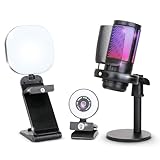
- ALL-IN-ONE STREAMING & GAMING SETUP — Everything you need to go live in one box: a 1080P HD webcam, RGB USB microphone, and adjustable LED light. Skip piecing together streaming accessories one at a time — plug in and start streaming in minutes.
- CRYSTAL-CLEAR 1080P VIDEO — A high-resolution CMOS sensor captures true 24-bit color up to 1920×1080 at 30FPS, with automatic brightness and color compensation so you look sharp on Twitch, YouTube, Zoom, or Teams without manual tweaking.
- STUDIO-QUALITY AUDIO, BACKED BY A 30 DAY WARRANTY — A 14mm capacitive microphone with cardioid pickup, built-in pop filter, gain control knob, and shock mount delivers clear, echo-free sound (>70dB signal-to-noise). Real-time headphone monitoring lets you hear exactly what your audience hears — and it's backed by a full 30 DAY
- PROFESSIONAL LIGHTING, 5 MODES & 5 BRIGHTNESS LEVELS — A CRI 90+ LED panel spans 3000–7200K, from warm to cool white, with 5 brightness levels and a memory function that saves your favorite setting. Rotates 180° and hooks onto your monitor for the perfect angle every time.
- WORKS RIGHT OUT OF THE BOX—Compatible with Windows, Mac, Android, and iOS for streaming, video calls, and content creation. Note: PS5/Xbox streaming requires a capture card (sold separately) to connect this kit to your console.
Stabilize and position the camera
A tripod is a practical essential for fixed shots and many mobile setups. Use a mount that fits the phone or camera and supports its weight; a loose clamp or overloaded tripod can ruin an otherwise good production. Frame the presenter with enough headroom, avoid bright windows behind the subject, and leave space for lower-third graphics if the software adds them.
For a moving sports production, one locked camera may not cover the action. Add cameras only when the crew can operate them and the switcher can accept their signals. Each additional position also needs its own mount, power, cable path, and backup plan.
Build the signal path: capture, switch, encode, stream
Think of the broadcast as a chain rather than a pile of devices:
- Capture: the camera creates video and the microphone creates audio.
- Connect: cables, adapters, or a wireless receiver carry those signals to the production device.
- Produce: software or a hardware switcher selects shots, mixes audio, and adds graphics when required.
- Encode: an encoder or streaming application converts the produced program into the platform’s stream.
- Upload: the computer or supported mobile device sends the stream over the venue network.
- Monitor: headphones and a preview or multiview display reveal problems before the audience does.
For manual productions, NFHS Network’s overview calls for a video capture device and streaming encoder. It also says a complete broadcast should include video, audio commentary, and graphics. A direct single-camera stream can omit a separate switcher, while a multi-camera show normally needs a hardware or software switcher and a way to preview sources.
Rank #4

- All-in-One Professional Podcast Equipment Bundle: Complete podcast equipment bundle includes audio interface mixer, microphones, microphone boom arms, 3.5mm earphone, shock mounts, pop filters, foam caps, XLR cables, USB cable, 3.5mm audio cables. Zero extra purchases needed. Ideal for voice over starter
- Excellent Sound Quality(Cardioid pickup technology): Elevate your audio with our podcast equipment bundle, featuring advanced noise reduction and cardioid pickup technology. The dual-layer POP filter and windproof foam cap minimize background noise, the built-in Audio Interface Mixer delivers studio-quality sound
- Newly Upgrated F998 Sound Card: Featuring 16 background effects sound, 7 podcast & recording modes, 4 Voice changer modes, and 9 adjustable kinobs. Perfect for podcast beginners, no audio skills needed
- Universal Plug & Play Compatibility: This podcast kit connects directly to PC, smartphones, Laptop, Xbox and systems like Windows, Mac OS, iOS, and Android. No converters or drivers needed! Just plug in and podcast immediately
- User-Friendly Podcast Equipment: Designed for beginners and pros alike, this podcast equipment bundle includes everything you need! For first-time use or after long storage, fully charge the device
What to add for panels, assemblies, and multi-camera shows
Once the show has several sources, plan the production position as carefully as the camera positions.
- Additional cameras, tripods, mounts, and power: provide alternate angles or a dedicated wide shot.
- Audio mixer or interface: route and balance microphones, playback, and commentary.
- Video switcher: select among live feeds and, when supported, add graphics or transitions.
- Preview or multiview monitor: let the operator see the program and incoming sources without guessing what is live.
- Capture devices and converters: bridge camera outputs to the switcher or computer when signal formats do not match.
- Spare cables and adapters: replace a failed or incorrectly sized connection quickly.
- Presenter adapters and confidence monitoring: help presenters connect playback devices and see what the audience receives.
A February 5, 2025 equipment list from the University of Utah Student Union illustrates a complete event setup: a Canon XA60 and power supply, interface cable, tripod, Mac Mini running OBS, monitor, wireless mouse and keyboard, Yamaha mixer, and USB cable. Its documented signal flow connects event microphones and audio to the mixer, then the mixer to the streaming laptop: Live Streaming Events. The specific models are examples of functions, not a required student shopping list.
A studio-oriented checklist from Adorama Business includes cameras, fluid-head tripods, lights, microphones, an audio mixer, monitor headphones, a live-stream encoder, a video switcher, and stable high-speed internet. It notes that cabling and networking depend on the setup, so treat it as a larger-studio reference rather than a minimum requirement: How to Start a Broadcast Studio at Your School.
Outdated Drivers Are Slowing You Down
One free scan finds every outdated or missing driver and matches the right update for your exact hardware.Free scan · exact hardware matchPC Slower Than It Used to Be?
A free scan shows the junk files, broken settings and background clutter dragging Windows down - then fixes them in one click.Free scan · Windows 10 & 11Sports and outdoor broadcasts need extra planning
Outdoor and sports productions add distance, movement, weather, and venue constraints. Plan a commentator position, action coverage, and a safe route for every cable. Use weather protection appropriate to the equipment, keep spare power and batteries available, and confirm where the crew can stand without obstructing spectators or athletes.
Best Value

- 【Full-set Vlogging Kit】Designed for content creator kit, this video blog kit includes: a smart auto-tracking AI tripod, fill light, professional microphone, and storage bag. It provides hands-free video recording, professional lighting, clear sound quality and neat storage, perfect for you to record professional vlogs, live broadcasts, interviews and social media videos.
- 【360° Rotation Auto Face Tracking Tripod】This automatic face tracking phone tripod has a built-in real-time artificial intelligence-driven AI camera that can automatic follow your movements and rotate in real time. This product can rotate 360° without dead angles, "OK👌" gesture to start following, "Palm🖐" gesture to stop following. Also equipped with a phone clip and magnetic attachment function, Provides hands-free video recording and easy to use.
- 【Magnetic Lavalier Microphone】This magnetic microphone kit includes one receiver and two microphones for professional-grade recording. The magnetic design allows for discreet microphone wearing, maintaining a clean look. Plug and play, no app installation required. A full charge takes approximately 2 hours and provides up to 12 hours of battery life. A recording distance of up to 66 feet makes it ideal for interviewers and content creators.
- 【Adjustable Fill Light】This content creator essentials is also equipped with two fill lights, which take about 2 hours to fully charge and can be used continuously for 6 hours. There are 3 colors of cool, natural and warm with 3 adjustable brightness to obtain the best lighting effect, which can meet the needs of shooting in various outdoor environments.
- 【Multi-Scene Use】This YouTube starter kit is designed for video bloggers, equipped with: face tracking selfie stick tripod*1, fill light*2, microphone transmitter*2, microphone receiver*1, Type-C charging cable*3, storage bag*2, user manual*2, suitable for making professional Vlog, live broadcast, interview, YouTube and Tik Tok videos, etc.
For a typical three-camera location stream, H2R Gear’s checklist includes cameras or PTZ units, lenses, tripods, memory cards for backup recording, switching, preview and confidence monitoring, converters, and presenter adapters: Live Stream Equipment Checklist. Scale those quantities to the actual show. A school does not need three cameras simply because a three-camera checklist exists.
Independent reader supportYour contribution helps us test, update, and keep practical guides available for everyone.Plan venue, power, and internet before event day
Walk the venue with a floor plan and identify the camera positions, production table, presenter area, audience or field boundaries, power outlets, network access, and cable routes. Check whether the venue allows wired Ethernet at the production device; if it does, use it rather than relying on a congested wireless connection. Do not assume that a network that works for browsing will remain reliable under a live upload.
- Measure cable distances and order or borrow the correct lengths.
- Confirm every device has its required charger or power supply.
- Use safe cable covers or routing where people walk.
- Keep spare HDMI, USB, audio, and network cables that match the actual connectors.
- Reserve space for the crew and equipment so operators can work without blocking exits or sightlines.
- Prepare backup recording on cameras or memory cards when the equipment supports it.
NFHS Network advises checking crew and equipment space, power, and internet at the location, arriving early, and running a test stream: Overview of Manual Productions.
Do these 3 things before closing this tab:
1Scan for outdated or missing drivers - takes under a minute2Repair Windows errors before they cause bigger problems3Fix the driver behind crashes, sound loss and screen glitchesUse this setup and test procedure
- Inventory: list the school’s cameras, phones, mounts, microphones, mixers, computers, monitors, cables, adapters, and power supplies.
- Map the show: mark each camera, microphone, operator, production device, network connection, and cable route on the venue plan.
- Assemble one complete path: connect the camera and microphone to the capture or production device, then connect the encoder or streaming software to the chosen platform.
- Set the shot: lock the tripod, frame the subject, check lighting, and verify that camera movement will not pull a cable or lose focus.
- Set audio: place or clip microphones, connect the mixer if needed, and listen through headphones for hum, clipping, echo, or clothing noise.
- Add sources: connect extra cameras, playback, and graphics one at a time; label inputs so the operator knows which source is live.
- Test privately: run a complete stream or platform test early enough to correct permissions, capture, audio, network, and power problems.
- Rehearse failure recovery: practice switching to a wide shot, muting a noisy microphone, replacing a cable, and continuing with one camera if another fails.
- Monitor during the event: keep one person responsible for headphones, preview, stream status, and audience-facing problems while other students handle cameras or presentation.
Common failure points and fixes
| Symptom | Likely cause | First action |
|---|---|---|
| Viewers hear room noise but not speech | Microphone is too far away, muted, or connected to the wrong input | Check the physical connection and input meter, then move the microphone closer to the speaker. |
| Audio is distorted | Input level is too high or multiple devices are feeding the same source | Lower the mixer or device gain and remove duplicate audio paths. |
| Camera image is missing | Incorrect input, incompatible adapter, or failed cable | Check the selected source, reseat the connection, and substitute a known-compatible cable. |
| Stream drops or stalls | Unreliable network, overloaded device, or inadequate power | Use wired networking where possible, close unnecessary applications, and connect stable power. |
| Operator cannot tell what is live | No preview or confidence monitor | Add a display or assign a student to monitor the program feed. |
| Camera shakes or drifts | Unstable tripod, loose mount, or cable pulling the camera | Lock the tripod and mount, then reroute and secure the cable. |
Spend in the order that improves the show
When funds are limited, improve the largest weakness first. For a one-presenter stream, a stable mount, close microphone, reliable power, and a tested network usually matter more than a second camera. For a panel, allocate money to microphones, a mixer or interface, and monitoring before adding decorative graphics. For sports, prioritize coverage, safe cable runs, power, and a dependable capture and encoding path.
As the team grows, add equipment in functional stages: second camera and operator, then audio expansion, then switching and preview, then lighting or graphics. Buying a device that cannot connect to the school’s existing cameras, mounts, software, or platform creates cost without improving the broadcast. Compare each proposed purchase on coverage, audio capture, production complexity, venue constraints, compatibility, portability, and whether students can operate it reliably under time pressure.
Quick Recap
A practical decision checklist
- What exactly must viewers see and hear?
- How many presenters, microphones, camera angles, and operators are involved?
- Can existing school devices provide the required video and audio feeds?
- Do mounts, connectors, adapters, software, and the streaming platform work together?
- Where will the production table, power, network, and cable runs be located?
- Who monitors audio, camera shots, stream status, and backup recording?
- What is the fallback if one camera, microphone, cable, computer, or network path fails?
- Has the complete system been tested in the actual venue before going live?
Product prices and availability are accurate as of the date/time indicated and are subject to change. Any price and availability information displayed on Amazon at the time of purchase will apply.

