
Do these 3 things before closing this tab:
1Repair Windows errors before they cause bigger problems2Scan for outdated or missing drivers - takes under a minute3Clear out junk files and repair common Windows errorsiTechGuides is reader-supported. When you buy through links on our site, we may earn an affiliate commission. As an Amazon Associate I earn from qualifying purchases. Learn more
HDTV display modes describe a high-definition picture by its active vertical line count and how those lines are scanned. In 720p, 720 active picture lines are displayed progressively; in 1080i, 1080 active lines are sent as interlaced fields. The number and the letter describe different parts of the format, so line count alone does not determine which picture looks better.
What does HDTV mean?
HDTV can mean either a family of high-definition video formats or, in some definitions, a complete television system. The broad format-based definition from the Advanced Television Systems Committee (ATSC) describes HDTV as having “a resolution of approximately twice that of conventional television in both the horizontal (H) and vertical (V) dimensions and a picture aspect ratio (HxV) of 16:9.” ATSC glossary
System-oriented definitions add requirements beyond the picture format. For example, a 2001 U.S. Federal Communications Commission (FCC) order recorded an industry and ATSC definition involving 720p, 1080i, or higher vertical display resolution, 16:9 display capability, and Dolby Digital audio. The FCC did not adopt one HDTV standard or impose an HDTV requirement on broadcasters in that discussion; this is historical U.S. regulatory context, not a universal current product rule. FCC order
A U.S. International Trade Commission report from around 2010 gives another system-oriented example: it includes ATSC terrestrial reception and decoding, minimum active-line formats, 16:9 display capability, and Dolby Digital audio. That report describes terminology in its period; it should not be treated as a current certification checklist. USITC report
#1 Best Overall

- 𝗡𝗲𝘃𝗲𝗿 𝗣𝗮𝘆 𝗠𝗼𝗻𝘁𝗵𝗹𝘆 𝗕𝗶𝗹𝗹: Watching local channels with this HD digital tv antenna for smart tv indoor 4K, you can watch crystal HDTV channels without cable service and enjoy local tv channels.
- 𝗜𝗻𝗱𝘂𝘀𝘁𝗿𝘆 𝗟𝗲𝗮𝗱𝗶𝗻𝗴 𝗧𝗲𝗰𝗵𝗻𝗼𝗹𝗼𝗴𝘆: This digital indoor tv antenna for local channels is made of eco-friendly flame-retardant dual PC soft material (not ordinary PVC), providing moisture resistance and lightning protection for indoor use.
- 𝗢𝗺𝗶𝗻𝗶-𝗱𝗶𝗿𝗲𝗰𝘁𝗶𝗼𝗻𝗮𝗹 𝗥𝗲𝗰𝗲𝗽𝘁𝗶𝗼𝗻 & 𝗠𝗮𝗴𝗻𝗲𝘁𝗶𝗰 𝗕𝗮𝘀𝗲: The indoor HDTV antenna brings omini-directional Reception; Whether hd digital tv antenna indoor is installed on the TV stand or on the table, you can receive the crystal clear picture
- 𝗖𝗼𝗺𝗽𝗮𝗰𝘁 𝗮𝗻𝗱 𝘀𝗺𝗮𝗹𝗹 𝗗𝗲𝘀𝗶𝗴𝗻: The indoor antenna for tv without cable features a compact and slim design, making it easy to hide without taking up space. The lightweight build allows you to move it conveniently and adapt to different living environments effortlessly.
- 𝗡𝗼𝘁𝗲 𝗮𝗻𝗱 𝗖𝘂𝘀𝘁𝗼𝗺𝗲𝗿 𝗦𝗲𝗿𝘃𝗶𝗰𝗲 : Read the manual first, set up your TV properly, and scan for channels. 𝐅𝐨𝐫 𝐨𝐩𝐭𝐢𝐦𝐚𝐥 𝐫𝐞𝐜𝐞𝐩𝐭𝐢𝐨𝐧, 𝐭𝐞𝐬𝐭 𝐛𝐨𝐭𝐡 𝐯𝐞𝐫𝐭𝐢𝐜𝐚𝐥 𝐚𝐧𝐝 𝐡𝐨𝐫𝐢𝐳𝐨𝐧𝐭𝐚𝐥 𝐩𝐥𝐚𝐜𝐞𝐦𝐞𝐧𝐭. Mount the antenna high, near a window facing local broadcast towers (Check "dtv gov maps" for available channels), to avoid obstacles and interference. Actual Reception depends on location, terrain, and weather, always re-scan for channels after moving the antenna. If you have any issues, please contact us. We will provide professional service and a satisfactory solution for you.
What do 720p and 1080i mean?
| Label | Active vertical lines | Scan method |
|---|---|---|
| 720p | 720 | Progressive: lines for a complete picture are presented in sequence |
| 1080i | 1080 | Interlaced: odd and even lines are sent as separate fields that together form a frame |
| 1080p | 1080 | Progressive: lines for a complete picture are presented in sequence |
The FCC’s 2001 explanation describes progressive scanning as presenting lines successively from top to bottom, with a complete image in each frame. Interlaced scanning sends odd and even lines consecutively as separate fields; the receiver combines the fields into a frame. A Spanish government HDTV explainer also describes the odd/even field distinction. FCC order Spanish government HDTV explainer
How should you compare HDTV modes?
Compare the active line count and scan method, then consider the particular source and display. 1080i has more active vertical lines than 720p, but it uses interlaced scanning rather than progressive scanning. The mode labels alone do not establish a universal picture-quality winner: the available definitions do not support a blanket claim that one always looks sharper or smoother on every display.
Rank #2

- Enjoy More Tv antenna for Local Channels: Get more channels by antenna for smart TV, receive local broadcasting, ABC, CBS, NBC, CPS, FOX, CW, ION, UMAS, etc.
- HD Antenna for TV: Our digital TV antenna indoor adopts an upgraded Smart IC Chip, receives TV broadcasts including 4K, UHD and 1080 HDTV for the hd picture.
- 16FT Coax Cable: Coaxial cable is composed of a solid center conductor, dielectric insulation, three aluminum shielding layers, and a durable outer layer. so that you will never lose signal or suffer distortion even in bad weather.
- Compatibility and Usage Tips: Not suitable for older analog televisions; supports smart TVs and digital TVs. For optimal signal reception, try placing the antenna near a window or in other locations, and test both vertical and horizontal orientations.
- Easy to Install: Plug the coaxial cable from your digital indoor HDTV antenna into the ANT/IN connector on the back of your TV, point the TV antenna toward your local TV tower and scan for channels. (Check "dtv gov maps" for available channels).
Likewise, 1080p indicates 1080-line progressive notation, but that label by itself does not specify a frame rate or establish whether a particular broadcast service carries it. The cited FCC discussion mentions 1080p or higher in relevant contexts, but does not provide a current, comprehensive table of 1080p variants or universal broadcast availability.
What the mode labels do not tell you
- The number is the active vertical picture-line count; it does not describe every aspect of image quality.
- The suffix identifies how picture lines are scanned: progressive in sequence or interlaced in separate fields.
- A mode label by itself does not establish a universal quality ranking or the exact format options available from every broadcaster, device, or region.
For broader standards questions, the International Telecommunication Union (ITU) maintains a catalogue of recommendations; it is a standards catalogue rather than a consumer guide. ITU recommendations catalogue
Quick Recap
Best Value
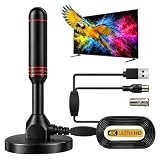
- ADVANCED DUAL-SIGNAL BOOSTERS: Unlike standard antennas with a single amplifier, our TV Antenna Indoor model features dual-booster technology to capture signals from multiple directions, helping reduce dead zones and provide more stable reception.
- 32FT CABLE FOR FLEXIBLE PLACEMENT: The extra-long coaxial cable lets you position this Indoor Antenna for Smart TV setups wherever reception is strongest—behind your TV, on a tabletop, or near a window.
- CRISP 4K & 1080P PICTURE QUALITY: Enjoy uncompressed over-the-air broadcasts with clear, vibrant images. This TV Antenna for Smart TV supports 4K and 1080P signals when available, helping you get more from your television.
- ENJOY LOCAL CHANNELS WITHOUT MONTHLY FEES: This powerful TV Antenna for Local Channels helps you receive available broadcasts from networks such as ABC, CBS, NBC, FOX, PBS, and more—no cable subscription required.
- COMPACT, DISCREET & EASY TO INSTALL: The minimalist design blends naturally into any room, while the magnetic base provides quick and secure placement. Simply connect the antenna, position it for the best signal, and scan for available channels.
Rank #4

- FREE LOCAL HD TV — Watch local channels in crystal clear 1080p HD with no monthly fees; 4K and 8K Ultra HD for future ready performance
- 70+ MILE LONG RANGE RECEPTION — Captures VHF and UHF broadcast signals from up to 70+ miles away for reliable local channel access
- UNIVERSAL TV COMPATIBILITY — Works with all TV brands and converter boxes that use a standard coax cable connection
- HIDDEN ATTIC OR OUTDOOR MOUNTING — Designed for attic installation to stay out of sight; weather resistant and outdoor rated for flexible roof or mast mounting
- NEXTGEN TV READY — Supports ATSC 3.0 over the air broadcasts where available for improved signal strength, picture and sound
Rank #3

- Clear Reception with Realistic Range: The FLATenna captures HD and digital signals with a 35-mile range, designed to accommodate real-world factors such as obstructions and interference, making it suitable for urban and suburban environments.
- Access to Free Local Channels: Provides access to local networks such as ABC, CBS, FOX, NBC, PBS, Univision, and Telemundo without requiring a subscription.
- Practical and Flexible Design: Features an ultra-thin, lightweight, and reversible black-and-white design for easy integration into various home setups, with multiple mounting options for walls, windows, or tabletops.
- Future-Ready Compatibility: Supports ATSC 3.0 NextGen TV and 4K broadcasts, and includes a 12' professional-grade RG6 coaxial cable with enhanced shielding for improved signal reliability.
- Established Manufacturer: Developed by Channel Master, a long-standing provider of TV antenna technology since 1949, designed for reliable over-the-air TV reception.
Product prices and availability are accurate as of the date/time indicated and are subject to change. Any price and availability information displayed on Amazon at the time of purchase will apply.

