
iTechGuides is reader-supported. When you buy through links on our site, we may earn an affiliate commission. As an Amazon Associate I earn from qualifying purchases. Learn more
A data center’s electricity use and water use are connected, but they are not the same measure. Electricity powers servers and cooling equipment; cooling choices affect both the facility’s power demand and the water used on site. Generating that electricity can also consume water elsewhere. To estimate a local impact, keep those water categories separate and use facility- and location-specific data where possible.
How much electricity do data centers use?
The latest reviewed U.S. historical estimate is 192 terawatt-hours (TWh) in 2024, or 4.7% of total U.S. electricity consumption. The Lawrence Berkeley National Laboratory (LBNL) and U.S. Department of Energy (DOE) figure is modeled, and its scope excludes cryptocurrency mining. See the 2025 U.S. Data Center Energy Usage Report.
The same report’s 2030 reference case projects 649 TWh of U.S. data-center electricity use. Its compounded uncertainty range is 521–843 TWh. These are projections based on assumptions about equipment, power, utilization, and cooling—not a promise that demand will land at a particular point in the range.
Windows Errors? Fix Them Before They Spread
Repair common Windows errors and clear accumulated junk for a smoother, more stable PC - no reinstall needed.Free scan · no reinstallOutdated Drivers Are Slowing You Down
One free scan finds every outdated or missing driver and matches the right update for your exact hardware.Free scan · exact hardware matchFor context, LBNL’s 2024 report estimated U.S. data-center electricity use at 176 TWh in 2023, or 4.4% of U.S. consumption. The newer update revises the historical estimate and should be used for the latest U.S. figure; the older figure describes what that earlier report estimated. The 2024 report is available from LBNL.
#1 Best Overall

- Condition: 100% Brand New and in Perfect package to ensure you receive a perfect product
- Model: DV4600-492
- Bearing Type: Ball; Fan Diameter: 120mm; Maximum Fan Speed: 2650/3100 RPM; Material: Plastic; Type: Axial cooling fan
- Packaging: Carton; Power Connection: 2-Pin; Voltage: 115VAC
- Fan size: 120*120*38MM
Global figures are a different comparison
The International Energy Agency’s (IEA) global base case projects data-center electricity use of around 945 TWh in 2030, just under 3% of global electricity consumption. This is a global forecast, not a U.S. historical statistic. Its geography and projection are different from LBNL’s U.S. estimate. See the IEA analysis of energy demand from AI.
Why electricity and water figures need separate accounting
A facility uses electricity for IT equipment and supporting systems, including cooling. Much of the electricity used by servers ultimately becomes heat that must be managed. Cooling design can change the facility’s electricity needs and its direct water consumption, but a site’s water number does not capture all water associated with its power use.
There are two distinct water categories to track:
- Direct site water: water consumed at the data center, including water used by cooling systems. LBNL estimated approximately 66 billion liters of direct U.S. site water consumption in 2023.
- Indirect electricity-source water: water consumed at power plants to generate electricity used by data centers. LBNL estimated nearly 800 billion liters for U.S. data-center electricity in 2023. Its analysis used location-specific grid factors, but did not incorporate individual power-purchase agreements or behind-the-meter generation.
Both 2023 water figures are estimates from LBNL’s 2024 report. They should not be treated as a facility’s measured water use or as a precise local estimate.
Recommended Free Tools
Also distinguish consumption from withdrawal. Consumption is water not returned to the immediate water cycle—for example, water lost through evaporation. A reported water figure is hard to interpret unless its definition and boundary are clear.
Rank #2

- APPLICATION: USB computer fans cool off gaming systems, routers, amplifiers, and receivers. 120mm case fan keep entertainment centers' stereos and cables cool and help with air flow in various spaces
- PLAY AND PLUG: Just plug this server fan into any USB source—like a charger, power bank, phone adapter, game console, or USB outlet. It's a breeze to use
- PACKAGE INCLUDING: This usb cooling fan set comes with two USB fans, one USB cable to control two fans (high speed medium speed low speed), and a metal shield to protect your hands. Easy to use, safe and reliable
- Variable Speed Fan: It has a variable-speed controller so you can adjust the pc fan for the best mix of quiet operation and airflow
- Specification: 120 x 120x 25 mm ( 4.72 x 4.72 x 0.98 in. ) | Rated Voltage : 5V | Rated Current: 0.25A | Airflow: 77 x 2 CFM | Noise: 32dBA | Speed: 2000 RPM (MAX)
How cooling changes the trade-off
Cooling systems do not fall on a single scale from “good” to “bad.” Evaporative and water-cooled systems can reduce electricity use while consuming more water at the site. Air-cooled systems can use little or no cooling water but require more energy. The local climate, system design, and operating practices all matter.
For that reason, compare direct site water and site water-use effectiveness (WUE) alongside facility electricity and the water effects of its electricity supply. A low site-water figure can coexist with higher electricity use, while a favorable grid water factor says nothing by itself about water used for on-site cooling. LBNL describes variation by cooling system, space type, operating practice, and climate in its 2024 report.
Do not infer zero water use from a broad description such as “closed-loop cooling.” A cooling configuration may limit or change water use, but the label alone does not establish a facility’s annual water consumption. Facility-specific measurements and a stated metric boundary are more useful than a general design description.
The Tool Desk
Outbyte PC Repair FREERepair Windows errors before they cause bigger problemsFix Now →Outbyte Driver Updater FREEFix the driver behind crashes, sound loss and screen glitchesFind Drivers →How to estimate electricity and water for a local facility
Use actual annual facility data if it is available. Ask for or identify the reporting year, location, annual electricity, annual site water consumption, cooling configuration, and the electricity metric’s boundary: IT load or total facility load. Measured facility data is preferable to a national average or a modeled proxy.
Rank #3

- An ultra-quiet UL-certified fan system designed for cooling cabinets that requires minimal noise.
- Features a multi-speed controller to set the fan’s speed to optimal noise and airflow levels.
- Contains a CNC machined aluminum frame with a modern brushed black finish.
- Powered by wall outlet or USB port, included Turbo Adapter increases performance by 25%.
- Dimensions: 8.5 x 4.4 x 1.3 in. | Total Airflow: 52 CFM | Total Noise: 18 dBa | Bearings: Dual Ball
1. Establish total facility electricity
If the reported electricity figure is already total facility electricity, use it as-is. Total facility electricity includes IT equipment and supporting infrastructure, so applying power usage effectiveness (PUE) to that total would count the supporting load twice.
If only IT electricity is known, estimate the facility total with:
Facility electricity (kWh) = IT electricity (kWh) × PUE
Quick wins for a faster PC:
Clear out junk files and repair common Windows errorsFree Scan →Scan for outdated or missing drivers - takes under a minuteDriver Scan →PUE is total facility energy divided by IT equipment energy. It measures energy overhead, not water use or carbon emissions. LBNL’s modeled U.S. average PUE declined from 1.6 in 2014 to 1.4 in 2023; individual sites can differ, and those modeled values assume systems operate as designed. The values and their limitations are described in the LBNL 2024 report.
Rank #4
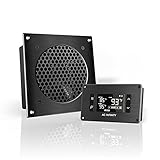
- An ultra quiet UL-certified fan system designed for cooling cabinets that requires minimal noise.
- Features an on board processor that provides a digital read-out of the cabinets temperatures.
- Programming includes thermostat control, fan speed control, and SMART energy saving mode.
- Dimensions: 6.3 x 6.3 x 1.3 in. | Airflow: 52 CFM | Noise: 18 dBA | Bearings: Dual Ball
2. Estimate direct site water
Use metered annual site-water consumption when possible. If the facility’s site WUE is known, a rough calculation is:
Site water (liters) = facility electricity (kWh) × site WUE (liters/kWh)
Before multiplying, check what electricity appears in the WUE denominator. Some values are reported per kWh of IT electricity rather than per kWh of total facility electricity; those denominators are not interchangeable. Confirm the metric boundary and reporting period. If either is unknown, label the result approximate rather than presenting it as a measured facility total.
3. Estimate indirect water from electricity generation
To estimate water consumed at power plants for the facility’s electricity, use a location- and year-matched grid water-consumption intensity:
Best Value
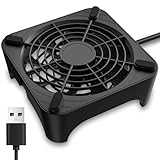
- 【Universal Compatibility】This USB cooling fan works seamlessly with Mini PC, PS5, routers, Apple TV, modems, PlayStation, receivers, Rokus, T-Mobile 5G Home Internet, Xbox Series, and other audio-video electronics. Whether cooling a gaming console, router, or streaming device, it eliminates overheating worries across your digital ecosystem.
- 【Powerful Cooling Performance】Equipped with a 120mm fan boasting 55.8 CFM airflow and 850RPM±10% speed, this USB PC fan delivers rapid cooling—dropping device temperatures by 20% in seconds. The 9-blade design ensures powerful airflow to tackle heat buildup in routers, mini PCs, and gaming consoles, preventing lag and performance drops caused by overheating.
- 【Ultra-Quiet Operation & Scratch-Proof Protection】 Designed for ultra-quiet and scratch-resistant cooling needs, this USB computer fan comes with 4 shock-absorbing pads and operates at just 18dB(A)±10% noise—whisper-quiet, quieter than library silence (30dB) and close to the sound of rustling leaves (20dB). It enables efficient device cooling without noise interference or surface scratches, letting you fully immerse in video, audio, and gaming. It’s perfect for home offices, living rooms, and gaming setups.
- 【USB-Powered & Space-Saving Setup】This USB powered fan features an integrated 530mm (20.87-inch) USB cable, connecting easily to chargers, mobile power banks, or laptops—no extra wires needed. With dimensions of 130mm×130mm×48.6mm (5.12×5.12×1.91 inches), it can be placed flat or upright, making it perfect for narrow spaces while keeping your setup tidy.
- 【Sturdy & Long-Lasting Durability】Made from premium eco-friendly ABS material, this USB fan (with a box fan-like structure) supports heavy-duty use and can withstand weights up to 11LB. With a lifespan of 40000 hours, it offers long-term cooling for your devices, ensuring stable performance and protection against overheating for years to come.
Source water (liters) = electricity (kWh) × local grid water-consumption intensity (liters/kWh)
Choose a factor for the facility’s location and the same year as the electricity data. LBNL’s U.S. analysis associates counties with balancing authorities and derives annual-average grid factors from plant generation and water data. This estimates source water, not water delivered to the data center. The calculation may not reflect an individual power-purchase agreement or on-site generation; LBNL’s facility-level analysis does not incorporate those arrangements. See its methodology and estimates.
4. Present the result with its boundary and uncertainty
Report direct site water and electricity-source water separately. If you add them into a combined footprint, state that it combines those two categories and specify whether the values represent consumption or withdrawal. Include the reporting year, location, cooling information, and whether electricity means IT load or total facility load.
If actual electricity, water, cooling, or power-supply data is missing, give a range or identify the missing input rather than implying false precision. A national average can provide context, but it is not a substitute for local data.
Independent reader supportYour contribution helps us test, update, and keep practical guides available for everyone.What to compare across facilities or designs
For a useful comparison, align the measurement period and boundaries first. Then compare the same set of measures for each facility or design:
- Annual total facility electricity in kWh or MWh.
- IT electricity and PUE, if available.
- Direct site water consumption and site WUE, including WUE’s electricity denominator.
- Indirect water intensity for the electricity supply.
- Cooling system, operating climate, and reporting year.
- Whether figures are measured facility data or modeled estimates.
Without aligned definitions, two numbers with the same units may still describe different things—for example, WUE per unit of IT electricity versus per unit of total facility electricity.
Quick Recap
Product prices and availability are accurate as of the date/time indicated and are subject to change. Any price and availability information displayed on Amazon at the time of purchase will apply.

