
The Tool Desk
Outbyte PC Repair FREERepair Windows errors before they cause bigger problemsFix Now →Outbyte Driver Updater FREEFix the driver behind crashes, sound loss and screen glitchesFind Drivers →iTechGuides is reader-supported. When you buy through links on our site, we may earn an affiliate commission. As an Amazon Associate I earn from qualifying purchases. Learn more
Pioneer Labs says its evolved microbe sPL.001 can produce PHA, a bioplastic, using nutrients derived from simulated Martian soil, water, and acetate made from simulated atmospheric resources. The proposed use is to manufacture material for future habitats inside a controlled bioreactor—not to release microbes onto Mars or make the planet habitable. The result is a laboratory demonstration with simulated inputs, not proof of production on Mars.
What did the researchers make?
Pioneer Labs announced sPL.001 on September 22, 2026. The bioRxiv preprint describes it as an evolved isolate of Cupriavidus necator that produces polyhydroxyalkanoate (PHA), a type of bioplastic, under simulated Mars conditions. The work is a preprint, so its reported performance should be understood as the authors’ research claim rather than an independently confirmed result.
The idea is to turn locally derived resources into useful polymer. Pioneer Labs has proposed PHA as a material for future habitat-related products. That is a possible application, not a demonstration that the polymer has already been made into construction components or used to build a habitat.
What’s actually slowing this PC down?
Pick the symptom - the matching free tool is one click away.
How the proposed process works
Prepare nutrients and feedstock
The reported experiments use chemically defined medium intended to represent relevant Martian resources. Pioneer Labs’ proposal connects nutrients derived from simulated regolith and water with acetate as a carbon source. The study does not establish that the organism can use untreated Martian soil or draw what it needs directly from Mars’ atmosphere.
#1 Best Overall
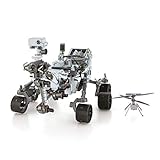
- HOBBY MODEL KIT – Unassembled model packed in an envelope with easy to follow instructions. Ideal for ages 14 and up.
- NO GLUE OR SOLDER NEEDED – Parts can be easily clipped from the metal sheets. Tweezers are the recommended tool for bending and twisting the connection tabs.
- MARS ROVER PERSEVERANCE & INGENUITY HELICOPTER – 4.5 Sheet Model with a challenging difficulty level. Assembled Size: Rover: 4.92 L x 3.54 W x 2.95 H inches. Helicopter: 1.02 L x 1.30 W x 0.79 H inches. 1:30 Scale.
- FROM STEEL SHEETS TO 3D – Pop out the pieces and connect using tabs and holes. Includes illustrated instructions.
- HIGHLY DETAILED ETCHED MODEL – Display your 3D model once completed - collect and build them all.
Grow the microbe in a reactor
The organism is cultivated in a stirred, heated bioreactor. According to Space.com’s account, the reactor shields it from the planet’s extreme cold, radiation, and low pressure, and the process requires processed air and an acetate supply. C. necator is not photosynthetic; it cannot simply use sunlight and Martian air to feed itself.
Produce PHA
Under those controlled conditions, the reported output is PHA bioplastic. The proposed chain—processed inputs, reactor cultivation, polymer output—is a biomanufacturing concept that could contribute to future in-situ resource use. It is not an outdoor-growth system.
Rank #2

- Mars Exploration Made Easy: GalaxyRVR, compatible with Arduino Uno R3, recreates the experience of real Mars rovers. Inspired by NASA’s rocker-bogie suspension system, it easily travels over rocks, sand, and grass—delivering true off-road capability beyond ordinary robot cars. Powered by solar charging and equipped with real-time FPV, smart obstacle avoidance, and remote control, it brings an immersive Martian adventure right to you. Start with easy controls, then advance to Arduino programming or Scratch block coding. Perfect for students, educators, and DIY enthusiasts
- Tough and Terrain-Ready: GalaxyRVR, crafted from sturdy aluminum alloy and featuring a rocker-bogie system like real Mars rovers, is designed for outdoor exploration and effortlessly tackles diverse terrains such as sand, rocks, grass, and mud pits for seamless adventure
- Solar-Powered and FPV: GalaxyRVR comes equipped with a solar panel, enabling solar charging. Its ESP32 CAM, paired with an app, offers remote control and a real-time FPV experience, bringing exploration to your fingertips
- Intelligent Obstacle Avoidance and Enhanced Lighting: GalaxyRVR is fitted with ultrasonic and infrared sensors, ensuring effective obstacle avoidance. Enhanced by RGB light strips and ESP32 LED lighting, it not only brings vibrancy but also confidently illuminates its path, making exploration in the dark possible
- Beginner-Friendly with Comprehensive Support: The GalaxyRVR kit is designed for easy assembly, allowing users to get started quickly without frustration. It comes with detailed online tutorials and step-by-step video lessons, ensuring a smooth learning curve. Coupled with an active community forum and responsive technical support, even novices can confidently bring this project to life
What the preprint reports
The bioRxiv abstract gives three figures that describe the laboratory work:
- 16 candidates screened: the authors say they screened 16 organisms for growth in chemically defined Mars medium.
- More than 1012 cumulative cell divisions: the authors report this total during adaptive laboratory evolution. It is a measure of the evolution effort, not the number of cells in a deployed system.
- More than threefold higher PHA titer: the top evolved C. necator isolate reportedly produced a titer more than three times that of its parent strain under simulated Mars conditions. This is a comparison within the reported experiment, not a prediction of construction output on Mars.
The available abstract does not provide the full methods needed to assess every experimental detail or translate these figures into industrial production rates.
Rank #3

- IGNITE SPACE EXPLORATION PASSION: Dive into the world of Martian engineering with the Perseverance Mars Rover, an immersive NASA-inspired STEM toy. Assemble and operate a real working Mars rover powered by a powerful motor, equipped with a movable robotic arm, strong grip, and powerful torque, offering the excitement of Martian exploration up close.
- UNVEIL STEM WONDERS: Unbox the future of learning with the Perseverance Mars Rover kit, containing 71 pieces and a 60-page educational and instructions booklet. Aimed at kids aged 8 and above, this kit is more than just a toy—it's a gateway to hands-on STEM education, fostering curiosity and understanding in robotics, mobility systems, electrical connections, and transmission systems, among other disciplines.
- MASTER SPACE MISSION CONTROL: Embark on a journey of discovery as you assemble and control the Perseverance Mars Rover model. With its DC motor capable of driving uphill and crossing uneven surfaces, children simulate Martian exploration missions, learning about the intricacies of mobility systems and experiencing the excitement of space missions on the Red Planet.
- EMPOWER FUTURE INNOVATORS WITH STEM EDUCATION: Inspire the next generation of scientists and engineers with the Perseverance Mars Rover. Through interactive play, children not only gain valuable insights into robotics, engineering, and space exploration but also develop essential skills like hand-eye coordination and concentration, laying the foundation for future STEM careers and innovations.
- BOND THROUGH COSMIC ADVENTURES: Bring families and friends together with the Perseverance Mars Rover kit, fostering teamwork and collaboration as they tackle assembly challenges and simulate Martian exploration missions. Spark lively discussions about space exploration and science, creating lasting memories filled with learning and fun.
What the result does—and does not—show
| Question | What the available evidence supports |
|---|---|
| Was PHA produced? | The preprint abstract reports PHA production by the evolved isolate in simulated Mars conditions. |
| Was actual Martian soil used? | No. The reported work uses simulated Mars medium; the available sources do not establish testing with actual Martian regolith. |
| Can the microbe grow outdoors on Mars? | No such result is demonstrated. The reported process depends on a controlled bioreactor and prepared inputs. |
| Has habitat construction been demonstrated? | No. The proposed use of PHA in future habitat materials is a potential application, not a settlement-scale construction result. |
| Does this terraform Mars? | No. Reactor-based production of a material is not planetary-scale alteration of Mars’ environment. |
The distinction matters: an early biomanufacturing step might help future missions use resources available locally, but it does not by itself solve the many other requirements for a settlement, such as life support, energy, food, and protection from the Martian environment.
How to interpret the safety claims
Pioneer Labs says sPL.001 stops growing when removed from its bioreactor or deprived of feed, and presents that dependence as a way to limit persistence after an accidental release. Space.com also reports that the reactor protects the organism from the outside environment and refers to a separate safety study. These are the lab’s risk assessment and reported context—not an independently established guarantee of zero risk. The detailed safety calculations and methods are not available in the sources cited here.
Rank #4

- Gift Envelope Includes - Unassembled Model Easy to Follow Instructions
- From Steel Sheets to Museum Quality 3D Model
- Assembled Size 3.65x3.35x2.35 inches
- No Glue or Solder Needed
- Ages 14+
Samuel McKee, a DNA repair scientist at the University of Reading who did not take part in the work, told Space.com: “Many adapted or edited microbes on Earth do not survive outside of a fixed environment despite their evolution, or without a certain food supply.” That observation gives context for the containment rationale; it does not independently verify this strain’s behavior in every possible release scenario.
Free tools Windows power users keep installed
One-click scans. No signup required.
Why this is not a terraforming breakthrough
The proposal is to operate a microbe in a protected reactor and make a useful material. Terraforming would mean changing Mars’ environment on a planetary scale. The reported experiment does not do that, and it does not show that sPL.001 can create fertile soil, shelter, oxygen, or food on its own. Pioneer Labs CEO Erika DeBenedictis described the broader vision to Space.com: “On Mars, nature will do the same jobs for us that she does on Earth — create fertile soil, shelter, oxygen and food.” That is the team’s aspiration, not an outcome established by this PHA experiment.
Best Value

- Feed a passion for science and technology – Kids can learn more about the challenges of space exploration with this LEGO Technic NASA Mars Rover Perseverance (42158) building toy set
- Conduct a test flight – This advanced building kit for kids ages 10 and up includes a buildable toy version of NASA’s Ingenuity helicopter, which accompanied the Perseverance Rover and was used to test powered flight on Mars
- AR brings the mission to life – The accompanying augmented reality app experience lets kids dive into the details of the rover and its mission
- Explore the functions – Features 360° steering, movable arms and fully articulated suspension that lets the vehicle travel across uneven surfaces, plus buildable scientific instruments
- A gift for kids who love engineering – This Mars Perseverance Rover NASA toy makes a great gift idea for kids with a passion for space exploration, technology or science projects
What remains unproven
The key gap is between growth in simulated medium and a working Mars production system. The available sources do not establish performance with actual Martian materials, operation on Mars, or manufacturing at settlement scale. DeBenedictis acknowledged that limit to Space.com: “The biggest limitation of what we’ve done is that simulated Mars isn’t actual Mars.”
The result is best read as an early laboratory step toward producing a bioplastic from Mars-relevant feedstocks. Whether that can become a reliable, safe, and useful manufacturing process on Mars remains an open question.
Quick Recap
Product prices and availability are accurate as of the date/time indicated and are subject to change. Any price and availability information displayed on Amazon at the time of purchase will apply.

