
iTechGuides is reader-supported. When you buy through links on our site, we may earn an affiliate commission. As an Amazon Associate I earn from qualifying purchases. Learn more
The 144,000-gigabit figure refers to the Pacific Light Cable Network’s stated design capacity: 144 terabits per second (Tb/s) across the entire trans-Pacific system, not the speed available to one home, phone, or computer. Pacific Light Data Communication (PLDC) describes a 12,971-kilometer route between points of presence, built with six fiber pairs and designed for 240 wavelengths per pair at 100 Gbps per wavelength. PLDC’s PLCN project page gives those design details; they explain how the headline’s arithmetic works, but not a current measurement of traffic on the cable.
What does 144,000 gigabits per second mean?
One terabit equals 1,000 gigabits, so 144,000 Gbps is 144 Tb/s. That is the stated aggregate design capacity of PLCN, a carrier-scale undersea fiber-optic system linking Hong Kong and Los Angeles. It is not a speed test, nor a dedicated connection that an individual customer can use.
PLDC’s published design adds up as follows:
- Six fiber pairs
- 240 wavelengths per pair
- 100 Gbps per wavelength
Multiplying those values gives 6 × 240 × 100 Gbps, or 144,000 Gbps. The figure describes the designed capacity across the system; it does not establish how much capacity is currently activated or carrying traffic. [PLDC]
Recommended Free Tools
How can one cable carry so much data across the Pacific?
Many optical channels share the fibers
A fiber carries information as light. Rather than relying on one signal, a long-haul system can send many distinct wavelengths of light through a fiber, with each wavelength carrying its own data stream. PLCN’s design specifies 240 wavelengths on each fiber pair, with a stated rate of 100 Gbps per wavelength. Fiber pairs and wavelengths multiply the system’s aggregate capacity.
#1 Best Overall

- Length : 164ft(50M) ,The quantity of optical fiber:1pcs,PMMA plastic fiber optic cable, great optical conductivity and flexible to easily create the shape what you need
- Diameter of fiber: 0.04in(1mm) transparent end glow plastic fiber optic cable,fiber length can be cut whatever you want, the end of fibers still glow after connecting light source(no including)
- The fiber optic cable is suitable for most light engine diver, widely being made curtain, screen, ceiling sky decoration
- The fiber cable operation temperature: -58°F - 167°F, Lifetime: > 20 years,be cuttable, virtually no heat, no UV or IR energy
- The optical fiber were lit bright color by light source(not including), and we can customize other size of fiber as you request, please feel free to contact us via email
C+L bands expand the usable spectrum
PLCN’s project information describes the system as using C+L technology. The C and L bands are portions of the optical spectrum used to carry signals. In a 2017 explanation, IEEE Spectrum reported that the C band offered about 5 terahertz of usable bandwidth and that adding the L band could roughly double the usable bandwidth to about 10 THz, according to Neal Bergano, then a vice president and chief technology officer at TE SubCom. More usable optical bandwidth allows more channels, although it is only one part of the system design. [IEEE Spectrum] [PLDC]
Repeaters make ocean-scale transmission possible—and impose limits
Signals weaken over long distances, so submarine systems use repeaters to amplify them along the route. Amplification also adds noise, and that noise accumulates as a signal travels. IEEE Spectrum’s 2017 account said repeaters were needed roughly every 50 kilometers and explained that signal processing cannot perfectly eliminate the accumulated noise. Engineers therefore have to balance data rate against reach: pushing more information through a system is not useful if the signal cannot remain distinguishable over the full distance. [IEEE Spectrum]
Rank #2
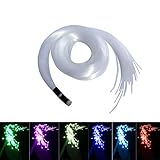
- PMMA fiber optic cable transmits visible and soft light so no risk of heat damage and can be apply to heat allergic occasions. Can be cut to any length you need to transmit light.
- No electrical hazard at the point of illumination. No UV rays or IR Energy. Perfect for making the star ceiling sky light in the museum, children’s room and art exhibitions, car roof starlight headliner or home star ceiling light. (Need to buy light engine to use together to provide light)
- The waterproof optical fiber strands is not charged so no risk of electric shock and fit for many environments. Such as swimming pool, steam showers, saunas and so on.
- Specification of fiber optic strands: diameter - 0.03in/0.75mm, length - 6.5ft/2m, quantity - 1bundle(100pcs). This package WITHOUT any light source.
- Long lifespan and low maintenance. Suitable for items such as model, art crafts that you need to add lighting elements. (Need to buy light source to use together to provide light)
Was 144 Tb/s a record—and is it still one?
The record language belongs to the period when PLCN was being announced and built, not to a current, like-for-like ranking of working cables. The numbers available describe different things and were published at different times:
| System or figure | Published capacity | What the source establishes |
|---|---|---|
| PLCN | 144 Tb/s | PLDC’s undated project page, accessed in 2026, states a design capacity across six fiber pairs; it does not provide a current activated-capacity or traffic measurement. Source |
| PLCN estimate in Google’s 2016 announcement | 120 Tb/s | Google described an estimated capacity in its October 2016 announcement. This is an earlier estimate, not the same statement as PLDC’s later published design figure. The sources do not explain the difference. Source |
| Petal, announced by Meta in September 2026 | 1 Pb/s | Meta describes a planned France–US cable of about 7,000 kilometers, with service expected in 2029. This is a projected capacity for a different, future system—not evidence of present operating capacity. Source |
One petabit per second is 1,000 terabits per second, but the larger announced number should not be read as a direct performance comparison with PLCN: the projects differ in route, technology, date, and deployment status. NTT separately said in March 2026 that it had developed a submarine multicore-fiber system with 192 cores and a fourfold capacity increase, with practical deployment targeted around 2029. That is a development-stage technology announcement, not a measurement of PLCN or evidence that the two systems are already operating on equivalent terms. [NTT]
Rank #3
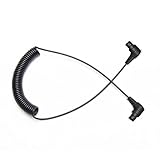
- Scuba Flash Link Optical Cable Composed of 613 Cores Fibers,Diameter 1mm Only,High-Tech Scuba Diving Equipment and Accessories
- Highest Efficiency Light Signals Fiber Cable for Underwater Strobe,Flashlights,Lets Camera's Built-In Flash Fire Strobe
- Fiber Optical Audio Cable Line Length Max 70 inches/180cm ,Suggested working length: Less than 57inches/150cm
- When the diving fiber cable is bent, attenuation of light is minimal,613 Diving fiber has a longer life expectancy than other cores Scuba fiber cable
- Scuba Optical Fiber Line Suitable For INON Z-330 D-200 S2000,Sea&Sea YS01 YS03 YS-D2 YS-D3,IKELITE DS160 DS161,SEACAM,,SUBTRONIC ,ONEUW,WEEFINE Retra And All Sea & Sea Housings and Olympus Strobes and Diving Waterproof Case,Universal Connector ect
Does the figure tell you how fast your internet will be?
No. PLCN’s stated 144 Tb/s is an aggregate design capacity for a submarine cable system. It is not an end-user broadband rate and does not promise that any household or device can reach that speed. Consumer connections depend on separate network links, service plans, equipment, and traffic conditions; the cable’s total capacity is shared infrastructure used by telecommunications and data-network operators.
Those systems support large-scale traffic between networks and data centers as well as other communications. A high-capacity ocean route helps move data between regions, but it does not by itself determine the speed of a local broadband connection. IEEE Spectrum’s 2017 story cited historical estimates that inter-data-center traffic accounted for 77% of Atlantic and 60% of Pacific subsea traffic in the prior year, attributing the figures to TeleGeography’s Alan Mauldin. Those are dated, secondhand estimates, not current traffic statistics. [IEEE Spectrum]
Rank #4

- Pet-Proof Armored Cable for Everyday Reliability — Designed with a stainless steel armored tube and LSZH jacket, this SC/APC to SC/APC single mode cable resists crushing, bending, and even pet chewing. Perfect for homes with active pets, tight conduits, or wall pass-throughs where standard fiber easily fails.
- Stable OS2 Performance for Smooth Home Internet — Using G657A1 or G657A2 bend-insensitive fiber, this single mode OS2 jumper delivers stronger FTTH stability in tight bends and corners, with low insertion loss and excellent return loss for streaming, gaming, remote work and smart-home devices.
- FTTH-Friendly for Clean Home Network Upgrades — Ideal for relocating fiber equipment from the basement to the living room, improving Wi-Fi coverage, or extending a fiber run through a weak-signal area. Supports Verizon Fios, AT&T BGW320 All‑Fi Hub Fiber, Google Fiber, and other SC/APC-based FTTH systems.
- Plug-and-Play Fiber Connectivity — Installer-approved for residential and light commercial use, this armored SC/APC cable works instantly with ONTs, media panels and rack systems — no setup, no tools, no compatibility problems.
- Bonus SC/APC Coupler & Zip Ties for Hassle-Free Setup — Includes a matching SC/APC coupler for quick line extensions or equipment relocation, plus zip ties for neat routing along baseboards, inside cabinets, or behind entertainment centers. No extra accessories needed — cleaner installs from day one.
What is known about PLCN’s operating status?
PLDC’s page lists both “Ready for Service: Q2, 2019” and “System Testing to be Completed.” Those fields do not establish the cable’s present operational status or how much capacity is activated today, so neither the 144-Tb/s design figure nor the readiness date should be treated as a current traffic measurement. [PLDC]
Hong Kong’s Office of the Communications Authority reported 364,719.14 Gbps of equipped cable capacity and 300,434.89 Gbps of activated cable capacity in March 2026. These are Hong Kong-wide external telecommunications facility totals—not PLCN figures—and include cable and overland systems. The regulator defines equipped capacity as capacity for which termination equipment is available to customers on request, and activated capacity as circuits in use. [Office of the Communications Authority]
Quick Recap
Best Value

- 217-Core Fiber Optic Cable for Superior Performance**: Composed of 217 fiber optic cores, this cable minimizes light attenuation even when bent, ensuring reliable light signal transmission from your camera's built-in flash to the strobe—just like a durable firework fuse cord but designed for underwater photography. Perfect for avoiding signal loss during your dives.
- Universal Compatibility for Underwater Gear**: Works seamlessly with all Sea & Sea housings, Olympus strobes, Nauticam housings, and various diving waterproof cases. Features a universal connector that fits setups like PT059, MF2 backscatter, and more, making it a versatile choice for different underwater camera systems.
- Durable Construction & Optimal Length**: With a max length of 150cm (60 inches), it offers flexible positioning for your strobe. Made with PMMA core, fluorinated polymer clad, and a black PE jacket (2200μm diameter), it’s resistant to bending, physical impact, and distortion—built to handle the harsh underwater environment.
- High-Quality with Exceptional Value**: Praised by customers as "as good as OEM," this fiber optic cable delivers reliable performance (attenuation ≤0.6 dB/m, tensile strength ≥80 N) for both casual and serious divers. It combines top-notch quality with great value, making it a smart choice for your underwater photography needs.
- Easy to Use, Long-Lasting & backed by 2-Year Warranty**: Simple to install and remove while staying securely in place. Many users have relied on it for over a year, withstanding regular use. What's more, it comes with a 2-year warranty—if you encounter any issues, contact us. Whether as a primary cable or a spare for your underwater setup, it’s a trustworthy solution that gets the job done.
Product prices and availability are accurate as of the date/time indicated and are subject to change. Any price and availability information displayed on Amazon at the time of purchase will apply.

